


Your organization’s incident response playbook can be the difference between defending against a cyber attack and becoming a victim.
An incident response playbook is a step-by-step guide on how your organization should
respond to and manage cyber security incidents. It provides your security team with instructions to follow when they encounter a potential cyberattack, and it is a proactive approach to minimizing the impact of such an attack.
All organizations with a mature cyber security program extensively utilize incident response playbooks to prepare their teams, quickly resolve incidents, and effectively defend against attacks.
This article will outline the key components of these security playbooks, guide you through creating your own, and provide advice on the best implementation practices. Let’s get started on your journey to building enterprise-ready incident response playbooks!
Key Components of an Incident Response Playbook
Incident response playbooks contain several key components you must address if yours is to be effective. You can ensure you cover them all by following the National Institute of Standards and Technology’s (NIST) Incident Response Lifecycle. This model outlines the lifecycle of a cyber incident and offers guidance on how to respond at each stage.
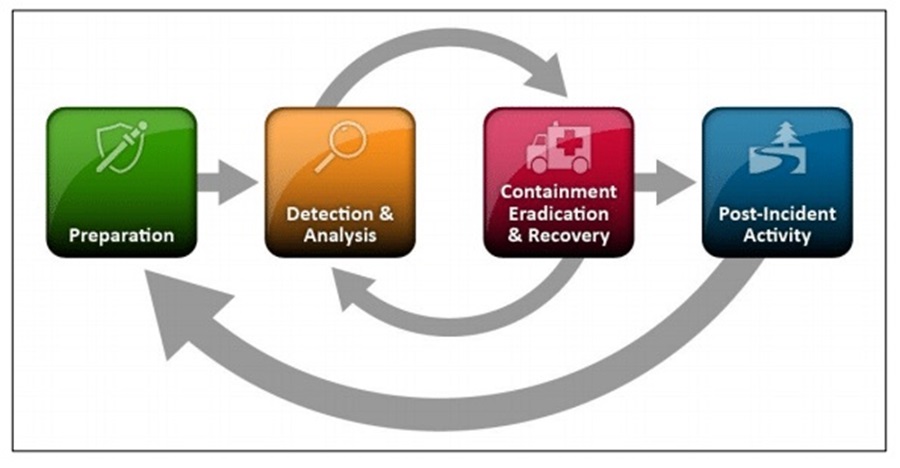
Phase 1 – Preparation
This first phase of the lifecycle lays the foundation for an effective incident response capability within an organization. It involves setting up vital resources and tools, creating policies, defining key roles and responsibilities, and establishing communication channels. There are several key components of the security incident response playbook that you must create to cover this phase of an incident.
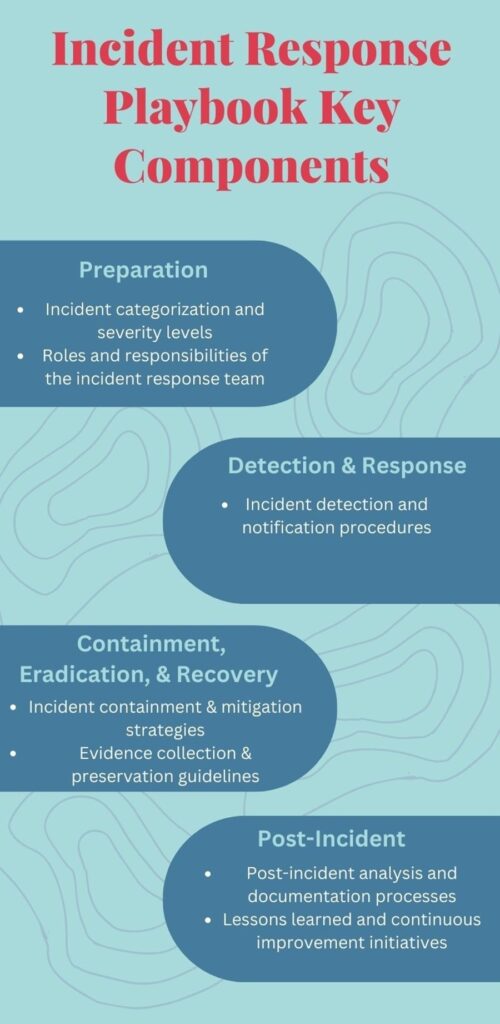
Incident Categorization and Severity Levels
You need to define clear criteria for categorizing and prioritizing incidents by your cyber security team. Standard categorizations include Ransomware, Potential Unwanted Program (PUP), Malware, and Risky Behavior. You can then use a severity scale to assign an incident a priority level from one (P1) to four (P4), with P1 being the most severe.
Roles and Responsibilities of the Incident Response Team
Your incident response playbook should include the key roles and responsibilities, as well as who has been assigned to them on your cyber security team. Clearly defining roles and responsibilities before an incident occurs ensures no time is wasted when an incident arises, and everyone involved knows what is expected. Some key roles and responsibilities include
- Incident Response Manager – Coordinates activities among team members, communicates with key stakeholders, determines the allocation of resources, and is responsible for the overall incident response effort.
- Technical Analyst – Conducts technical analysis of network and endpoint indicators to determine the nature and scope of an incident. They gather evidence, analyze logs, and investigate suspicious or malicious activity to identify the affected assets and attack vectors. They are responsible for root cause analysis of an incident, and the SOC usually performs this role.
- Forensic Expert – Conducts in-depth analysis of systems to reconstruct the sequence of events. This often involves collecting and preserving digital evidence for potential legal action. This role is typically performed by an external third party with specialized expertise, who is retained by the organization.
- Vendor Manager – Coordinates with external vendors or service providers to address incidents and ensures that third-party involvement aligns with incident response goals.
- Executive Manager – Receives regular updates on the incident’s progress and impact. They are responsible for making critical decisions regarding resource allocation, communication strategies, and potential escalation.
- Legal and Compliance Manager – Ensures that incident response activities adhere to all applicable legal and regulatory requirements. They are responsible for guiding data breach notification laws and ensuring compliance with these obligations.
Escalation and Communication Channels
Cyber security incidents will require different levels of expertise to handle. A level 1 Security Operations Center (SOC) analyst may be able to handle a PUP incident. Still, they will need to escalate it to a more experienced analyst for a Ransomware incident.
This is where having clear escalation paths and efficient communication channels is vital. An incident needs to be communicated to the right person as quickly as possible to generate an effective response. Once you have clearly defined the roles and responsibilities of your incident response team, you can establish effective communication channels between these roles to handle incidents efficiently.
Phase 2 – Detection and Analysis
In this phase, the SOC first detects and analyzes an incident. The SOC will monitor systems, networks, and other devices for signs of malicious activity. If detected, they will investigate this activity to determine its severity, assess its impact on the organization, and explore potential mitigation strategies.
Incident Detection and Notification Procedures
Your security team is responsible for creating detections that alert your SOC when malicious activity occurs on your organization’s network or endpoint devices. In your incident response playbook, you must define how these alerts are investigated and how key personnel are notified.
There are several benefits to having a documented procedure that analysts can follow whenever an incident arises:
- A consistent approach to investigating incidents.
- Analysts can investigate incidents more efficiently using a shared knowledge base.
- You limit the chances of incidents being missed.
- Key details are captured and documented for every incident. These can be used to prepare for future incidents and inform your defensive strategies.
When I worked as a SOC analyst at a large Managed Security Service Provider (MSSP), we used a Security Orchestration, Automation, & Response (SOAR) tool that provided templates for security incidents.
If our security tools detected a PUP, we would use our PUP template and fill out the investigation details that the template requested. If malware were detected, we would use our malware template, which included additional investigation details.
Templates are a great way to help analysts consistently investigate incidents and automate many tedious details. This frees an analyst to investigate more incidents or perform other tasks.
Phase 3 – Containment, Eradication, and Recovery
Once an incident has been analyzed, the security team needs to take action to contain, eradicate, and recover from any potential impact. This typically involves your SOC and Digital Forensics and Incident Response (DFIR) team working together to minimize the impact of an incident and prevent any further damage.
Your incident response playbook should cover two key essentials during this phase of the lifecycle.
Incident Containment and Mitigation Strategies
Different incidents require different containment and mitigation strategies. Your approach to generic malware (e.g., an information stealer) will differ from your strategy for ransomware. Each plan must be documented in your incident response playbook so your security team can follow the relevant strategy to contain and mitigate an incident effectively.
By developing a strategy before an incident occurs, you can thoroughly test and refine it to ensure it is fit for purpose. You can also consult with industry experts to ensure your containment and mitigation strategies are thorough enough.
Evidence Collection and Preservation Guidelines
Once you have contained the incident and mitigated any further threats, you can begin collecting evidence to determine the incident’s impact and identify ways to prevent it from occurring again.
You must provide your DFIR team with guidelines around collecting evidence, as your organization may have legal or regulatory requirements for digital forensic data. For instance, you may need a specialist forensic investigator to collect this digital evidence.
Phase 4 – Post-Incident Activity
The final phase of the incident response lifecycle involves an organization analyzing the incident and documenting lessons learned. This enables you to be better prepared in the event of a similar incident.
Post-Incident Analysis and Documentation Processes
After an incident has been contained and mitigated, you should conduct a post-incident analysis to determine the cause of the incident and its impact on your organization.
Legal or regulatory requirements may require you to disclose the impact of the incident. However, even if these are irrelevant, it is still important to document your findings to improve your organization’s cyber security posture and fill any gaps.
Lessons Learned and Continuous Improvement Initiatives
Your post-incident analysis will help you identify any security gaps or vulnerabilities that allowed the incident to impact your organization. Your findings should be documented as lessons learned, and you must prioritize filling these gaps through improvement initiatives.
By documenting and analyzing your organization’s incidents, you can ensure that your cyber security program continuously improves and adapts to the ever-evolving cyber security landscape.
Developing an Effective Incident Response Playbook
Now you know the key components to include in your incident response playbook, let’s look at how you can develop a practical security playbook for your organization.
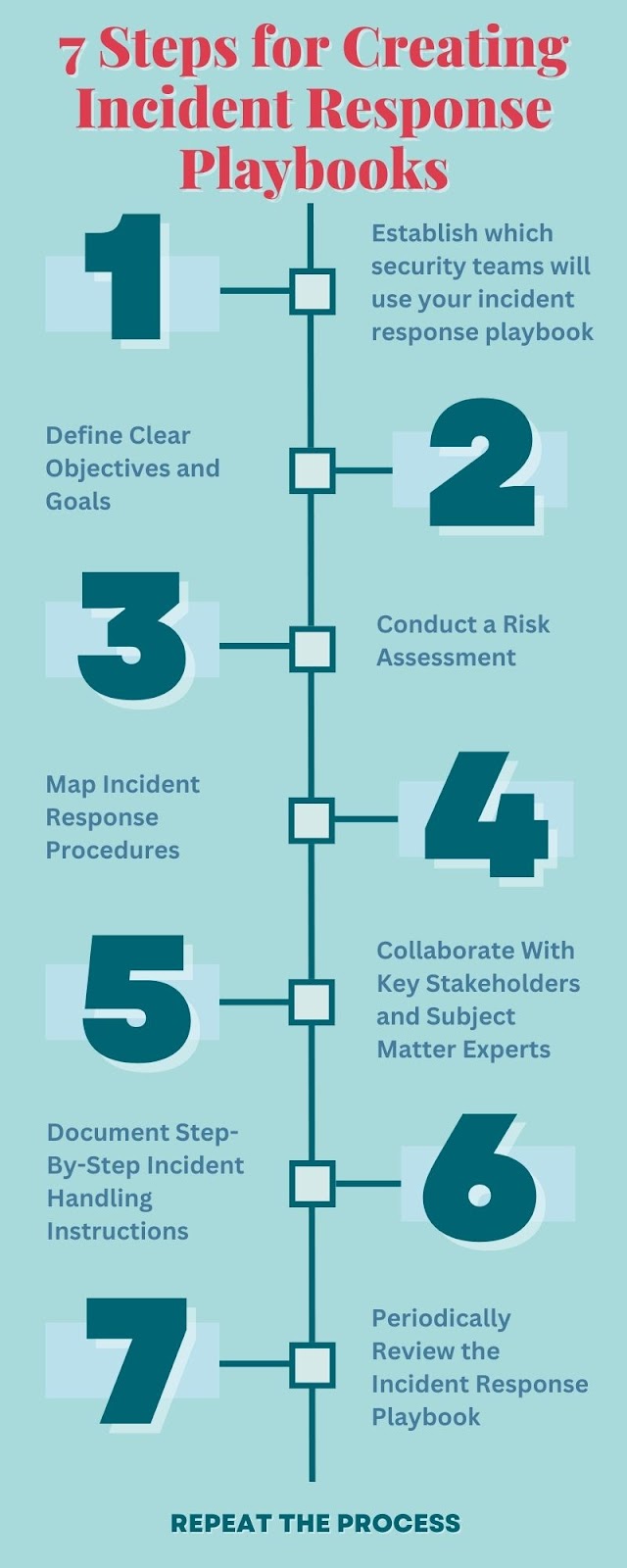
Step 1: Establish Which Security Teams Will Use Your Incident Response Playbook
The first step in developing a security incident response playbook is determining what security teams will use it. You may have one playbook designed for your SOC team and another for your DFIR team. On the other hand, you may choose to create incident response playbooks based on the nature of the incident and have both teams use the same playbook.
A clear picture of who the incident response playbook is for will help you define its objectives and incident response procedures based on the team’s expertise.
Step 2: Define Clear Objectives and Goals
Once you have established who will use your incident response playbook, you must define its objectives and goals. These describe the scope of the security playbook and will help you detail how it is used.
Step 3: Conduct a Risk Assessment
With the scope of the incident response playbook determined, you can proceed with conducting a risk assessment of your organization. This involves identifying your organization’s threats and the risks that must be mitigated. By identifying these threats, you can prioritize the assets that require resource allocation to protect and the key incident response tasks that must be performed if they are compromised.
Step 4: Map Incident Response Procedures
Incident response procedures are the central part of any security incident response playbook. They provide a step-by-step guide to handling an incident, from the detection and analysis phase to the post-incident phase.
Your incident response procedures should resemble a cooking recipe, with the necessary tools and resources listed first, followed by details on the tasks that must be completed to respond to an incident. They should also detail any dependencies the incident response playbook user may need to rely on, as well as any communication/escalation channels they may need to use.
Optimizing your incident response procedures and the workflow of your security team is imperative for quickly mitigating threats and reducing the impact of security incidents.
Step 5: Collaborate With Key Stakeholders and Subject Matter Experts
When conducting your risk assessment and developing incident response procedures, you may be unclear about how to best handle certain incidents. This is when you should consult key stakeholders and subject matter experts for guidance.
These experts can guide you on best practices for quickly resolving incidents and the key workflows that need to be established to optimize your incident response. They can also evaluate your incident response playbook procedures to determine if they will withstand a real incident and offer advice on how to improve them.
Step 6: Document Step-By-Step Incident Handling Instructions
Once you have your incident response procedures mapped out, you must thoroughly document these instructions step-by-step so that your security team can easily follow them. This is anomalous to filling in the cooking recipe you previously mapped out with the specific steps the cook must take.
This documentation should outline the reporting requirements that the team must complete both during and after an incident. Reporting is required to ensure all best practices were followed, to meet regulatory requirements, and to present to key stakeholders.
It’s essential to be clear and precise in your documentation. During an incident, many people panic and waste valuable time. If you can succinctly document all the actions required to respond to an incident in one location efficiently, your team won’t waste time panicking or trying to generate a response on the spot.
Step 7: Periodically Review the Incident Response Playbook
Once you have completed your security playbook, scheduling a regular review is essential. During this review, you should ensure that your incident response playbook:
- Covers all possible use cases and incident scenarios based on your risk assessment.
- Aligns with the latest cyber security best practices in the procedures and workflows you have mapped out.
- Your cyber security team can follow the step-by-step incident handling instructions in the security playbook.
- Have any key dependencies changed (e.g., key personnel, employee or contractor contact details, tools, resources, etc.)?
- Automation has been created to improve the efficiency of your incident response procedures.
Regularly reviewing your incident response playbooks is essential for staying current with the ever-evolving cyber security landscape.
Best Practices for Implementing Incident Response Playbooks
Incident response playbooks can be notoriously tricky to get right on your first try. There are various variables to account for and nuances that arise from different situations. This is why organizations often require multiple revisions to optimize their incident playbooks and position themselves in the best possible position to combat cyberattacks.
That said, there are several best practices that you can follow to aid you in the successful implementation of your incident response playbooks.
Training and Educating the Incident Response Team
Your security team should have the skills to perform every action detailed in your incident response playbook. They should be able to efficiently analyze, investigate, and mitigate cyber threats and be trained on the tools used by your organization.
It is crucial that your incident response team possesses the necessary skills to execute your security incident response playbook and continually develops its skill sets to stay ahead of the evolving cyber security landscape.
Testing and Validating the Security Playbook Through Simulations and Drills
To ensure your incident response playbook works effectively during an incident, schedule a time to test and validate the incident response procedures and workflows you have mapped out. You can run your security team through simulations that mimic real-world cyberattacks or use drills that allow the team to practice specific procedures.
Integrating the Security Playbook With Existing Security Tools and Systems
A successful incident response playbook must integrate with your security tools and systems. If you use an Endpoint Detection and Response (EDR) solution, for example, your incident response procedures must align with this tool’s specific features and capabilities.
If you fail to consider your current cyber security capabilities provided by your tools and systems, your incident response playbook will not be specific or detailed enough for your security team to follow.
Establishing Metrics and KPIs to Measure Security Playbook Effectiveness
You must continually update and improve your security incident response playbook as the cyber landscape evolves. To achieve this, you need a method to measure the effectiveness of your playbook in enabling your team to respond to incidents. This is often done using KPIs and metrics that measure the effectiveness of your team’s response efforts. Standard metrics include: mean time to detect (MTTD), mean time to respond (MTTR), and your incident resolution rate.
By having predefined measurements established, you can track the maturity of your security playbooks and identify areas for improvement.
Continuously Updating the Security Playbook to Address New Threats and Vulnerabilities
Step 7 of incident response playbook development involves scheduling regular time to review your security playbooks. This is crucial to ensure that your incident response playbooks are continuously updated and improved.
Creating an incident response playbook is an iterative process that involves refining current procedures and adding new ones as emerging threats are discovered. Your security playbooks should continually evolve as the cyber security landscape changes, with each iteration building upon the last.
Building in Automation Where Possible
You should automate security incident response playbook tasks whenever possible to minimize the strain on your security team, reduce errors, and expedite the incident response process. Automation is game-changing for cyber security as it allows you to scale your existing processes exponentially. You should always be on the lookout for chances to utilize it.
Standard incident response playbook automation includes generating templates for specific incidents, automatically collecting data from machines to facilitate investigation when an incident occurs, and gathering additional context around an incident to aid analysts in their investigation.
Conclusion
Incident response playbooks are indispensable resources that guide your security team in resolving incidents and combating cyber threats efficiently. Your security playbooks should provide your team with step-by-step instructions on responding to and managing cyber security incidents based on industry best practices.
To mature your organization’s cyber security posture, you must begin developing and implementing incident response playbooks today, using the steps discussed in this article. Once complete, train your team to use this resource as an anchor to steer your organization to safety when everyone else is panicking.
Remember to address the key components every incident response playbook should include and follow the best implementation practices described. This will help you create a security playbook that thoroughly details the practical steps to resolve an incident using your organization’s tools and technologies.
Good luck creating your incident response playbooks!




What is a Security Playbook?
A security playbook (e.g., incident response playbook, SOC playbook) is a detailed, step-by-step guide that outlines the specific actions an organization should take in response to a particular cyber security incident, such as a ransomware attack or data breach. It provides a pre-defined plan covering detection, containment, eradication, and recovery, ensuring the response is swift, consistent, and effective. By clearly defining roles, communication protocols, and procedures in advance, a security playbook helps eliminate confusion during a crisis, thereby minimizing damage and reducing operational downtime.
How to Create an Incident Response Playbook?
To create an incident response playbook, start by identifying the most critical and likely security incidents your organization might face, such as ransomware or data breaches. For each potential incident, document the step-by-step procedures for every phase of the response—from detection and containment to eradication and recovery—while clearly assigning roles and communication responsibilities. Finally, ensure the incident response playbook is effective by regularly testing it through simulations and tabletop exercises, treating it as a living document that you update with lessons learned and as threats evolve.
Where Can I Find Incident Response Playbook Examples?
Excellent sources for incident response playbook examples include templates from cyber security framework bodies, such as the NIST (National Institute of Standards and Technology) and CISA (Cybersecurity and Infrastructure Security Agency), which provide a strong foundation.
Additionally, many cyber security vendors and cloud service providers offer free, detailed security playbook templates for specific threats, such as ransomware, phishing, or cloud credential compromise. For community-driven and open-source examples, platforms like GitHub host numerous public repositories where security professionals share incident response playbooks mapped to frameworks such as MITRE ATT&CK.
What is a Malware Incident Response Playbook?
A malware incident response playbook is a specialized, step-by-step guide detailing the specific actions required to handle a malware infection, such as one caused by a virus, worm, or Trojan. It provides focused procedures for identifying the type of malware, containing its spread by isolating affected systems, and eradicating it from the network. This incident response playbook ensures a rapid and consistent reaction, minimizing data loss and operational disruption by outlining malware-specific technical steps, tools to use, and communication protocols. You can learn to create your own malware analysis environment to test this playbook here.