
You have probably heard of the term cyber threat intelligence (CTI) before. It is constantly cited on social media, makes cyber security news daily, and is a top feature on every security vendor’s newest tool. But what is cyber threat intelligence?
Threat intelligence is a game-changer for many organizations battling the latest emerging threats on the cyber security landscape, and it can be used at both operational and strategic levels. In this definitive guide to cyber threat intelligence, you will learn what CTI is, its key components, and how it is used in the cyber security industry. You will discover how to use CTI to enhance your security operations, streamline your incident response capabilities, hunt for the latest threats, and more!
Let’s dive in and demystify the murky world of cyber intelligence.
What is Cyber Threat Intelligence?
Cyber threat intelligence (CTI) is a proactive approach to defending an organization against cyber threats. It involves collecting, analyzing, and disseminating intelligence about cyber threats and potential risks an organization will face.
This definition probably makes you wonder what a “threat” is and what “intelligence” actually consists of. Use the dropdowns below to find out.
What is a threat?
A threat is any potential danger or activity that aims to compromise the confidentiality, integrity, or availability of your data, computer systems, or networks. A threat can be an entity (malicious insider, a ransomware gang, a nation-state), an attack (malware, phishing, DDoS), or even an unintentional action like accidentally deleting or exposing sensitive information. In cyber intelligence, you typically focus on groups, attacks, and vulnerabilities as threats you want to track and mitigate.
What is intelligence?
Intelligence is collected, processed, and analyzed information about a competitive entity. In cyber threat intelligence, a competitive entity is an individual or organization that may impact your organization’s security, and the information about them provides insights into the threat they represent.
The primary goal of CTI is to empower operators and key stakeholders to make informed decisions.
- It empowers operators to make informed decisions when triaging, analyzing, and responding to incidents. This includes security analysts, incident responders, and threat hunters.
- It empowers key stakeholders to make informed decisions about what threats to prioritize, what technologies to invest in, and the right strategic direction to follow. This includes managers and C-suite executives.
Without CTI, organizations would be silos, each responding to threats that are reactively hitting their front line.
An organization won’t know if an indicator is associated with a particular attacker, if this is a new threat actor, or if there is existing mitigation advice to deal with a threat. They won’t know what trends are happening across the cyber security landscape and how they may need to realign their strategy to combat emerging threats. They won’t be able to make efficient, informed decisions to respond to threats effectively.
CTI is essential for all businesses. The mom and papa shop down the street needs to understand the threats targeting small businesses, just as Walmart needs to be aware of how sophisticated threat actors might attempt to extort them with ransomware, or a defense contractor needs to know how to defend against nation-states. The stakes are significantly different, but the underlying need to make informed cyber security decisions remains.
With this in mind, let’s take a look at the key objectives CTI aims to achieve to provide value to an organization.
Key Objectives of CTI
CTI aims to empower operators and key stakeholders to make informed decisions about everything related to cyber security. You can break the key objectives that CTI aims to deliver into operator-focused and stakeholder-focused objectives.
Operator Objectives
- Proactive defense: Empower defense against emerging threats by providing information about the latest developments.
- Enrichment: Enrich alerts with insights that streamline investigations and help prioritize incidents.
- Inform business strategy: Provide actionable intelligence to support strategic decision-making based on business goals.
- Prioritize mitigation efforts: Allow defenders to focus on the threats that are relevant to their organization and prioritize mitigations that defend against them.
- Early threat detection: Enable organizations to recognize potential cyber threats at the earliest possible stage so they can respond to them before they escalate.
- Vulnerability management: Enable organizations to identify and prioritize vulnerabilities that could be exploited by an attacker.
- Improve incident response: Enhance an organization’s incident response capabilities by providing timely and relevant intelligence about cyber incidents so they can respond swiftly and effectively.
Stakeholder Objectives
- Inform business strategy: Provide actionable intelligence to support strategic decision-making based on business goals.
- Risk mitigation: Reduce risk by keeping key stakeholders informed about the latest trends across the cyber security landscape.
- Inform business strategy: Provide actionable intelligence to support strategic decision-making based on business goals.
- Information sharing: Foster collaboration and information sharing within the cyber security community and allow organizations to build relationships.
- Compliance and regulation adherence: Ensure compliance with relevant cyber security regulations and standards by demonstrating a commitment to cyber security best practices.
To achieve these objectives, CTI collects, analyzes, and disseminates three different types of threat intelligence.
The Three Types of Threat Intelligence
Not all threat intelligence is the same. Intelligence about real-time attacks and vulnerabilities differs from intelligence about geopolitical events and emerging threats that are exploiting technological trends.
There are three primary threat intelligence types that you can broadly categorize a piece of intelligence into: operational, tactical, and strategic threat intelligence.
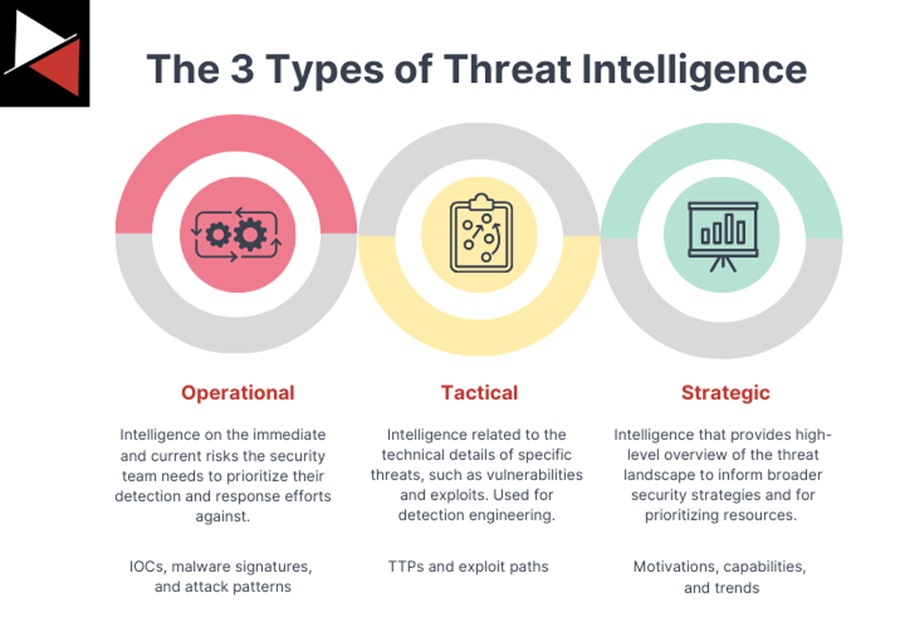
Operational Threat Intelligence
Focus: Day-to-day security operations.
Purpose: Provide cyber intelligence on the immediate and current risks the security team needs to prioritize their detection and response efforts against. It includes Indicators of Compromise (IOCs), malware signatures, and attack patterns.
Tactical Threat Intelligence
Focus: Short to medium-term actions and operations.
Purpose: Provide cyber intelligence related to the technical details of specific threats, such as vulnerabilities and exploits. Defenders use this to identify and mitigate particular threats by applying detection rules and mitigation policies through security tools. The focus is on targeting threat actors’ tactics, techniques, and procedures (TTPs) rather than individual indicators.
Strategic Threat Intelligence
Focus: Long-term planning and decision-making.
Purpose: Provide a high-level overview of the threat landscape to inform broader security strategies (e.g., developing policies and procedures, resource allocation, and prioritizing investments). It includes the motivations, capabilities, and trends.
There can be confusion between operational threat intelligence and tactical intelligence. It is best to think of tactical threat intelligence as cyber intelligence further up the pyramid of pain – indicators that are more difficult for an attacker to change.
This includes specific vulnerabilities, exploit code, and TTPs, rather than atomic indicators like IP addresses, domains, and hashes that are relatively easy to change to evade detection. Building mitigations for indicators derived from tactical threat intelligence takes longer, but they will be more robust.
Each of these threat intelligence types is collected, analyzed, and disseminated following a model known as the Cyber Threat Intelligence Lifecycle (or CTI Lifecycle for short).
It is also important to point out that tactical and operational threat intelligence can be defined differently, depending on who you are talking to in CTI. This is often the case in North America, where tactical and operational threat intelligence are flipped (CrowdStrike). The descriptions above align with how operational, tactical, and strategic threat intelligence are defined in the United Kingdom and Europe, from my experience (CREST).
The CTI Lifecycle
The CTI lifecycle encompasses the stages involved in collecting, analyzing, and disseminating threat intelligence. You will see the lifecycle explained in more detail later in this series. Here is a basic overview so you can get to grips with the CTI process.
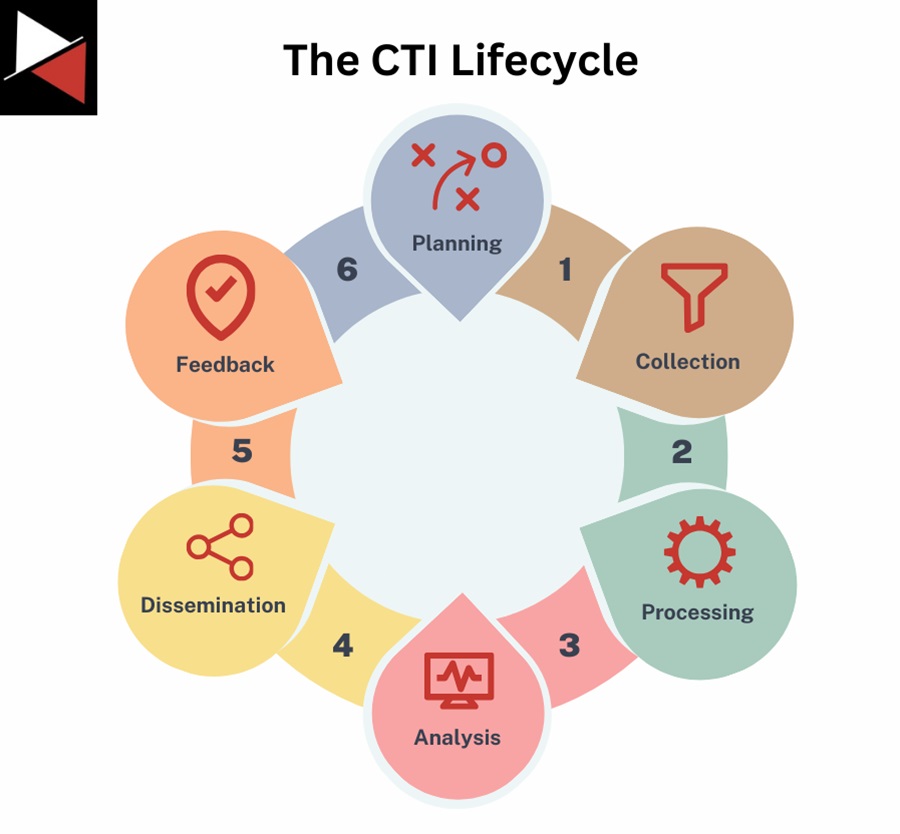
The CTI lifecycle consists of six stages:
- Planning: Defining the goals and objectives of your CTI collection, such as your intelligence requirements, what assets you want to prioritize defending, and how you will communicate the intelligence you find.
- Collection: Going out and collecting threat intelligence relevant to your goals and objectives. This could be open-source intelligence (OSINT), cyber intelligence from proprietary feeds, or engaging with information-sharing communities.
- Processing: Organizing the collected intelligence into a form that allows it to be analyzed. This includes normalizing and structuring data, enriching the data with contextual information, and assessing the credibility and reliability of the intelligence sources where you collected the data.
- Analysis: Analyzing the processed intelligence for meaningful insights that can be used to defend your organization (operational/tactical intelligence) or inform strategic decision-making (strategic intelligence).
- Dissemination: Sharing the intelligence and insights the intelligence provides with relevant stakeholders. This includes tailoring the presentation of the intelligence to suit the recipient so they can use it effectively.
- Feedback: Collecting feedback about the intelligence you shared and the efficiency of your CTI process. This is used to assess intelligence requirements and make adjustments to align with business objectives.
Operational, tactical, and strategic threat intelligence all flow through this cycle. The actions performed at each stage vary depending on the intelligence; some stages can be automated, while others require a human. You will learn more about the CTI lifecycle using real examples later in this series.
You will see the term “indicators” constantly popping up in CTI. An indicator is just a piece of information that can be used to identify or characterize a threat. They can indicate different things, such as an IOC or an IOA.
An Indicator of Compromise (IOC) is an atomic indicator (e.g., IP address, file hash, domain, etc.) that has been seen in a previous cyber attack. An Indicator of Attack (IOA) indicates a behavior associated with an attack, such as an attacker’s tactics, techniques, and procedures (TTPs).
Now you have a general overview of CTI, let’s dive into how CTI is used within the cyber security industry.
Role of CTI in Cyber Security
CTI plays a crucial role across various cyber security jobs, from deeply technical ones like incident responders to key decision-makers like managers or directors. It provides valuable insights into potential threats, vulnerabilities, and risks that help cyber security professionals make informed decisions. Let’s look at some examples.
Security Operations
For those working in security operations roles, such as Security Operations Center (SOC) Analyst, CTI can support them in the following ways:
- It can help them efficiently triage incidents by enriching them with contextual information.
- It enables them to proactively defend their organization by supplying information about the latest attacks and vulnerabilities.
- Aids in the development of detection rules and signatures.
- Facilitates threat hunting by providing insights into adversary behavior that may go undetected.
- Helps identify and understand new attack techniques and tactics.
Incident Response
Incident responders are called in when a security incident arises to minimize the impact on the business. They are often there on people’s worst days to provide technical support, contain an incident, prevent escalation, and remediate. CTI can help them achieve this by:
- Supporting the creation and refinement of incident response playbooks that ensure a swift, consistent, and comprehensive response to cyber incidents.
- Helping incident responders understand the tactics, techniques, and procedures (TTPs) an attacker uses so they can direct their investigation efforts.
- Providing IOCs for identifying malicious activities on endpoints and networks.
Vulnerability Management
All organizations need a vulnerability management program that discovers, prioritizes, assesses, and remediates vulnerabilities in the infrastructure, applications, and services an organization uses for its operations. It is a cornerstone of all organizations that want a strong cyber security posture, and CTI can support vulnerability management in the following ways:
- Enriches vulnerabilities with contextual information to help vulnerability prioritization and assessment.
- It helps discover the latest vulnerabilities.
- Provides information about the exploitability of a vulnerability, its potential business impact if exploited, and if attackers are using it in the wild.
- Supports remediation by providing mitigation advice.
Management
CTI is not just technical; it can help key stakeholders make informed decisions that keep their organization safe in the ever-evolving cyber landscape. CTI can be used by security managers, directors, or executives by:
- Providing a comprehensive view of the organization’s cyber security posture and the threats it faces to support informed decision-making.
- Facilitate strategic planning for security improvements and investments based on trends seen in the cyber landscape.
- Aid in communicating the importance of security measures to stakeholders by providing real-world data about geopolitical events, security breaches, and trends.
Conclusion
Cyber threat intelligence (CTI) is a proactive approach to defending an organization against cyber attacks. It involves collecting, analyzing, and disseminating intelligence about threats an organization will likely face. Technical operators and key stakeholders can use CTI to improve the cyber security posture of their organization and make informed strategic decisions.
You discovered threat intelligence can be grouped into three main threat intelligence types (operational, tactical, and strategic intelligence) and uses the CTI lifecycle to collect, analyze, and distribute this intelligence. You also learned about the role of CTI in different cyber security jobs and the benefits it can provide.
This is just scratching the surface of cyber intelligence. A quick guide to get you up and running. Keep following this series to learn more about CTI and the key definitions and concepts you will encounter as you dig deeper.




Frequently Asked Questions
What Is Cyber Threat Intelligence and How Is It Used?
Cyber Threat Intelligence (CTI) is the process of collecting and analyzing data about cyber threats to create actionable knowledge that helps organizations protect themselves. It involves transforming raw data about attackers and their methods into meaningful insights. These insights are then used to make faster, more informed security decisions, enabling a shift from a reactive to a proactive defense against cyberattacks.
What Is Operational Threat Intelligence?
Operational Threat Intelligence is focused on immediate, day-to-day security risks to help teams prioritize their response efforts. It provides highly technical and specific details about active cyber attacks, such as malware signatures and Indicators of Compromise (IOCs). This type of intelligence is time-sensitive and helps security staff understand the nature of an attack as it unfolds.
What Are the Types of Threat Intelligence?
Three main threat intelligence types serve different purposes for an organization’s security.
- Operational intelligence focuses on immediate, day-to-day threats by providing Indicators of Compromise (IOCs) and attack patterns for security teams to act on.
- Tactical intelligence provides technical details on an attacker’s methods and specific vulnerabilities to help defenders create detection rules and improve their defenses.
- Strategic intelligence offers a high-level view of the overall threat landscape and attacker motivations to inform long-term planning and security investments.
What Is CTI in Cyber Security?
CTI, short for Cyber Threat Intelligence, is the finished product of collecting and analysing information about cyber threats to provide actionable knowledge. This intelligence gives organizations crucial context about adversaries, including their identities, motivations, capabilities, and the specific infrastructure and methods they employ.
By leveraging CTI, security teams can make faster, more informed decisions, allowing them to shift from a reactive stance to a proactive one, anticipating and defending against attacks before they happen.
What is Threat Intelligence?
Threat intelligence is evidence-based knowledge about existing or emerging cyber threats that has been collected, processed, and analysed to provide actionable insights. It provides crucial context about a threat actor’s motivations, capabilities, and infrastructure, including specific Indicators of Compromise (IOCs) and their Tactics, Techniques, and Procedures (TTPs).
Ultimately, the goal of threat intelligence is to help organisations make faster, more informed security decisions, enabling them to move from a reactive to a proactive defence posture against cyber attacks.
What Is Tactical Intelligence?
Tactical intelligence provides the technical details needed for short to medium-term defensive actions. It focuses on specific threats, such as system vulnerabilities and exploits, giving defenders the information required to create detection rules and mitigation policies.
The primary goal of tactical intelligence is to understand and counter an adversary’s specific tactics, techniques, and procedures (TTPs). This allows security teams to move beyond blocking individual indicators and target the attacker’s actual operational methods.