

Defenders are often stuck in a reactive loop. We’re chasing alerts, patching vulnerabilities, and trying to keep up with adversaries who are constantly changing their attacks. The sheer volume of noise from traditional security tools can be overwhelming, leading to alert fatigue and letting real threats slip through the cracks. What if you could change the game entirely?
Instead of building taller walls, turn your network into a minefield for hackers with cyber detection!
This guide will explore how deception technology works and why it’s essential for modern defense. We’ll take a deep dive into the Acalvio ShadowPlex platform, an industry-leading solution that uses AI to create a dynamic and intelligent active defense, turning the hunter into the hunted.
Let’s jump in!
Want to listen on the go? Check out this article in podcast form!
What is Deception Technology?
Think of deception technology as creating a digital hall of mirrors for cyber attackers.
This technology employs a proactive defense strategy to fundamentally change the battlefield by seeding your real IT environment with a landscape of fake, but highly convincing, assets.
These aren’t just simple gimmicks; they are fully-fledged illusions designed to waste an attacker’s time, expose their tools, and mislead their efforts.
Deception technology usually includes two components:
- Traps (Decoys): These are fake IT assets that mimic your real environment with incredible fidelity. They can be anything from emulated Windows workstations that appear to belong to the finance department, decoy domain controllers that advertise fake services, or specialized decoys that replicate critical infrastructure like retail POS systems or industrial SCADA controls.
- Lures (Breadcrumbs): These are the digital breadcrumbs that lead intruders astray into your traps. They are spread through your environment and can include Honey Credentials (e.g., fake user accounts), Honey Files (temptingly named documents, and Honey Tokens (e.g., fake AWS API keys).

These deceptive assets are designed to be invisible and entirely useless for your legitimate employees. However, they present an irresistible target for an attacker performing reconnaissance or moving laterally within your network.
To an intruder, these decoys appear to be low-hanging fruit—an unguarded server, a misconfigured cloud bucket, or an easy path to privileged access. The moment an attacker interacts with one of these decoys—by trying to log in with a stolen honey credential, copying a honey file, or even just running a port scan against a decoy server—they’ve tripped a silent, high-precision alarm.
Because no legitimate traffic should ever touch these assets, any interaction is, by definition, malicious. This results in a high-fidelity, actionable alert with virtually zero false positives, allowing your security team to investigate with confidence.
High-fidelity alerts like these free your security team from the noise of conventional alerts, allowing them to focus on confirmed threats and turn a reactive SOC into a proactive threat hunting team. It’s a simple, brilliant way to turn your network into an active defense system.
Sounds cool, but do you really need this technology in your network? Let’s explore why the answer is a resounding yes!
Why is Deception Technology Needed?
Traditional security tools are essential, but they operate on a “fortress model.” They focus on hardening the perimeter with firewalls, blocklists, and anti-virus software.
However, once an attacker bypasses these outer defenses, they often find a soft, trusted interior. This allows them to lurk in the network for weeks or months, resulting in prolonged “dwell times” during which they can map the network and exfiltrate data undetected.
Deception technology implements a “tripwire model.” It assumes a breach is inevitable and shifts the focus to immediate post-breach detection. Gone are the days of waiting to be attacked. Deception technology flips the script and tips adversaries up.
Passive Defense
This traditional approach emphasizes hardening the perimeter with tools such as firewalls and antivirus software, much like medieval castle walls. While essential, it has a flaw: if attackers bypass outer defenses, they often find a soft interior where they can operate undetected, map networks, escalate privileges, and exfiltrate data over extended periods.
Active Defense
This modern approach accepts that breaches are inevitable, shifting focus from prevention to immediate detection and engagement through cyber deception. By seeding the network with deceptive tripwires, it creates uncertainty where every step risks exposure, stealing attackers’ time and shrinking their operational window from months to minutes.
Here are some of the main reasons why implementing detection technology in your environment should be a no-brainer.
- Reducing Alert Fatigue: Instead of overwhelming your SOC team with low-priority events and vague alerts, deception offers few high-confidence alerts that directly indicate malicious activity. This shifts from alerts like “unusual network traffic” to definitive ones like “unauthorized access on a decoy domain controller.” Such clarity helps defenders focus on attacker TTPs rather than noisy, transient IOCs.
- Detecting Unknown Threats: Deception doesn’t rely on signatures or patterns, but instead detects threats through malicious behavior, touching what shouldn’t be touched. This approach is effective against zero-day exploits, polymorphic malware, and new attack methods that are invisible to signature-based tools. Attackers using new exploits are caught when they explore the network and encounter a decoy.
- Protecting the Unprotectable: Modern networks contain devices that can’t run traditional security agents, creating blind spots. Deception offers visibility into these areas—such as IoT devices, legacy OT, or edge devices—using agentless decoys that mimic assets. It effectively detects threats in vulnerable network parts.
- Enhancing Zero Trust: Deception complements Zero Trust, which follows ‘never trust, always verify.’ While policies enforce security, deception adds a detection layer. If credentials are stolen, an attacker might bypass controls by accessing a decoy, which triggers an alarm, revealing the breach and halting the attack.
So, how can you go about using deception technology today?
- You can opt for the open-source route with tools like T-Pot and OpenCanary. This is great if your team has a limited budget, but it can be very challenging to implement at scale with limited support and features.
- You can choose a commercial option. Commercial vendors offer a comprehensive, easy-to-deploy solution with centralized management and seamless integration into your existing security stack.
There are numerous great open-source and commercial options available. Today, let’s focus on a commercial platform that has recently emerged as a recognized industry leader through its innovative application of artificial intelligence (AI). Let me introduce you to Acalvio’s ShadowPlex platform.
Acalvio’s AI-Powered Deception: ShadowPlex Platform
Acalvio is a cyber security company that specializes in cyber deception. Their primary offering is the ShadowPlex platform, a fully autonomous deception technology that utilizes AI to detect and respond to threats across an enterprise.
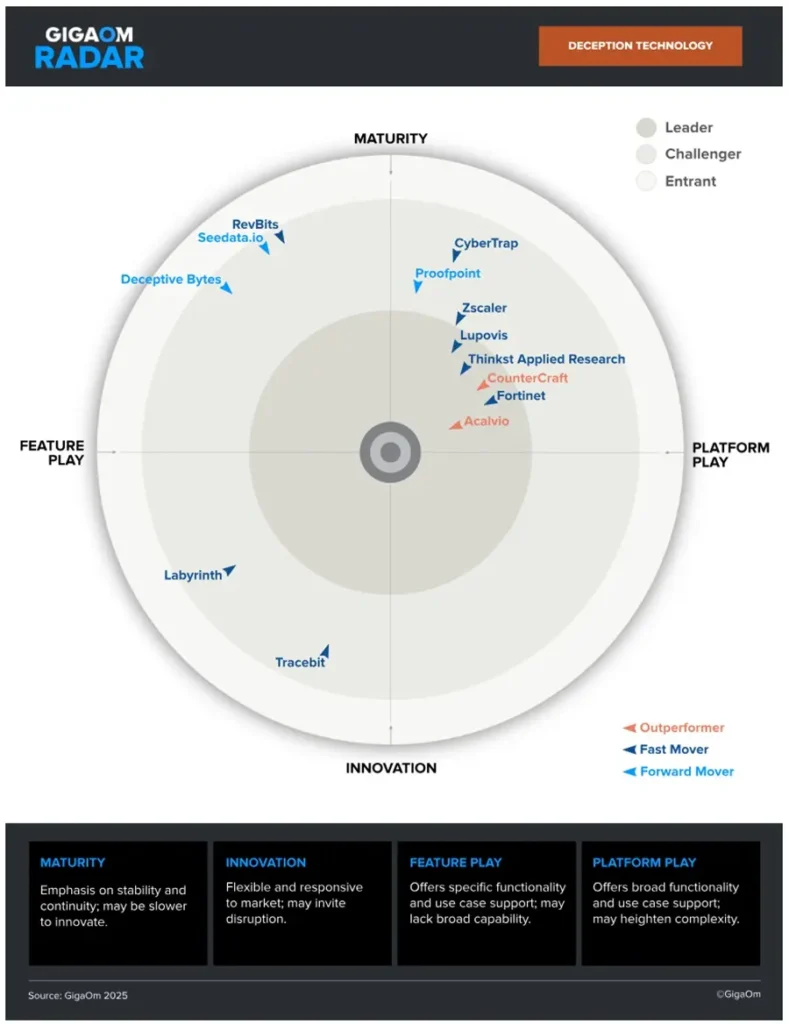
ShadowPlex is focused solely on cyber deception, ensuring ongoing value for customers as the threat landscape evolves and novel attack techniques are identified. This focus has led to its recognition as a Leader and Outperformer in the GigaOm Radar for Deception Technology.
Acalvio takes the core concept of deception and supercharges it with AI. The result is a distributed deception platform that is both powerful and easy to manage, designed for enterprise-scale active defense.
Their AI engine acts as a master strategist, automatically learning your environment’s unique characteristics.
This learning goes beyond surface-level details. It analyzes network traffic to understand the roles of different assets, learns your internal naming conventions, and profiles typical user behaviors to build a rich, contextual map of your organization. Based on this deep understanding, the platform recommends and deploys the most effective decoys, ensuring they are indistinguishable from your real assets.
For example, if it identifies a cluster of production web servers, it won’t just create a generic decoy; it will make one that mirrors the specific OS, patch level, and running services of its neighbors.
This AI-driven approach ensures the deception layer is always authentic, relevant, and dynamically refreshed, making it incredibly difficult for attackers to fingerprint or evade. It isn’t about setting up a few static, easily identifiable honeypots that a savvy attacker could spot. It’s about weaving a rich, believable, and ever-changing tapestry of deception throughout the entire fabric of your IT, OT, and cloud infrastructure, turning your whole network into an intelligent sensor.
Enough talk, let’s get down to the features. Specifically, what are the key features that have led to this platform becoming an industry leader?
Autonomous & Scalable
The Acalvio ShadowPlex platform uses patented AI technology to deploy and manage deceptions at enterprise scale automatically. This completely removes the massive manual effort and specialized expertise once required to maintain traditional honeypots.
The AI ensures that decoys have appropriate hostnames, IP addresses, and services that perfectly match the subnet in which they reside, allowing them to blend seamlessly with your production environment.
For example, a decoy in an engineering subnet will be named dev-build-server-04, while one in finance might be acc-qtr-rpt-vm. This “low-touch” approach means the deception fabric scales effortlessly as your network grows and changes, significantly reducing the operational burden and freeing up your security team to focus on high-value analysis and response rather than tedious manual configuration.
Broad Coverage
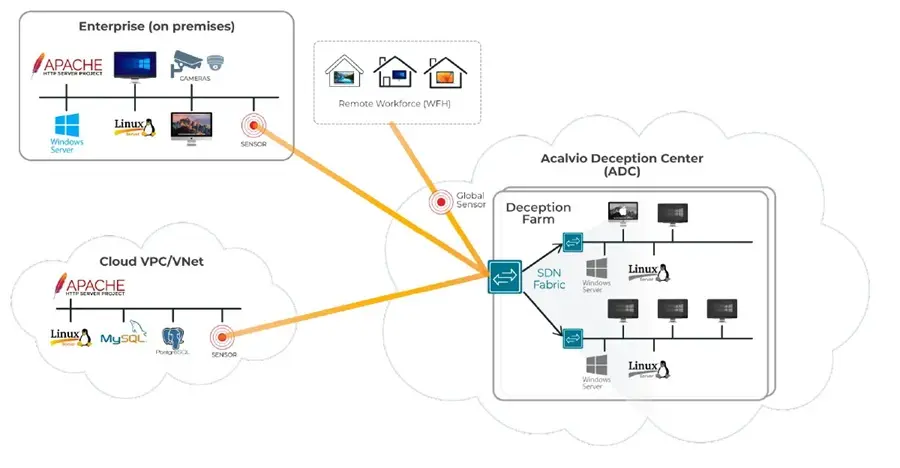
The platform provides unified coverage across the entire enterprise attack surface, a key strength highlighted by GigaOm.
This is not limited to just IT networks; it also includes on-premises data centers, every major cloud environment (AWS, Azure, GCP), as well as specialized OT/ICS and IoT networks.
An attacker’s path is rarely linear; they may compromise an IT system to pivot into a sensitive OT environment that controls physical processes. ShadowPlex provides a single pane of glass to detect this lateral movement, whether it’s from a corporate laptop to a factory floor controller or from an on-prem server to a cloud storage bucket.
This comprehensive visibility ensures that no corner of your hybrid network is left unprotected.
Comprehensive Deception Assets
ShadowPlex offers a vast and diverse library of decoys, including full-OS decoys for deep interaction and lightweight, low-interaction decoys for broad coverage. It also provides cloud-native honeytokens (e.g., fake AWS API keys or Azure service principals) that act as tripwires in cloud control planes.
The platform has a particularly strong focus on protecting Active Directory (AD), a primary target for attackers. It can create decoy user accounts with tempting descriptions, fake computer objects, and deceptive Group Policy Objects (GPOs).
It also strategically deploys “breadcrumbs”—deceptive lures, such as cached credentials in memory, saved SSH keys in configuration files, or browser histories pointing to decoy web services—onto production systems. These breadcrumbs are designed to exploit common attacker discovery techniques, guiding them into the deception environment and tricking them into revealing their presence early.
Strategically deploying deception assets, such as breadcrumbs, at scale is one of the most challenging aspects of implementing a cyber deception strategy. It takes planning, time, and effort to maintain such an infrastructure, something ShadowPlex makes easier.
Rich Forensics & Threat Intelligence:
When an attacker engages with a decoy, ShadowPlex doesn’t just raise an alert; it becomes a full-fledged, contained intelligence-gathering operation.
It captures a detailed, real-time forensic trail of their Tactics, Techniques, and Procedures (TTPs). This includes the specific sequence of commands they run, the tools and scripts they upload, and any malware they attempt to deploy. This information is invaluable because it’s not generic; it’s specific to an attacker actively targeting your organization.
Using this information, you can generate intelligence that provides actionable insights for threat profiling, enabling you to understand their objectives and proactively hunt for similar activity across your real assets.
These features sound good, but how do they look in reality? How do they actually help your security operations and cyber threat intelligence team in their daily work?
A Day in the Life: How ShadowPlex Benefits a SOC Team
To understand the actual impact of Acalvio’s technology, let’s follow Maya, a senior security analyst. Her morning starts like any other: with a sea of alerts. But today, one alert stands out.
It’s not a low-priority SIEM correlation; it’s a single, high-priority alert from ShadowPlex, labeled “Critical: Decoy Credential Use.”
9:00 AM: Early and High-Fidelity Detection in Action
Several hours earlier, an attacker bypassed the team’s perimeter defenses and started their internal reconnaissance. They found what they thought was a cached administrative credential on a workstation—a honey credential planted by ShadowPlex.
The moment they tried to use it to access a server, the trap was sprung.
Instead of being another needle in the haystack, this alert is a definitive signal of a breach in progress. Maya knows it’s real, and she knows it’s happening now. The kill chain has been interrupted at the lateral movement stage, long before any real data could be accessed or encrypted.
09:30 AM: Gathering Actionable Intelligence on Attacker TTPs
The ShadowPlex alert is more than just a notification; it’s a treasure trove of intelligence. Maya clicks into the event and sees a full playback of the attacker’s session within the decoy environment.
She sees the exact commands they ran, the discovery scripts they used to enumerate the network, and the specific tools they uploaded.
This isn’t generic threat intelligence; it’s a real-time dossier on an adversary currently in her network. She can immediately see their TTPs and map them directly to the MITRE ATT&CK® Framework, understanding their playbook and predicting their next move.
10:00 AM: Accelerating Response and Containment
With this high-confidence alert and rich intelligence, there’s no need for a lengthy investigation to validate the threat. The alert is automatically fed into their SOAR platform, triggering a pre-configured incident response playbook.
The compromised source endpoint is instantly isolated from the network, and the attacker’s command-and-control IP address is blocked at the firewall.
What would have taken hours or days of manual analysis and coordination is contained in minutes. The attacker is evicted before they even realize they’ve been caught—just another morning for Maya and the team as they defend their organization from sophisticated threat actors.
2:00 PM: Unmasking an Insider Threat
A few hours later, another ShadowPlex alert fires. This time, it’s different.
An employee from the sales department has accessed a decoy folder on a finance server named “Confidential_Client_Contracts_Q4.” The employee has no business reason to be there. This isn’t an external hacker but a potential insider threat.
The alert provides the security team with unambiguous, non-repudiable evidence to initiate a discreet investigation with HR, protecting the company’s sensitive data from within.
For Maya and her team, ShadowPlex has transformed their workflow. They’ve moved from being overwhelmed by noise to acting with precision, armed with the early detection and deep intelligence needed to stop threats in their tracks.
Conclusion
In a world of ever-increasing cyber threats, simply playing defense is no longer a winning strategy; it’s a recipe for burnout and constantly being one step behind attackers. The Acalvio ShadowPlex platform allows you to go on the offensive and shift the power balance in your favor.
By embracing deception, you can create a deliberately hostile environment for attackers, one where every wrong turn they make becomes a dead end that exposes their tools and intentions. This allows you to detect them with surgical precision and gather the critical, high-fidelity intelligence needed to strengthen your defenses for the future.
This isn’t just about blocking an IP address; it’s about understanding an adversary’s playbook so you can anticipate their next move. It’s time to stop chasing alerts and start setting traps.




Frequently Asked Questions
What is Acalvio ShadowPlex?
Acalvio ShadowPlex is an advanced cyber deception platform that utilizes artificial intelligence (AI) to detect and respond to threats proactively. It goes beyond traditional, passive security by creating a hostile environment for attackers. By deploying a network of convincing decoys and lures across IT, OT, and cloud environments, it provides early, high-fidelity alerts the moment an intruder makes a wrong move.
What is Cyber Deception?
Cyber deception is a proactive cyber security strategy that uses fake, but realistic, assets—such as decoy servers, credentials, and files—to mislead, detect, and gather intelligence on attackers who have infiltrated a network. Unlike traditional tools that look for known “bad” things, deception technology creates a field of “good” looking traps. Since these assets have no legitimate business use, any interaction with them is an unambiguous indicator of malicious activity.
How does Acalvio ShadowPlex use AI?
Acalvio utilizes AI to automate the entire deception lifecycle, addressing a significant limitation of older honeypot technologies. Its AI engine first learns your unique environment by analyzing traffic patterns, naming conventions, and common services. It then uses this knowledge to recommend and automatically deploy the most effective decoys and lures, ensuring they are always realistic and blend in perfectly.
The AI also maintains this deception fabric over time, keeping it fresh and making it difficult for attackers to identify, which significantly reduces the manual workload on security teams.