
Small businesses are told threat intelligence is an enterprise luxury, something you buy once you have a complete security operations center. That advice keeps businesses blind. But the opposite advice is just as bad. Buying a threat feed before you have basic controls wastes money and attention.
So when is your business actually ready for cyber threat intelligence (CTI)?
This guide answers that. You will learn why attackers deliberately target smaller organizations, the three layers of intelligence you can consume, the readiness threshold that makes CTI worth doing, and a 60-day roadmap you can run with a three-person IT team and almost no budget.
Let’s get started!
The Small Business That Died Between Detection And Response
In December 2012, attackers began draining the accounts of Efficient Services Escrow Group, a nine-person firm in Huntington Beach, California. The first wire sent roughly $432,215 to a bank in Moscow. The firm and its bank spotted it and clawed the money back.
Then it happened again.
In January, the attackers sent two more wires totaling $1.1 million to accounts in Heilongjiang Province, China. Those went through undetected, and that money was gone. Investigators later found a remote access trojan inside the network.
The lesson is not the one people usually take.
This company was not oblivious. It knew it had been robbed in December but had no process to act on that: no hunt for how the attackers got in, no lockdown on outbound wires, no review of who could authorize a transfer.
When Efficient reported the loss, regulators gave it three days to replace the money. It could not. In March 2013, the California Department of Corporations shut the firm down, and all nine employees lost their jobs.
You have probably seen the claim that “60% of small businesses close within six months of a cyber attack.” Treat it with suspicion. It is usually credited to the National Cyber Security Alliance around 2011, but no underlying study has surfaced. The real numbers are alarming enough. Be the analyst who checks the source.
Efficient Services Escrow Group wasn’t a large organization, but this didn’t matter to the adversaries who attacked. They just wanted a payday.
Why Adversaries Target Small Businesses On Purpose
The most damaging myth in this market is that attackers only care about large enterprises.
The inverse is closer to the truth. Adversaries deliberately hunt for organizations below the security poverty line, a term coined by Wendy Nather in 2011 for the threshold below which an organization cannot be effectively protected, for lack of money, expertise, capability, or influence.
Your business is not too small to be targeted. It is exactly the right size. Attackers are not asking whether you are important enough to hit, only whether you are cheap enough.
The 2021 Kaseya VSA incident showed how efficiently this scales. REvil did not compromise hundreds of small businesses one at a time. They exploited CVE-2021-30116, a zero-day in Kaseya VSA, a platform managed service providers use to administer thousands of downstream customer environments. Kaseya’s own incident report put it at fewer than 60 direct customers compromised, and between 800 and 1,500 downstream businesses hit with ransomware.
For those victims, the breach did not arrive by phishing email. It arrived through trusted software, pushed by a vendor they paid to protect them.
What The Numbers Actually Say
Be careful with statistics here, because the good ones get mangled fast.
IBM’s 2023 Cost of a Data Breach Report put the average breach cost for organizations under 500 employees at $3.31 million. Treat that as directional rather than personal, because IBM’s sample covers breaches of 2,100 to 113,000 records.
This next figure is closer to home. In VikingCloud’s 2026 SMB Threat Landscape Report, 40% of SMBs said an attack costing $100,000 or less could close their doors for good. That is not a measured closure rate; it is owners telling researchers how thin their survival margin is. A six-figure incident, not a seven-figure one, is where four in ten believe they stop existing.
So how can threat intelligence turn the tables for organizations operating at that security poverty line?
What Cyber Threat Intelligence Actually Is
Cyber threat intelligence is not a list of bad IP addresses.
It is evidence-based knowledge, including context, mechanisms, indicators, implications, and actionable recommendations, about a threat to your assets. It turns raw data into finished intelligence products that help key stakeholders make informed decisions.
Picture your business as a local bank.
Your firewall and antivirus are the vault door and alarm. They are reactive: if someone breaches them, you find out afterward.
CTI is the citywide security network telling you a specific crew is dissolving vault hinges with a specific compound in the next town over, and that they work Tuesday nights.
There are three types of CTI you need to be aware of to get started.
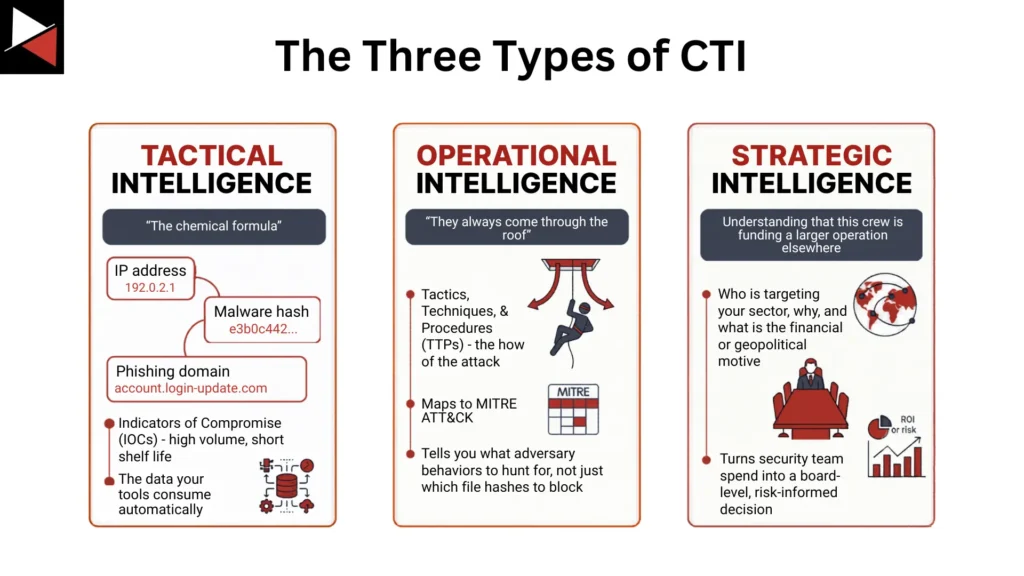
Tactical indicators expire fast, which is why the indicator lifecycle matters. Operational intelligence maps to the MITRE ATT&CK framework and tells your team what behavior to hunt for (a distinction our comparison of tactical and operational CTI unpacks). Strategic products like our Scattered Spider and Volt Typhoon profiles turn spending into a risk-informed decision. They focus on trends and where you should invest your resources.
But how do you know when your business is ready for CTI?
The Readiness Test: When Is Your Small Business Ready For CTI?
Here is the part most vendor guides on CTI skip.
Every security vendor will try to sell you a threat feed. Threat feeds only pay off above a specific readiness threshold. Below it, a feed is a distraction generating alerts nobody can action. What you want is requirements!
Requirements-driven intelligence is different: it costs nothing, needs no tooling, and you should start it today. They outline what you want to achieve with your CTI; the products you want to produce, the decisions you need information on to make, and the areas of risk for your business.
However, to make these requirements effective, you need basic security controls in place.
The NIST Cybersecurity Framework describes four implementation tiers: Partial, Risk Informed, Repeatable, and Adaptive. The one that matters here is Tier 3, Repeatable, where risk practices are formally approved, expressed as policy, and applied consistently.
NIST is explicit that the implementation tiers are not maturity levels. They describe how well risk practices reflect the framework’s characteristics, not a ladder every organization must climb. Plenty of consultants get this wrong. Do not be one of them.
The practical gateway is CIS Implementation Group 1, 56 safeguards CIS calls essential cyber hygiene, designed for smaller organizations.
Before deploying a single feed, you should answer yes to all five of these:
- Do you have a current inventory of your hardware, software, and data?
- Do you have backups you have actually restored from, not just configured?
- Is multi-factor authentication enforced on everything external-facing?
- Do you have a written incident response plan naming who decides what?
- Can you patch a critical vulnerability within a defined window?
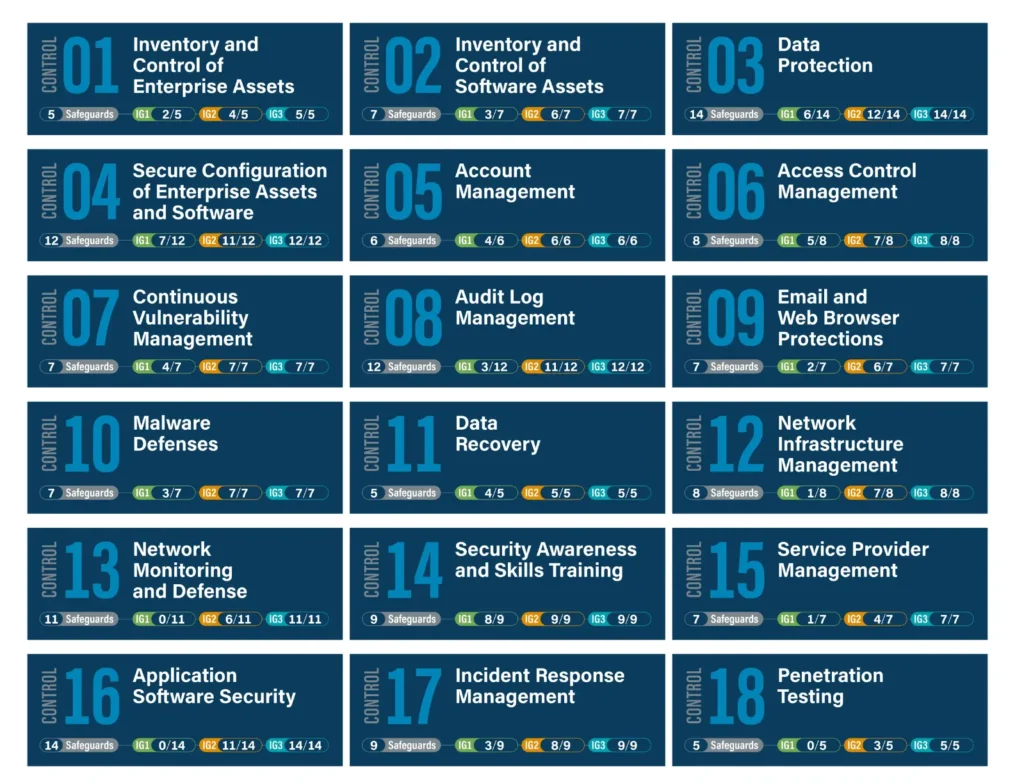
Five yeses and you can move on to creating intelligence requirements. Anything less and those requirements won’t be actionable.
The 60-Day CTI Roadmap For Your SMB
That sounds clean on a slide deck. Just write a list of things your business wants answered. The harder question is what it looks like on a Tuesday morning with a three-person IT team.
Here is a 60-day roadmap to follow (once you have your basic security controls in place).
Phase One (Days 1 to 15): Define Your Crown Jewels
Ask one question: what are the three most likely ways this business goes out of business tomorrow?
For most, the answers cluster around ransomware encrypting client data, business email compromise redirecting a live transfer, or a supply chain attack through a vendor.
Those scenarios become your priority intelligence requirements, the filter every piece of threat data is evaluated against. If a report does not relate to them, it is noise.
This is not one-size-fits-all. A news agency and a physiotherapy clinic differ completely.
- The news agency asks: are adversaries targeting our website, social channels, or publishing infrastructure?
- The clinic asks: is our booking software affected by known exploited vulnerabilities or misconfigurations?
Different threat models, different intelligence requirements, different defensible priorities. A structured crown jewel analysis beats guesswork.
If you use a managed service provider, remember Kaseya and treat that relationship as attack surface. Ask them three questions in writing this week:
- What is your patching SLA for the remote management tooling on our systems?
- Is multi-factor authentication enforced on every account with access to our environment?
- How quickly, and by what channel, will you notify us if you are compromised?
Their answers are intelligence. So is a refusal.
Phase Two (Days 16 to 30): Build The Tool Stack At Zero Cost
You do not need a purchase order to start actioning your requirements. Begin with two free sources and one free tool.
Threat correlation and IOC management. Your system of record for indicators. See our introduction to MISP. Free and open source.
Vulnerability prioritization based on confirmed exploitation. Free.
Community-verified indicators in near real time. Now run by LevelBlue after its spin-off from AT&T Cybersecurity. Free.
Maps threat data onto MITRE ATT&CK so you see behavior, not just indicators. Free, but expect real deployment effort.
Collaborative incident response once an event goes active. Free and open source.
The goal is simple. You are replacing a human manually googling is this IP malicious? with a system that already knows and has already blocked it.
Be honest about effort, because “free” is not “effortless.” Standing up OpenCTI takes a focused week, and MISP longer. Resist deploying everything at once, since a half-configured platform is worse than none. If you outgrow this stack, our guide to choosing a threat intelligence platform covers commercial options.
Phase Three (Days 31 to 45): Document The Lifecycle
This is where most small programs quietly fail!
Define what happens when a feed surfaces a malicious IP relevant to your requirements. The workflow should be: ingest, verify, act, audit. The indicator gets pushed automatically to a firewall block rule, then reviewed on a 30-day cycle so stale data does not generate false positives that erode trust.
Once you have processed our linted… write it down! A process that lives only in someone’s head is not a process. It is a single point of failure.
Remember Efficient Services. They had the intelligence. They had a documented process to take action on that intelligence!
Phase Four (Days 46 to 60): Plant Tripwires And Build The Business Case
Now the move that costs nothing and few make: canary tokens.
- Create a document that would attract an intruder, something like 2026_executive_bonus_projections.xlsx, and leave it on a shared drive.
- Plant a fake API key in a config file.
- Drop a decoy link in your wiki labeled “staging server admin panel.” Thinkst’s free service at canarytokens.org generates all of these in a browser, with no infrastructure to run.
Legitimate users have no reason to touch these tripwires, so any interaction generates an immediate, high-fidelity alert.
If a canary fires, someone is almost certainly inside conducting reconnaissance… and you know before they reach anything that matters. Our guide to active defense and cyber deception covers deploying these properly.
Finally, build the business case to support expanding your CTI operations (and resist borrowing an enterprise statistic to do it).
IBM found organizations using threat intelligence identified breaches 28 days faster– useful directional evidence, but drawn from a largely enterprise sample, and your board will smell the mismatch.
Work out what one day of downtime costs in lost billing, idle staff, and client trust. This number becomes your Annual Loss Expectancy (ALE), and most businesses are willing to spend between 7-20% of their IT budget to protect it. Our guide to CTI metrics covers what to track to prove your program’s value.
Benefits of a CTI Program
- Defensible prioritization
You patch what is actually being exploited against your sector, not a guessed-at CVE list. - Faster detection
Weeks removed from the window an intruder operates unnoticed. - Cheaper decisions
Spending gets justified against real adversary behavior, not vendor marketing. - Board-level credibility
“We need more budget” becomes a risk statement leadership can act on. - Compounding value
Every control you own gets better when fed relevant intelligence.
What Is Coming Next For SMB Threat Intelligence
The businesses that absorb the next wave share one characteristic. They know what is coming before it arrives.
Microsoft’s 2025 Digital Defense Report measured a 54% click-through rate on AI-generated phishing against 12% for manually written messages, making people roughly 4.5 times more likely to click. Note the framing, because this stat gets misquoted constantly. It is not 54% higher. It is more than four times more effective.
Malware is increasingly able to adapt mid-intrusion rather than follow a fixed script, and IBM’s 2025 report put the average extortion or ransomware incident at $5.08 million.
CTI is not the finish line for SMBs. It is the foundation every later security investment is built on.
You now know why adversaries target businesses below the security poverty line, what the three layers of intelligence do, and why CIS Implementation Group 1 is the gate separating a useful program from an expensive distraction. You also have a 60-day roadmap costing almost nothing beyond your team’s attention.
Start with your crown jewels. Everything follows from knowing what you cannot afford to lose. Once intelligence flows, map it against your architecture, which is what threat modeling is for.
Efficient Services Escrow did not fail because it had a bad product. It failed because it learned it was under attack and had no process to act on that.
Build the process. Then go find out what is already in your network.




Frequently Asked Questions
What Is CTI For SMB?
CTI for SMB is applying cyber threat intelligence inside a small or medium-sized business. It means filtering the global threat landscape down to the few adversaries and techniques that realistically threaten you, then using that filter to prioritize patching, detection, and response.
What Is The Difference Between A Threat Feed And Threat Intelligence?
A feed is raw data: addresses, domains, and hashes with no context. Intelligence is that data assessed against your environment and requirements. A feed says an address is malicious. Intelligence says why it matters to you and what to do next.
Is My Small Business Too Small To Need Threat Intelligence?
No, but you may be too early for feeds. If you lack asset inventory, tested backups, documented incident response, and multi-factor authentication on external services, invest there first. Defining your intelligence requirements, though, costs nothing and should start immediately.
How Much Does A Small Business CTI Program Cost?
The tooling can cost nothing. MISP, OpenCTI, TheHive, the CISA KEV catalog, and feeds like OTX are all free. Your real cost is time: budget a focused week for the initial MISP build, then a few hours weekly to maintain the workflow.
What Are Priority Intelligence Requirements For A Small Business?
These are the specific questions your intelligence effort exists to answer. For most small businesses, they derive from three scenarios: ransomware encrypting client data, business email compromise redirecting funds, and supply chain compromise through a vendor. Anything else is noise.