
Your organization is drowning in data. Logs, alerts, threat feeds, dashboards. The list goes on. Yet the Mandiant M-Trends 2025 report puts the global median dwell time at 11 days. When does an external party discover the breach? That jumps to 26 days.
That gap doesn’t exist because security teams lack data. It exists because very few organizations have built the process to turn data into something leadership can act on. This guide will teach you the difference between data, information, and intelligence and, more importantly, how to communicate that difference to stakeholders in a way that drives action. Let’s get started!
Why Data Alone Isn’t Enough
Picture this. You’re a Cyber Threat Intelligence (CTI) analyst preparing to brief your leadership team. You’ve got mountains of evidence: firewall logs, enriched indicators, threat feed outputs, and detection alerts. You walk into the room and start presenting… a list of suspicious IP addresses your team blocked this week.
The room politely nods. Someone checks their phone. The meeting ends with zero follow-up actions.
Sound familiar?
The problem isn’t the quality of your work. It’s what you’re delivering and how you’re framing it. Most security teams operate at the data level, some reach the information level, but very few have made the leap to producing genuine intelligence.
This distinction maps directly to the threat intelligence lifecycle, where raw collection (data) is processed, analyzed, and disseminated as finished intelligence. If you’re unfamiliar with the lifecycle, that article is a great companion to this one.
Presenting to the boardroom is all about getting and holding their attention. This means you must have an effective introduction to the topic you are discussing (not a list of IP addresses).
When you need the room’s attention, try these three things:
- Hook with a number they can’t ignore. The dwell time statistic in this article’s introduction creates urgency by telling every executive that attackers are already inside their networks, right now, undetected. Numbers do that in a way that concepts never will.
- Name the gap without blaming anyone. Saying “the gap doesn’t exist because security teams lack data” reframes the problem as a process issue rather than a people issue. The people in the room likely approved the budget for those tools. If they feel blamed, they stop listening.
- Promise a clear and achievable answer. Ending with “it starts with understanding a distinction that sounds simple” signals that what follows won’t be a deep dive. You’re giving the room permission to stay engaged and not be hit by technical jargon.
The techniques matter just as much as the content you’re sharing. The rest of the article shows you how to present a technical topic to executives using proven communication strategies. Following each segment will be a brief “director’s commentary” highlighting the strategies used.
The “what” gets the nod. The “how” gets the buy-in.
Segment 1: Data vs Information vs Intelligence
So, data, information, and intelligence. These aren’t interchangeable terms. They represent three different levels of value your security team can deliver. Let’s break them down.
Data is raw. A log entry, a file hash, a packet capture. It tells you something happened, but not what it means. Think of it like CCTV footage with no timestamps and no labels. You’ve got the recording, but you can’t tell the story.
Information is structured data. You parse the logs. You enrich the IP address. Now you can answer who connected, from where, and when. You’re moving from “something happened” to “here is what happened.”
Intelligence is where the real value lives. This is the step most organizations haven’t built yet. This is where your analysts take that structured information, apply context about the adversary (their intent, their capability, and their past behavior), and produce something that answers the question you actually need answered: What does this mean for us, and what should we do about it?
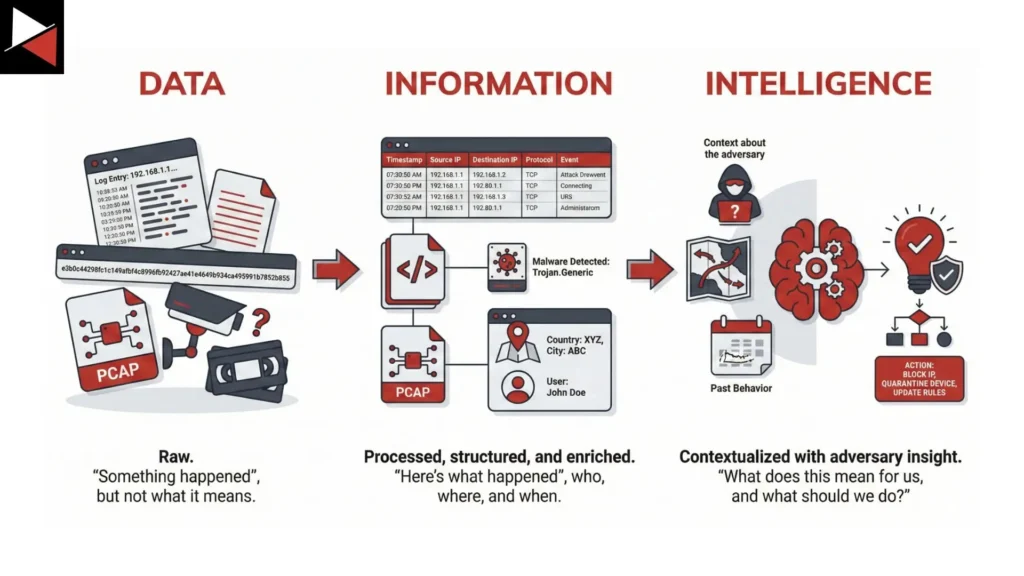
The practical difference looks like this.
At the data level, you receive a list of suspicious IP addresses. At the intelligence level, you receive a briefing that says: “A financially motivated group has been targeting firms in our sector using this specific technique. Here’s the likelihood they reach us, and here are three controls that would significantly reduce that risk.” That is the leap from data to intelligence.
If you want to go deeper on how analysts identify and profile these adversaries, check out the guide on threat actors and threat profiling.
Director’s Commentary: The CCTV Analogy Explained
Notice what was not included in that segment. No mention of the Data Information Knowledge Wisdom (DIKW) pyramid by name. No reference to information science. Not a single framework label.
The room doesn’t need to know the model exists. They need to understand the distinction it describes.
The CCTV analogy is the anchor. It’s a comparison your audience can hold in their head without writing anything down. Two weeks from now, when someone in that room is reviewing a security budget, they’ll remember “the CCTV thing.” And that is the point.
The other move worth noting is the concrete before-and-after: a list of IPs versus a briefing with a recommendation. Executives think in deliverables. Show them the output changes, not the process changes.
This ties into how you structure intelligence products. The best products aren’t defined by the analysis that went into them. They’re defined by the decision they enable.
Segment 2: What Is Your Team Actually Reporting?
Here’s a concept that will change how you evaluate your security team’s reporting.
Your team blocks threats every day. Malicious IP addresses. Suspicious file signatures. Known bad domains. That’s necessary BAU (business-as-usual) work. But an attacker can change any of those indicators in minutes. Rotating an IP address costs them almost nothing.
Now, at the other end of the scale are an attacker’s behaviors.
- How do they move through a network?
- How do they establish a foothold?
- How do they extract data?
These are patterns that take months or years to develop, and forcing an attacker to change their core behaviors is enormously costly to them. It often means rebuilding their entire operation.
So here’s the question worth asking in your next security review:
“Is your team reporting that they blocked 10,000 malicious IPs this week? Or are they reporting that they’ve identified how a specific threat actor operates and built defenses that catch them regardless of which IP address they use tomorrow?”
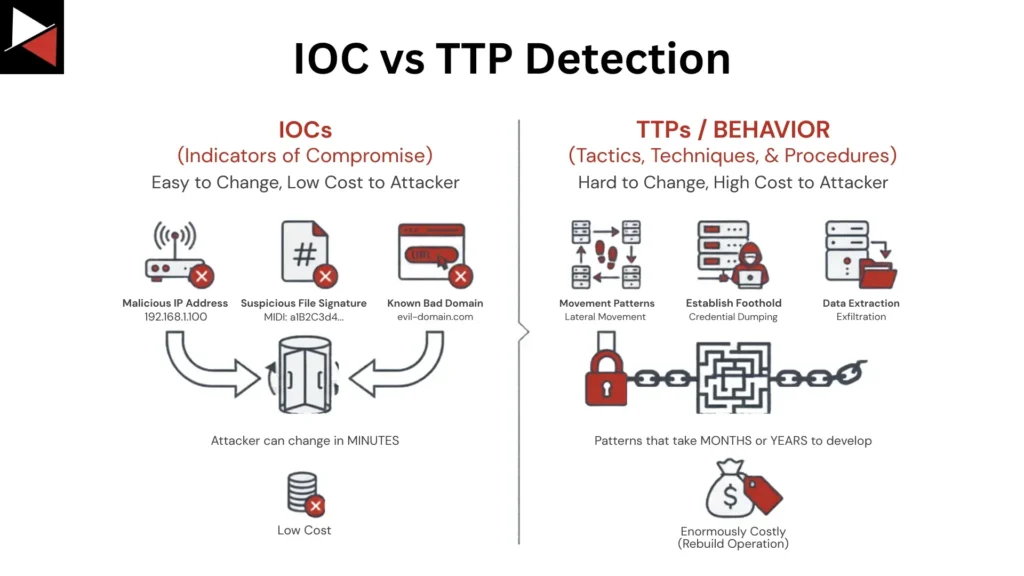
Both are valid. But they represent very different levels of maturity and protection.
Director’s Commentary: Why Jargon Kills Executive Buy-In
That entire segment was built around the Pyramid of Pain, yet those words never appeared in the briefing. Not once. The moment you drop an acronym in a leadership meeting, half the room stops listening and starts wondering if they should know what that means. You’ve lost them.
Instead, the concept was framed as a question they can take ownership of: “Is your team reporting this… or that?” Now it’s their question to ask, not your framework to explain. That’s the shift. You’re giving them a tool to evaluate their own program, and that’s far more powerful than teaching them a model they’ll forget by Friday.
Connecting Intelligence to Dwell Time & ROI
Let’s bring this to the metric that matters most at the leadership table: dwell time. How long does an attacker sit inside your environment before your team detects them?
According to the Mandiant M-Trends 2025 report, the global median is 11 days. Internally discovered breaches drop to 10 days. Externally discovered? 26 days. Organizations with a mature intelligence capability are often able to shrink that window significantly.
The financial impact isn’t linear either. The IBM Cost of a Data Breach Report 2024 found that breaches contained within 200 days cost an average of $3.93 million, while those extending beyond 200 days cost an average of $4.95 million. That’s a 23% increase driven purely by time. Day two versus day 20 isn’t incremental. It’s the difference between a contained incident and a regulatory event.
Here’s how to frame it for your leadership:
Collecting data is a cost. Turning it into intelligence is where the return on your security investment actually lives.
Your intelligence function isn’t a team that produces reports. It’s the function that tells you what threats are real, why they matter to this organization specifically, and what to do about them before the incident occurs. The key to making this land? Match your language to your audience. If your CSO measures risk in terms of regulatory exposure, talk about regulatory exposure. If your CFO measures value in terms of cost avoidance, talk about cost avoidance. Same intelligence. Different frame. Completely different impact on the room.
This is why the intelligence requirements process matters. When you know what questions your stakeholders need answered, you can tailor both the substance and language of your intelligence to match.
| Data | Information | Intelligence | |
|---|---|---|---|
| What it is | Raw, unprocessed facts | Processed and structured data | Contextualized, analyzed, and actionable insight |
| Example | A list of suspicious IP addresses | Enriched IPs with geolocation and timestamps | A briefing on a threat actor targeting your sector with recommended controls |
| Question it answers | “Something happened.” | “Here is what happened.” | “What does this mean for us, and what should we do?” |
| Value to leadership | Low (noise) | Moderate (awareness) | High (decision-enabling) |
Director’s Commentary: The Language of the Boardroom
That entire section uses language the room already thinks in. Dwell time. Breach cost. Regulatory exposure. Return on investment. No new concepts were taught. An existing one was translated into their vocabulary.
This is the thing CTI analysts most often get wrong in stakeholder meetings. They present the work. What you should be presenting is the outcome of the work, described in terms the audience already uses to make decisions.
Here’s a simple exercise for your next briefing. Before you build a single slide, write down three words your audience uses when they talk about risk. Those three words should appear in your opening, your key findings, and your recommendations. If those words don’t show up, you’re speaking your language, not theirs.
For a deeper look at structuring your written output for stakeholders, the guide on CTI report writing walks through the inverted pyramid technique and other approaches that help you lead with the “so what” rather than burying it in technical detail.
Summary
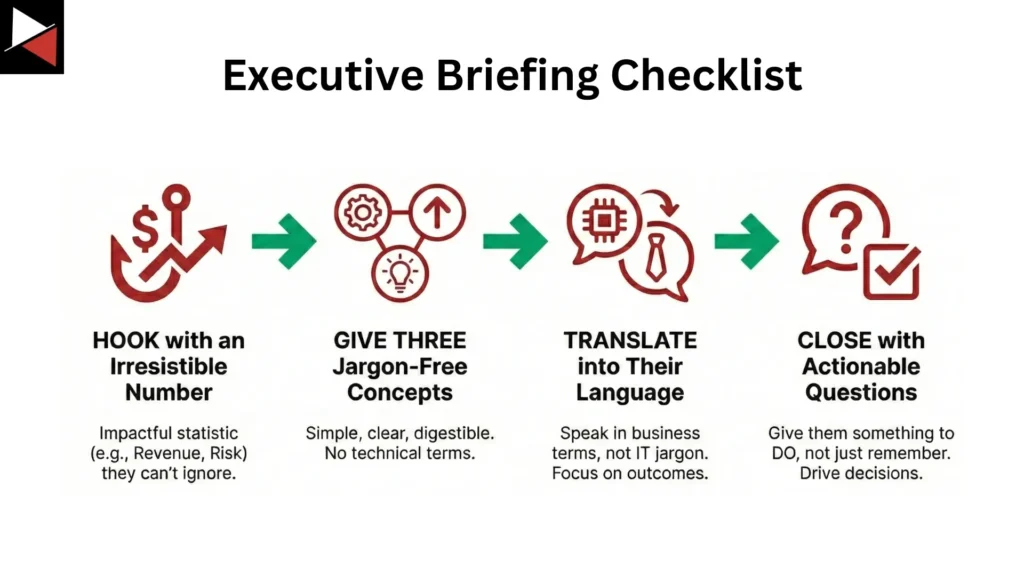
If you take nothing else away from this article, take this four-step approach to your next leadership briefing:
- Hook them with a number they can’t ignore. Use a statistic that creates urgency and relates to their world, not yours.
- Give them three concepts using zero technical jargon. Data, information, and intelligence are easy to explain when you anchor them with a memorable analogy, such as the CCTV comparison.
- Translate everything into the language they already use for decision-making. Dwell time, breach cost, regulatory exposure, and cost avoidance. These are the words that move budgets.
- Close with questions that give them something to do, not something to remember. “Is your team reporting this… or that?” is an evaluation tool they can take into their next security review.
Sample Five-Minute Stakeholder Briefing Outline
Opening (60 seconds)
Lead with one industry-relevant statistic (dwell time, breach cost). State the gap: “We have the data. The question is whether we’re turning it into something you can act on.”
The Distinction (90 seconds)
Explain data, information, and intelligence using a simple analogy. Show one before-and-after: data-level output versus intelligence-level output.
The Maturity Question (60 seconds)
“Is our team reporting blocked indicators, or are they reporting on adversary behaviors and recommending controls?” Let the room sit with it.
The Business Case (60 seconds)
Connect to dwell time and breach cost using your audience’s language (regulatory exposure, cost avoidance). Frame intelligence as ROI, not overhead.
Close (30 seconds)
One specific recommendation. Offer a one-page follow-up summary for reference. [/ACCORDION]
The difference between data, information, and intelligence isn’t just a concept for analysts. It’s the foundation of how you communicate value, justify investment, and protect your organization. Build the process. Translate the output. Speak their language.
Now it’s your turn. Good luck!




Frequently Asked Questions
What Is the Difference Between Data, Information, and Intelligence in Cyber Security?
Data is raw and unprocessed, like log entries or file hashes. Information is data that’s been structured and enriched to answer the questions of who, what, when, and where. Intelligence applies adversary context (intent, capability, past behavior) to produce actionable insights that answer “What does this mean for us and what should we do about it?” Understanding this progression is fundamental to building a mature CTI program.
How Do I Explain Intelligence Value to Non-Technical Stakeholders?
Avoid jargon and framework names entirely. Use simple analogies (like the CCTV footage example), concrete before-and-after comparisons, and the language your audience already uses to make decisions. Frame intelligence as the function that reduces dwell time, prevents regulatory events, and delivers return on security investment. You can also watch the full walkthrough.
What Is Dwell Time and Why Does It Matter?
Dwell time is the duration an attacker remains inside a network before being detected. The Mandiant M-Trends 2025 report reports a global median of 11 days, with externally discovered breaches averaging 26 days. The IBM Cost of a Data Breach Report found that breaches resolved within 200 days cost 23% less than those resolved after 200 days. Reducing dwell time is one of the most tangible ways to demonstrate the value of your intelligence program to leadership.
Why Should CTI Analysts Avoid Using Jargon in Executive Briefings?
The moment you drop an unfamiliar acronym in a leadership meeting, you risk losing your audience. Half the room stops listening and starts wondering if they should know what that term means. Worse, it shifts the dynamic so that executives feel like they’re in your meeting rather than the other way around. Framing concepts as questions they can take ownership of is far more powerful than explaining frameworks they’ll forget by the end of the week.
How Does Behavior-Based Detection Differ From Indicator-Based Detection?
Indicator-based detection focuses on blocking known malicious artifacts like IP addresses, domains, and file hashes. These are easy for attackers to change, often within minutes. Behavior-based detection focuses on how an attacker operates: movement patterns, persistence techniques, and data extraction methods. These behaviors take months or years to develop and are enormously costly to change. Organizations operating at the behavior level represent a significantly higher level of security maturity.