

The fastest recorded breakout time in 2025 was twenty-seven seconds. That is the elapsed time between an attacker’s initial foothold and their first lateral movement on another host, measured by CrowdStrike across thousands of real intrusions.
Twenty-seven seconds is not enough time for a SOC analyst to open the alert. It is barely enough time to react to a phone ringing.
If you think detection engineering is just writing better SIEM rules, you are already behind. The discipline has evolved three times in the last decade, and most teams are still running a model that died in 2019.
This guide will teach you what detection engineering actually is, walk you through the six-phase lifecycle, and show you why the MGM breach is the clearest signal yet that the whole model needs to shift. By the end, you will have a complete picture of where detection engineering stands today and where it is heading in 2026. Let’s get into it.
A Brief History: How Detection Engineering Was Born
Detection did not start as an engineering discipline. It started as a chase.
In 1971, the Creeper worm propagated across ARPANET, the predecessor to the internet. Someone wrote a program called Reaper to hunt it down. Known bad? Find it, kill it.
That was the entire model. It worked because there were maybe a few dozen pieces of malicious code on Earth. Then the Morris worm arrived in 1988 and broke everything. It infected roughly 10% of the internet-connected machines in existence at the time.
The industry’s response was to formalize CERTs (Computer Emergency Response Teams) and commercialize signature-based antivirus (think McAfee or Avast).
A signature is a hash, a string, or a sequence of bytes. You compute it, compare it, and alert on it. Mathematically elegant. Operationally doomed.
The 2010s changed the math for detection entirely. Along came Endpoint Detection and Response (EDR) tools. They solved one specific problem: getting structured telemetry off the host at scale. Think of Sysmon data, Windows Event IDs, process creation logs, and command-line arguments.
For the first time, defenders could see behavior and not just artifacts.
Then in 2013, YARA was released — a pattern-matching language for files and memory. This was closely followed by Sigam, which dropped in 2017. Same idea, but applied to log events, and written in YAML. Both vendor agnostic. Both open-sourced detections.
That portability empowered security teams all over the world. Suddenly, a detection written by a researcher in Berlin could run in a Splunk deployment in São Paulo. However, to do this effectively, a process is needed.
The Six-Phase Detection Engineering Lifecycle
Creating an effective detection involves six phases. Let’s walk through each phase so you can see how to go from a detection idea to a production-grade deployment.
Phase 1: Requirements and Discovery

Where does the idea come from?
- CTI flagging APT29 using a new technique for LSASS access.
- A red team engagement exposing a blind spot.
- An incident post-mortem that reveals a gap in your coverage.
These are valid sources for a detection requirement. “I read a blog post” is not.
If your detections start from vendor newsletters or random threat feeds, you are doing intelligence-driven detection wrong. No requirement means no rule. This is the phase most teams skip, and they pay for it later.
A detection that answers no real question is noise dressed up as security.
This is where Priority Intelligence Requirements (PIRs) become a direct input to your detection program. PIRs define what your organization needs to know. Detections are the mechanism that answers those questions at machine speed.
Phase 2: Triage
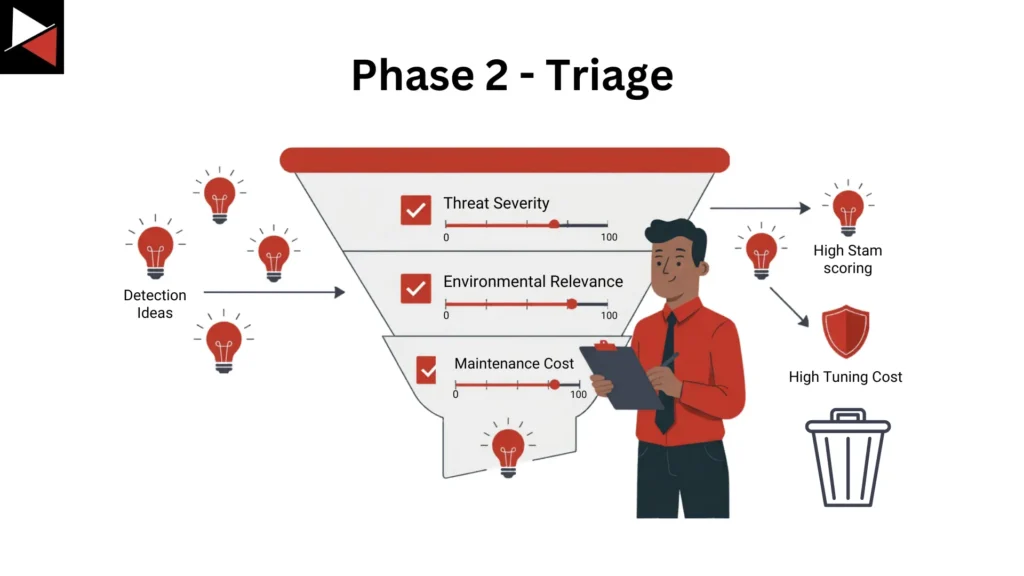
Not every detection makes sense to build.
Score each candidate on three criteria: severity level, environmental relevance, and maintenance cost. A simple matrix works fine — score each axis 1 to 5, multiply, and rank.
- A T1003.001 (LSASS memory dumping) detection might score 5/5/2 = 50 because the technique is high-severity, highly relevant in any Windows shop, and sufficiently stable to require minimal tuning.
- A T1059.001 (PowerShell) generic rule might score 4/5/1 = 20 because, despite the severity and relevance, the maintenance cost will eat you alive in a developer-heavy environment.
If a security control already covers the behavior, it is often better to lean on that control and redirect your engineering resources elsewhere. A rule that costs you 40 hours a quarter to tune is a liability, not an asset.
Phase 3: Investigation
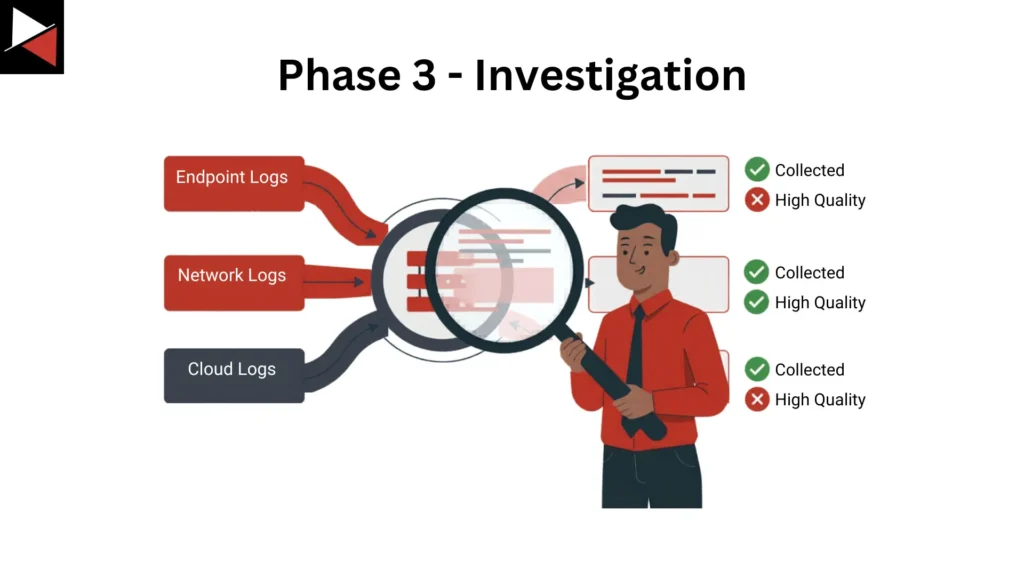
What does telemetry actually show about the behavior? What does normal look like in your environment? This is where most detection programs collapse. They build a generic baseline and ship it, resulting in thousands of false positives drowning the SOC.
The investigation phase is about understanding the specific context of your network before a single line of code gets written.
Before writing a detection for credential dumping, you should know which of your hosts already run LSASS-adjacent tooling (EDR vendors themselves often access LSASS), which service accounts legitimately run as SYSTEM with elevated privileges, which jump boxes see admin activity outside business hours, and what your top five most common parent-child process relationships look like on a Tuesday at 2 pm.
These are not theoretical questions. They determine whether your rule fires twice a week with a real signal or four hundred times a day with noise.
Phase 4: Development

This is where Sigma and YARA enter the picture.
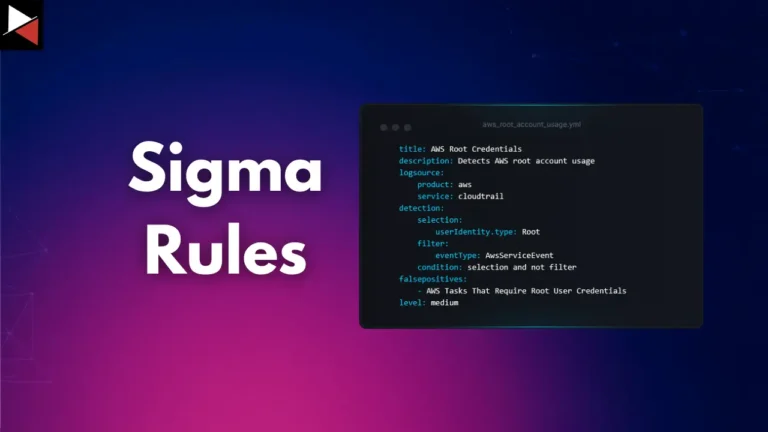
Sigma is your language for log events. YARA is your language for files and memory. Both are vendor agnostic, which means you can version-control your detections and deploy them at scale across different SIEM or EDR platforms.
The syntax itself is approachable. If you can write a SQL WHERE clause, you can write the bones of a Sigma rule. The hard part is getting it to actually work in your environment, which phases one through three are meant to prepare you for.
A single well-tuned Sigma rule for PowerShell console history clearing can be converted to Splunk SPL, Elastic KQL, Microsoft Sentinel KQL, and Chronicle YARA-L. Write it once, deploy to multiple platforms. That portability is the baseline capability every detection engineer should have.
Phase 5: Testing

You want to test your rules against historical data and simulated attacks before they go anywhere near production.
This is the phase a lot of teams fly through or skip entirely. The consequence is a rule that generates 10,000 false positive alerts on day one because someone forgot to check what legitimate admin behavior looks like in the target environment.
The practical workflow has two halves.
- First, replay the rule against thirty to ninety days of historical logs and count the hits. If the legitimate-activity volume exceeds a couple of percent of total alerts, you are not ready to deploy.
- Second, run an Atomic Red Team test that maps to the same ATT&CK technique and confirm the rule fires on the simulated attacker behavior. If it fires on the test and stays quiet on production data, you have a candidate worth merging.
Phase 6: Deployment and Maintenance
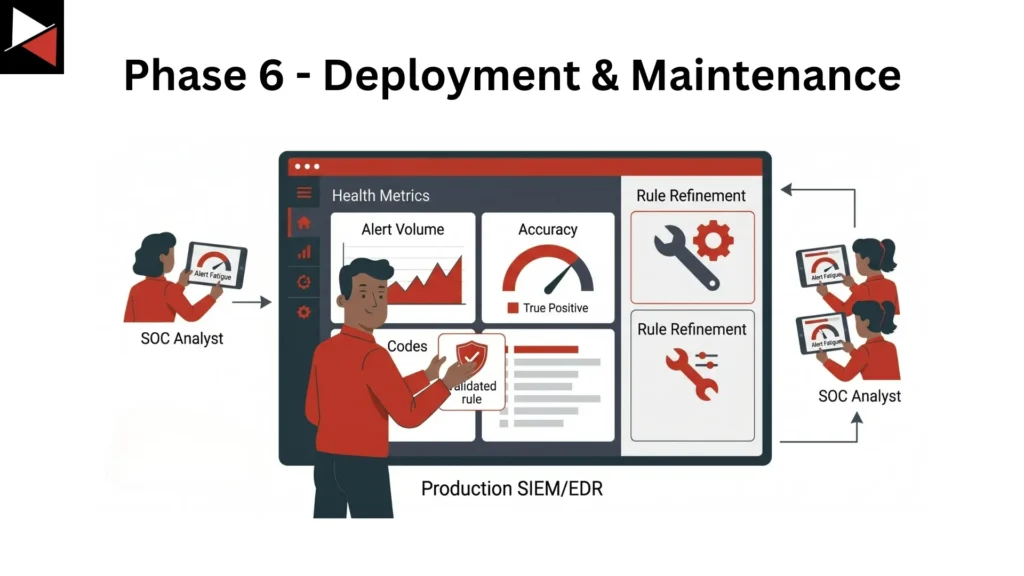
Push to production and then measure.
Detections have a half-life. Threat actors adapt. An adversary technique that generated a reliable signal in 2022 may be obsolete or trivially evaded by 2026. Treat your detection library as living infrastructure, not a trophy cabinet.
Use CTI metrics to measure what your detections are actually catching. Retire rules when they are no longer useful. If a security control covers a behavior more efficiently than a rule, implement the control and save the compute and storage costs.
At this point, you may be thinking that this all sounds like a lot of work! If only there were a way to codify, automate, and streamline it…
Detection as Code: The Engineering Part of Detection Engineering
Here is what separates mature programs from everything else.
Detection as code treats every rule like production software. That means a Git repository, version-controlled, organized by detection type or MITRE ATT&CK technique. Every change goes through a pull request workflow. No more editing rules in a web UI with no history.

Within the Continuous Integration (CI) pipeline, your rule executes against labeled test data before it goes anywhere. Known bad samples must match. Known good samples must not. You assert the expected behavior of your code, exactly as a software engineer would.
Before merging, a second engineer reviews the rule. They check for logic errors, performance issues, and evasion paths you may have missed. On merge, the pipeline pushes the rule to your SIEM via its API. Zero manual deployment.
The real benefit of detection-as-code is rollback. When a rule causes a false positive explosion at 3 am, you revert the commit, the pipeline pushes the rollback automatically, and you go back to sleep. That is the engineering part.
If your team is still editing rules in a web UI with no version control history, you are operating a 2015 program in a 2026 threat landscape.
Talking of 2026, it’s about time we address the elephant in the room… AI!
AI and Agentic Detection: What Changes, What Doesn’t
There are two AI conversations in detection engineering right now.
AI-augmented detection is already shipping. You use a model to draft a Sigma rule from a threat report, translate logic across query languages, or summarise a noisy alert chain. A lot of teams are using this to compress the time from intelligence to deployed rule by an order of magnitude. This is real, and it is available today.
Agentic detection is the model that CrowdStrike, Datadog, and various open-source projects are racing towards. Autonomous agents that ingest new threat intelligence, generate the corresponding atomic test, execute it in a sandbox, validate whether existing detections fire, and then open a pull request if coverage is missing. This is coming. Watch for it.
Here is what AI does not change. An LLM does not know what normal looks like in your environment. It could write a syntactically perfect rule for whoami execution. That rule might generate 10,000 alerts a day on your jump boxes because your sysadmins run whoami constantly. The investigation phase, the environmental baselining, the false positive triage — that judgment lives in your data and your intuition, not in a model’s training corpus.
The detection engineers who lose their jobs to AI in the next three years are the ones writing rules from scratch. Those who keep their jobs are the ones who can review an AI-generated rule, identify the evasion gap or performance issue, and explain it clearly in a peer review.
Benefits of AI for Detection Engineering
- Faster cross-platform translation
Sigma rules can be translated across SIEM and EDR query languages automatically, eliminating manual rewriting. - Consistent peer-review quality
AI can flag common logic errors, overly broad conditions, and known evasion patterns before a human ever reviews the pull request. - Broader telemetry coverage
Agentic pipelines can systematically identify gaps in coverage across your entire MITRE ATT&CK matrix, surfacing blind spots that manual review would miss. - Reduced time-to-coverage
AI-assisted rule drafting compresses the gap between a new threat report and a deployed detection from days to hours.
So how can you get started building your organization’s detection engineering program?
Getting Started: Your Detection Engineering Stack
You do not need a large team or an enterprise budget to start building a proper detection engineering program. Here is a practical baseline.
- Start with threat-driven requirements. Use your CTI team or external intelligence sources to determine which TTPs are relevant to your organization. Your threat profiling output feeds directly into phase one of the lifecycle.
- Write in Sigma first — but commit to tuning, not just translating. Sigma is the right authoring format because it is vendor-agnostic, version-controllable, and widely supported. But exporting a community Sigma rule into your SIEM is the start of the work, not the finish. Use the MITRE ATT&CK framework as your organizational structure. Map each rule to a technique and track your coverage as a percentage.
- Stand up a Git repository. GitHub or GitLab, private repository, organized by ATT&CK tactic. Start treating your detection library as code today, even if the CI pipeline comes later.
- Build your identity telemetry. Okta, Azure AD, AWS CloudTrail, or whatever your identity stack looks like. Log federation events, privilege escalations, and new application registrations. Identity is the new frontier for modern cyber attacks.
- Measure relentlessly. If you cannot report your coverage of Credential Access as a percentage, you are not yet an engineer. Instrument from day one.
Your detection engineering starter kit:
Vendor-agnostic YAML-based detection language for log events. Converts to Splunk SPL, Elastic KQL, Sentinel KQL, Chronicle YARA-L, and more. Start here.
Pattern-matching language for files and memory. Essential for malware hunting and file-based detection. Pairs well with EDR telemetry and sandbox outputs.
Open-source library of adversary simulation tests mapped to MITRE ATT&CK. Use for validation in phases five and six of the lifecycle.
Version control for your detection library. The foundation of any detection-as-code implementation.
Use the Attack Navigator to visualize your coverage and identify gaps against the techniques relevant to your threat model.
Conclusion
Detection engineering is not about writing more rules. It is about building a systematic, measurable, intelligence-driven program that can fire before an attacker finishes their second cup of coffee.
The history of the discipline is a story of the industry reacting to threats it was not built to face: signature antivirus against polymorphic malware, endpoint telemetry against living-off-the-land techniques, and now identity telemetry against threat actors who never touch a single endpoint. The six-phase lifecycle exists to ensure you are always ahead of the curve, not behind it.
If you take one action away from this article, make it this: write down your top five Priority Intelligence Requirements this week, then audit whether you have a detection mapped to each one. If you do not, you have just created your first real detection engineering backlog. Good luck!




Frequently Asked Questions
What Is Detection Engineering?
Detection engineering is a structured discipline for building, testing, maintaining, and measuring security detections against a defined threat model. It goes far beyond writing SIEM rules, encompassing a six-phase lifecycle from requirements gathering through deployment and ongoing maintenance.
What Is the Difference Between Detection Engineering and Rule Writing?
Rule writing produces alerts. Detection engineering produces measurable coverage against a threat model with defined confidence levels. A detection engineer can tell you what percentage of Credential Access techniques in the MITRE ATT&CK framework their program covers. A rule writer cannot.
What Is Detection as Code?
Detection as code is the practice of treating detection rules like production software. Every rule lives in a version-controlled Git repository; changes go through a pull request and peer-review workflow; rules are tested against labeled data in a CI pipeline; and deployments to production happen automatically via API with full rollback capability.
What is a Sigma Rule?
A Sigma rule is a vendor-agnostic detection written in YAML that describes suspicious behavior in log events. A single Sigma rule can be converted into query languages for Splunk, Elastic, Microsoft Sentinel, and other platforms, making it the standard portable format for sharing and version-controlling detections.
Why Is Identity Detection So Important in 2025 and 2026?
82% of detections in 2025 were malware-free. Threat actors like Scattered Spider have demonstrated that abusing legitimate identity features, such as registering a new Okta identity provider, can result in a complete compromise of the environment without triggering any traditional endpoint-focused detection. An identity-first telemetry strategy is no longer optional.