

The Traffic Light Protocol (TLP) is a framework for classifying the sensitivity of information and providing guidance on how to handle it. It is a classification system widely used in cyber security, particularly cyber threat intelligence.
This quick guide will teach you everything you need to know about the framework, from the four colors it uses to classify information to how to use it in the real world and implement it at your organization using a five-step process. You will learn the benefits of TLP classification and best practices that will fast-track your success, and you will be ready to use the framework today!
Let’s jump straight in and explore this classification system.
What is the Traffic Light Protocol?
The Traffic Light Protocol (TLP) is a standardized classification framework for securely sharing sensitive information in cyber security. It was created to facilitate effective information sharing while protecting sensitive information from unauthorized disclosure.
The framework uses four categories to classify information based on its sensitivity, how it should be handled, and the appropriate audience. Each category has a designated color based on the colors of a traffic light, hence the name. These classifications help organizations and individuals determine how and with whom to share information within the cyber security community.
Sharing and collaboration are essential to protecting organizations from emerging cyber threats. TLP’s focus on human readability, ease of adoption, and person-to-person sharing streamlines this communication. Dissemination is a key stage of the cyber threat intelligence lifecycle.
TLP was designed to facilitate greater information sharing and break down walls that were siloing organizations from key intelligence. Since then, it has been widely adopted within the cyber security community and is supported by various government agencies, industry organizations, and standards bodies.
Let’s examine the four main TLP classifications to gain a deeper understanding of how this framework operates.
Traffic Light Protocol Categories
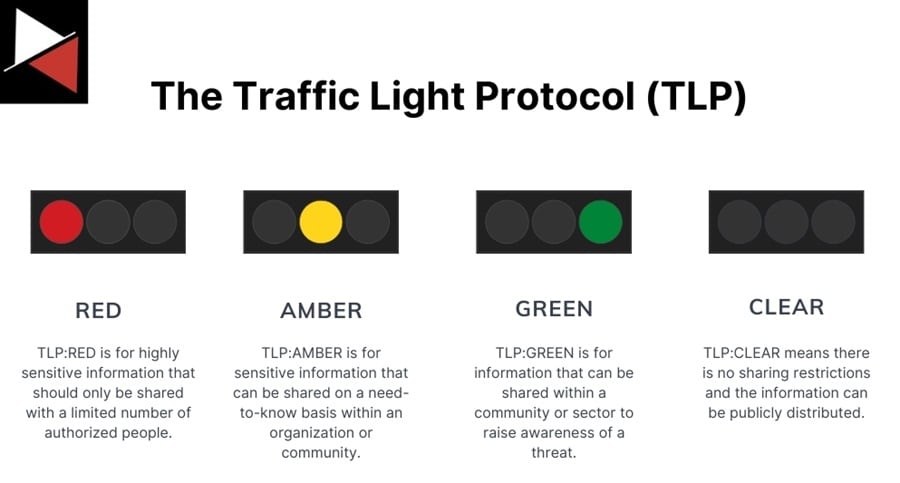
The Traffic Light Protocol uses four categories to classify information. These categories enable organizations to strike a balance between the need for collaboration in cyberspace and the protection of sensitive data. They include red, amber, green, and clear.
TLP Red
This is the strictest TLP classification. It protects sensitive information that can only be shared with a limited number of authorized personnel. Sharing this information can pose significant risks to the organization’s privacy, reputation, and operations.
For example, if a meeting is classified as TLP Red, all discussions held during that meeting should not be shared with any outside party. Additionally, any information shared between those present at the meeting should be communicated verbally or in person to minimize the risk of data leaks.
TLP Amber
Information marked with TLP Amber should be shared only on a need-to-know basis within an organization or with trusted partners. Sharing this information may carry privacy, reputation, or operational risks, but doing so may prevent potential harm.
A subclassification of TLP Amber is TLP Amber+Strict. This TLP classification means the information is restricted to the organization and not shared with its clients or trusted partners.
TLP Green
When information can be shared within a cyber security community, it is marked as TLP Green. This information is shared to raise awareness of emerging cyber threats that are not available via publicly accessible channels, such as news websites or research blogs.
Unless otherwise specified, TLP Green information should not be shared outside the cyber security community or your sharing group. You will typically find this information on commercial threat intelligence platforms or within sharing groups (e.g., ISACS, ISAOS, CERTs, etc.)
TLP Clear
TLP Clear information can be shared without restriction. It carries minimal or no foreseeable risk of misuse and can be released publicly in accordance with copyright or other applicable rules.
You may occasionally see TLP White on old documents. This category was used in an older version of the framework (TLP v1.0). Since 2022, TLP v2.0 has replaced it completely with TLP Clear.
Now that you know the basics of TLP, let’s look at why you would want to use it.
Benefits of the Traffic Light Protocol
The Traffic Light Protocol has helped improve the cyber security industry by providing a standardized system for classifying and handling sensitive information. It guides users through classifying, handling, and sharing data with others, all with an intuitive color-coding scheme.
This reduces the risk of accidentally disclosing sensitive information and promotes sharing crucial threat intelligence with the community to address security vulnerabilities and tackle threat actors collaboratively. It helps streamline communication, enhance situational awareness, and improve incident response by facilitating the sharing of threat intelligence and enhancing information exchange initiatives.
Here are the key benefits of adopting the Traffic Light Protocol for you and your organization.
- Compliance with data regulation: All organizations are subject to compliance regulations if they handle sensitive data (e.g., GDPR). TLP makes it easier to comply with these regulations by marking the sensitivity of data and ensuring employees know how to handle it appropriately.
- Fosters collaboration: TLP helps foster community collaboration and information sharing by providing clear guidelines for handling and sharing sensitive information. This allows multiple organizations to work together on a security project or respond to an incident.
- Enhances organizational reputation: The adoption of TLP shows that an organization takes protecting data seriously and is committed to ensuring it is handled appropriately. This enhances the organization’s reputation and builds trust with key stakeholders.
- Improve security: TLP allows organizations to safely share information about the latest cyber threats, detection techniques, and industry trends with the community. This controlled flow of intelligence empowers organizations to bolster their defenses while reducing the risk of disclosing sensitive information.
- Easy to adopt: TLP can be used on documents, emails, presentations, and within automated sharing exchanges like MISP. It is also optimized to be easy to use and human-readable, making it straightforward to implement in most organizations.
- Streamlines communication: TLP’s focus on person-to-person intelligence sharing, whether threat intelligence reports or emails, facilitates frequent and effective collaboration. Licensing terms, handling and encryption rules, or other overbearing restrictions do not hamstring it.
With these benefits in mind, let’s examine the application of the TLP in real-world scenarios.
How to Use the Traffic Light Protocol
The Traffic Light Protocol is adaptable to various real-world scenarios, including email and messaging, document distribution, and sharing via automated information exchange platforms such as MISP or OpenCTI. Here are some popular sharing methods and how to use the TLP protocol with them.
How to use TLP in Email
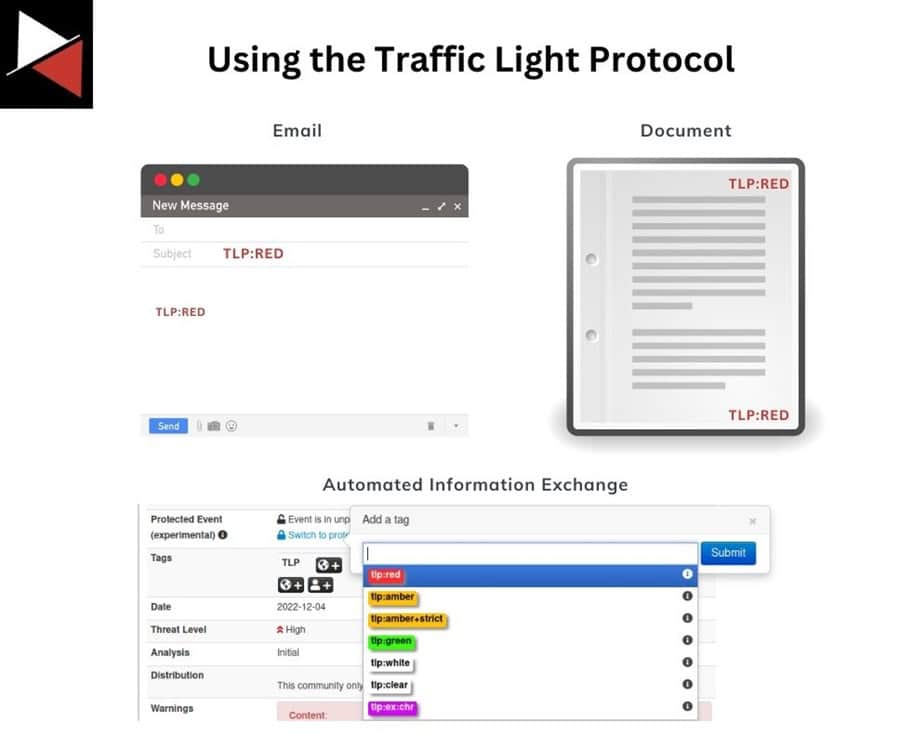
When exchanging emails that contain TLP-tagged information, you should indicate the TLP color in the Subject line and the email body before the designated information. This allows the recipient to see the TLP classification clearly and decide if they are the intended audience. If they are not, they should report the incident immediately.
To add the TLP classification, enter TLP: followed by the appropriate color and ensure you use capital letters (e.g., TLP:RED, TLP:AMBER, TLP:GREEN, or TLP:CLEAR). Maintain consistency for automated data protection tools and cohesive reporting.
How to use TLP in Documents
Documents that include a TLP classification should indicate the TLP color of the information in the header and footer of each page. It is advisable to right-justify TLP classifications to avoid confusion with existing control marking schemes.
To ensure the TLP classification is legible, the TLP color should appear in capital letters and use a 12-point font type or greater. Again, capital letters are a requirement of the classification.
How to use TLP in automated information exchange
TLP usage in automated information exchanges is not defined in the standard framework and is left to the designers of such exchanges.
It is common for automated information exchanges to provide tags that users can add to their threat intelligence to provide additional context. This allows users to tag information using TLP classifications and utilize sharing rules to ensure that sensitive information is only shared with the intended audience.
Traffic Light Protocol Best Practices
Determining the appropriate TLP classification for a specific piece of information can be challenging when applying the framework in the real world. Here are some best practices to help you get started.
- If a recipient needs to share the information more widely than indicated by the original TLP classification, they must obtain explicit permission from the original source.
- The source of the TLP-labeled information is responsible for ensuring recipients understand and can follow TLP classification sharing guidance.
- The source of the TLP-labeled information can specify additional sharing restrictions that recipients must adhere to, such as encryption requirements or licensing agreements.
- TLP classifications and their definitions are not intended to affect freedom of information or have legal ramifications.
- The TLP protocol is optimized for person-to-person sharing and is most effective in these situations, such as sharing documents, reports, presentations, messages, videos, and in-person meetings.
- Ensure that clear documentation on the framework is easily accessible to all employees, and that training is provided before implementing the TLP protocol within your organization.
So, how can you get started implementing TLP today?
Implementing the Traffic Light Protocol
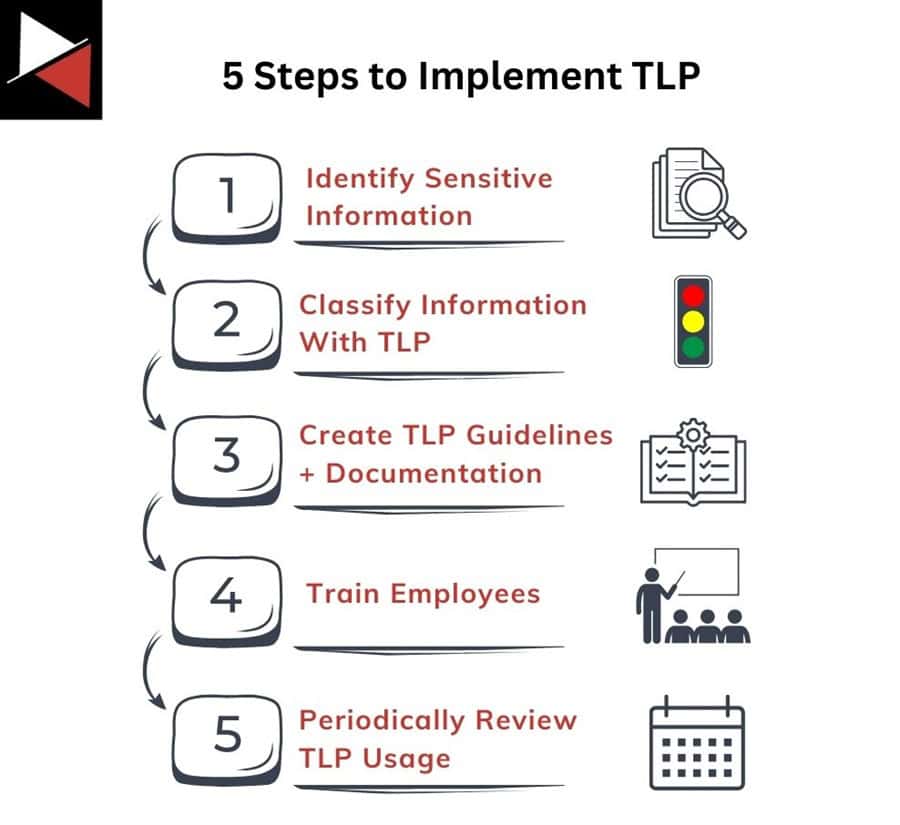
To implement TLP in your organization, you can follow these five simple steps:
- Identify sensitive information that requires protection: First, determine what information is sensitive to your organization and needs protection. This could include information about customers, operations, security vulnerabilities, or proprietary technologies. Techniques like crown jewel analysis (CJA) can help at this step.
- Use TLP to classify this information. Next, classify this information using the TLP classifications so that employees know how to handle it and what can be shared. It can be helpful to add automation to expedite this process and ensure that all new documents include a TLP classification.
- Create guidelines, training, and documentation on TLP: Once all sensitive information has been classified, you can develop policies and procedures for handling TLP-labeled information. This is an important step because it establishes how your organization will use TLP classifications, ultimately dictating the success of implementing the framework.
- Train employees and key stakeholders: With your guidelines in place, you can proceed with training your employees and key stakeholders on how to use the TLP protocol to handle sensitive information. This includes training employees on how to classify information with TLP, identify and report potential breaches of TLP guidelines, and procedures for sharing TLP-labelled information with others.
- Schedule periodic reviews to ensure TLP is being used appropriately. Periodically review how employees are using TLP, how documents are being labeled, and what information is being shared with the wider community. This will ensure that your TLP guidelines are understood and followed appropriately. You may find that guidelines need to be revised or that employees require additional training.
These five simple steps will help your organization get started with using the TLP protocol. Your success will largely depend on how you implement TLP and strike a balance between the need for information sharing, data protection, and minimizing overhead.
Conclusion
The Traffic Light Protocol (TLP) is a fundamental classification system used throughout cyber security, particularly in cyber threat intelligence, to classify the sensitivity of information and guide handling.
It uses four colors to assign a sensitivity label to information. These labels dictate how it should be handled, shared, and protected. Using this system, organizations can more efficiently share information without worrying about inadvertently leaking sensitive data that could be used against them.
This guide has taught you everything you need to get started using the TLP protocol, from best practices to practical examples. It is now time for you to get your hands dirty and implement it at your organization using the five-step process demonstrated. Good luck!




Frequently Asked Questions
What Are the Four Traffic Light Protocol (TLP) Colors?
The Traffic Light Protocol (TLP) comprises four color-coded classifications that categorize information based on its sensitivity and the appropriate handling required. The four classifications include:
- TLP Red: The strictest classification for the most sensitive information. This information should be shared with only a limited number of authorized individuals due to potential risks.
- TLP Amber: This is assigned to the information that must be shared on a need-to-know basis within an organization and with its trusted partners/clients to prevent potential harm. It has a subclassification called TLP Amber+Strict, which is information intended only for internal use within an organization and not shared with its clients.
- TLP Green: This information can be shared within a cyber security community to raise awareness about emerging threats that are not available through public channels, such as news sites or threat research blogs. It should not be shared outside of the community.
- TLP Clear: This is for information that can be shared freely without restrictions. It carries minimal risk of misuse and can be shared freely in accordance with copyright laws.
Who Uses the Traffic Light Protocol?
The cyber security industry has widely adopted the Traffic Light Protocol (TLP) to facilitate information sharing among organizations. It is used by numerous information-sharing communities (e.g., ISACS, ISAOS, CERTs, etc.), businesses, standard bodies, and government agencies.
Why Should I Use the Traffic Light Protocol?
The Traffic Light Protocol (TLP) offers many benefits regarding classifying and handling sensitive information. The main ones include:
- Compliance with data regulation: TLP makes it easier to comply with these data regulations and ensures employees know how to handle sensitive data appropriately.
- Fosters collaboration: TLP helps foster community collaboration and information sharing by providing clear information-sharing guidelines for sensitive information.
- Enhances organizational reputation: The adoption of TLP shows that an organization takes data protection seriously and is committed to handling sensitive data appropriately.
- Improve security: TLP allows organizations to safely share sensitive information about the latest cyber threats, detection techniques, and industry trends with the community to bolster everyone’s defenses.
- Easy to adopt: TLP can be used across various information-sharing mediums (documents, emails, etc.) and is optimized to be easy to use and human-readable.
- Streamlines communication: TLP’s focus on person-to-person intelligence sharing facilitates frequent and effective collaboration.
What Does TLP Red Mean?
TLP Red is the strictest TLP classification used to protect the most sensitive information. Information marked TLP:Red can only be shared with a limited number of authorized personnel, as sharing it can result in significant risk to an organization’s privacy, reputation, or operations. In contrast, TLP Clear is the least restrictive. This TLP classification means you can share the intelligence with anyone.
What does TLP White Mean?
TLP White was an old TLP classification used in TLP v1.0, replaced by TLP Clear in TLP v2.0. Information labeled TLP:Clear can be freely shared as it carries minimal or no foreseeable risk of misuse. However, if you release it publicly, ensure that you comply with copyright and other applicable laws.
What is TLP?
The Traffic Light Protocol, or TLP, is a system used to classify and manage the sharing of sensitive information. It uses four colors to indicate the extent to which a piece of information can be disseminated, ensuring that it reaches the intended audience in a controlled and trusted manner. This protocol is widely used by cyber security professionals, government agencies, and private sector organizations worldwide to facilitate secure collaboration.