

You’re analyzing an APT campaign that moved laterally across three network segments, pivoted through compromised jump servers, and exfiltrated data over DNS tunneling. You try mapping it to the traditional Cyber Kill Chain. It doesn’t fit. The attack looped back, skipped phases, and felt less like a chain and more like a chaotic dance.
Sound familiar?
The 2011 Cyber Kill Chain was groundbreaking for its time, but today’s adversaries operate in ways its creators never envisioned. Insider threats, supply chain compromises, cloud-native attacks… these don’t fit the old perimeter-focused model.
This is where the Unified Kill Chain comes in. This guide will teach you what it is, why it was created, and how it addresses the critical gaps left by its predecessor. You’ll learn how it relates to other frameworks and, most importantly, when to use it in your day-to-day CTI work.
Let’s jump in!
The Original Champion: The Cyber Kill Chain
The Lockheed Martin Cyber Kill Chain, published in 2011, was revolutionary. Its seven-phase model (Reconnaissance, Weaponization, Delivery, Exploitation, Installation, Command and Control, Actions on Objectives) provided defenders with a structured way to think of attacks as a process rather than isolated incidents.
This framework shaped an entire generation of security thinking.
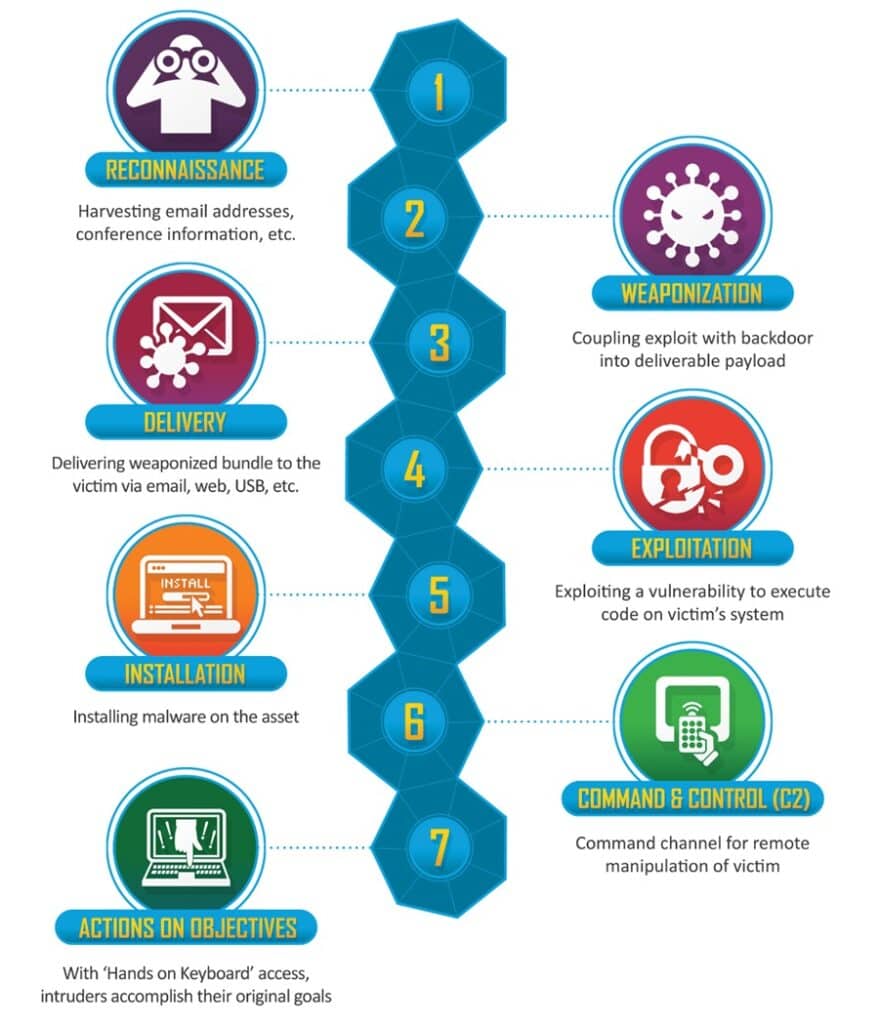
It introduced the idea that defense could be proactive. If you could detect reconnaissance activity or block weaponized payloads during delivery, you might prevent the breach entirely. Security teams built detection strategies around each phase. Threat intelligence reports organize findings according to kill chain stages. The model worked beautifully… for a while.
But as the threat landscape evolved, cracks began to show.
Criticism #1: The Perimeter and Malware Focus
The original Cyber Kill Chain was built for a specific threat model: external adversaries using malware to breach the network perimeter. Modern threats don’t follow these rules.
- In the 2020 SolarWinds supply chain attack, adversaries didn’t need to breach the perimeter because they were already inside, delivered through a trusted software update. The attack bypassed reconnaissance, weaponization, and delivery phases entirely.
- Look at insider threats, where the adversary is a legitimate user with valid credentials. There’s no “exploitation” phase because they don’t need to exploit anything. They already have access.
- Cloud-native attacks present another challenge. When infrastructure lives in AWS or Azure, what does “perimeter” even mean? In my analysis of cloud compromise incidents, adversaries routinely gain access through exposed management interfaces or misconfigured identity providers, completely bypassing traditional “weaponization” and “delivery” phases.
This focus on initial access left a massive blind spot: what happens after the breach?
The seventh and final phase, “Actions on Objectives,” is essentially a black box. It doesn’t describe the weeks or months of internal reconnaissance, lateral movement, and privilege escalation that define modern intrusions.
APT groups don’t breach the perimeter and immediately accomplish their goals. They establish persistence, map the network, escalate privileges, move laterally, and carefully position themselves before striking. However, the Cyber Kill Chain treats this entire post-compromise phase as a single step.
Criticism #2: The Deterministic Sequence Assumption
The Cyber Kill Chain assumes attacks follow a linear, deterministic sequence. Break one link, stop the attack.
But real attackers don’t follow scripts. They adapt, loop back through phases, and run parallel operations. An adversary might establish initial access, then loop back to reconnaissance to map the internal network. They might skip weaponization entirely using living-off-the-land techniques.
The 2017 NotPetya attack illustrates this perfectly. The malware spread through multiple vectors simultaneously: a compromised software update (supply chain), exploitation of the EternalBlue vulnerability (technical), and credential harvesting for lateral movement (post-compromise). It didn’t follow a neat sequence. It was a cascade of overlapping phases happening in parallel.
Modern ransomware operations are equally chaotic.
- Initial access brokers sell credentials to ransomware operators, completely bypassing the first six phases of the kill chain.
- The operators then conduct extensive internal reconnaissance, lateral movement, and data exfiltration before deploying ransomware.
- The actual ransomware deployment is phase 17 or 18 of an attack, not phase 7.
The rigid, sequential assumption doesn’t match reality. Attackers iterate. They experiment. They fail and try again. A kill chain model needs to account for this flexibility.
These two criticisms, the perimeter focus and the linear sequence assumption, aren’t minor quibbles. They represent fundamental gaps that limit the Cyber Kill Chain’s utility for analyzing modern threats. The model needed evolution, not just refinement.
Enter the Unified Kill Chain: A Meta-Model for Modern Threats
In 2017, Paul Pols published “The Unified Kill Chain,” introducing a fundamental reimagining of how we model cyber attacks. Pols created a meta-framework that synthesizes concepts from the Cyber Kill Chain, MITRE ATT&CK, and others into a comprehensive, flexible structure that accounts for modern attack complexity.

The UKC’s innovation lies in its explicit recognition that attacks aren’t linear processes but iterative campaigns where adversaries adapt based on what they discover. This philosophical shift from deterministic chains to flexible lifecycles better reflects how sophisticated threat actors actually operate.
By organizing 18 distinct phases into three strategic cycles, the framework provides granularity where it matters most, especially in post-compromise activities that consume the majority of an APT’s operational time.
The Three Cycles: In, Through, and Out
The Unified Kill Chain organizes eighteen distinct phases into three cycles representing adversary strategic progression.
The In Cycle (Phases 1-8): Gaining Access and Establishing a Foothold

- Reconnaissance – Gathering information about the target
- Weaponization – Preparing attack tools and payloads
- Social Engineering – Manipulating human targets (an explicit phase the original model lacks)
- Delivery – Transmitting the weaponized payload
- Exploitation – Triggering vulnerabilities to gain execution
- Persistence – Maintaining access across reboots and credential changes
- Defense Evasion – Avoiding detection by security controls
- Command & Control – Establishing communication channels
The Through Cycle (Phases 9-14): Internal Propagation and Positioning

This is where the UKC truly shines by explicitly modeling post-compromise activities:
- Pivoting – Using compromised systems as a launching point
- Discovery – Mapping the internal network, identifying assets
- Privilege Escalation – Obtaining higher-level access rights
- Execution – Running malicious code on additional systems
- Credential Access – Harvesting passwords and authentication materials
- Lateral Movement – Spreading across the network to reach targets
These six phases represent where sophisticated adversaries spend most of their time. In APT incidents, adversaries typically cycle through Discovery → Credential Access → Lateral Movement → Discovery repeatedly, gradually mapping and conquering the internal network.
This is also where most organizations have their weakest detection coverage. While perimeter defenses (In cycle) receive significant investment, internal network monitoring often lags. Understanding these phases helps prioritize defensive investments where they matter most.
The Out Cycle (Phases 15-18): Achieving Strategic Objectives
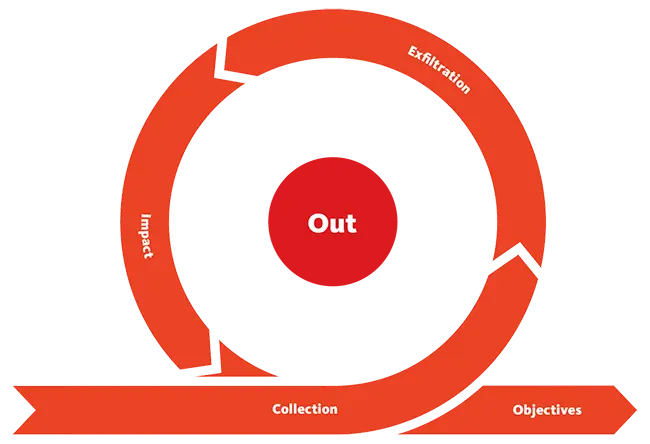
- Collection – Gathering target data from compromised systems
- Exfiltration – Moving collected data out of the environment
- Impact – Disrupting operations, destroying data, or deploying ransomware
- Objectives – Achieving the overarching strategic goal
Not all adversaries execute all phases. Espionage-focused APTs emphasize Collection and Exfiltration while skipping Impact. Ransomware operators prioritize Impact. The UKC provides a comprehensive menu of possibilities rather than a mandatory sequence.
Understanding which Out cycle phases matter most to your threat actors helps focus your data loss prevention and business continuity planning efforts.
How the UKC Addresses the Cyber Kill Chain’s Limitations
Solving the Perimeter Problem
The Unified Kill Chain explicitly accounts for attacks that bypass traditional perimeters. It separates Social Engineering (Phase 4) from Exploitation (Phase 5), recognizing that human-centric attacks require different defenses than technical exploits. It includes phases such as Credential Access (Phase 13) and Lateral Movement (Phase 14), which describe insider threat activity.
Most importantly, it organizes its eighteen phases into three distinct cycles: In, Through, and Out.
The In cycle (Phases 1-8) covers initial access and foothold establishment. This is roughly equivalent to the original Cyber Kill Chain’s scope. The Through cycle (Phases 9-14) describes internal network propagation, the post-compromise activity that the original model largely ignored. The Out cycle (Phases 15-18) details the adversary’s end goals: data exfiltration, system impact, or achieving strategic objectives.
This three-cycle structure forces defenders to think beyond the perimeter. Half of the UKC’s phases focus on what happens after the initial breach. This aligns perfectly with modern security paradigms like Assume Breach and Defense in Depth, where you accept that adversaries will get in and focus on limiting their movement and impact.
Solving the Linear Sequence Problem
The UKC doesn’t assume a deterministic sequence. Its eighteen phases can occur in any order, loop back, or run in parallel. An adversary might execute Discovery (Phase 10) multiple times as they explore different network segments. They might establish various Command and Control channels (Phase 8) as backups. They could conduct Collection (Phase 15) and Exfiltration (Phase 16) continuously throughout a campaign rather than as a single final action.
The model explicitly identifies Pivoting (Phase 9) as a distinct, critical phase. This is the act of tunneling traffic through a compromised system to reach other systems not directly accessible. It’s a chokepoint that adversaries must cross to move between network segments. For defenders, these pivot points are high-value detection opportunities because they’re forced by good network segmentation and highly observable.
The UKC also deconstructs the vague “Actions on Objectives” into three specific phases: Collection (Phase 15), Exfiltration (Phase 16), and Impact (Phase 17). These map directly to the CIA triad of information security. Collection and Exfiltration breach confidentiality. Impact breaches integrity (data manipulation) or availability (ransomware encryption, system wiping). This allows defenders to tailor their controls to the specific threat they’re facing.
Finally, the UKC includes Objectives (Phase 18) as the strategic “why” behind the attack.
This forces analysts to think like intelligence professionals, not just technical defenders. If the adversary’s objective is espionage, you know they’ll target databases and file shares. If it’s sabotage, they’ll target industrial control systems or critical infrastructure. Understanding the objective helps you predict the attack path and prioritize defenses.
The UKC doesn’t just patch the holes in the Cyber Kill Chain. It reframes how we think about attacks as iterative, nonlinear processes that span the entire environment, from the perimeter to the crown jewels.
What the UKC Is NOT
- The UKC is not a replacement for MITRE ATT&CK. ATT&CK provides specific techniques with detection guidance. The UKC offers a strategic structure. You need both.
- The UKC is not a detection framework. It doesn’t tell you what logs to collect or SIEM rules to write. It tells you what adversary objectives to plan defenses around.
- The UKC is not universally applicable. For simple commodity malware, the original Cyber Kill Chain often provides sufficient structure.
How the UKC Relates to Other Frameworks
At this point, you might be thinking: “Wait, don’t we already have MITRE ATT&CK for this?”
Yes. That’s precisely the point!
The Unified Kill Chain isn’t trying to replace MITRE ATT&CK or the Diamond Model. It’s the strategic overlay that brings them together. Understanding how these frameworks relate to each other is crucial for using them effectively.
MITRE ATT&CK: The Tactical Library
MITRE ATT&CK is a comprehensive knowledge base of adversary tactics and techniques based on real-world observations. It currently includes hundreds of techniques organized into fourteen tactical categories. It’s incredibly detailed, constantly updated, and has become the lingua franca of threat intelligence.
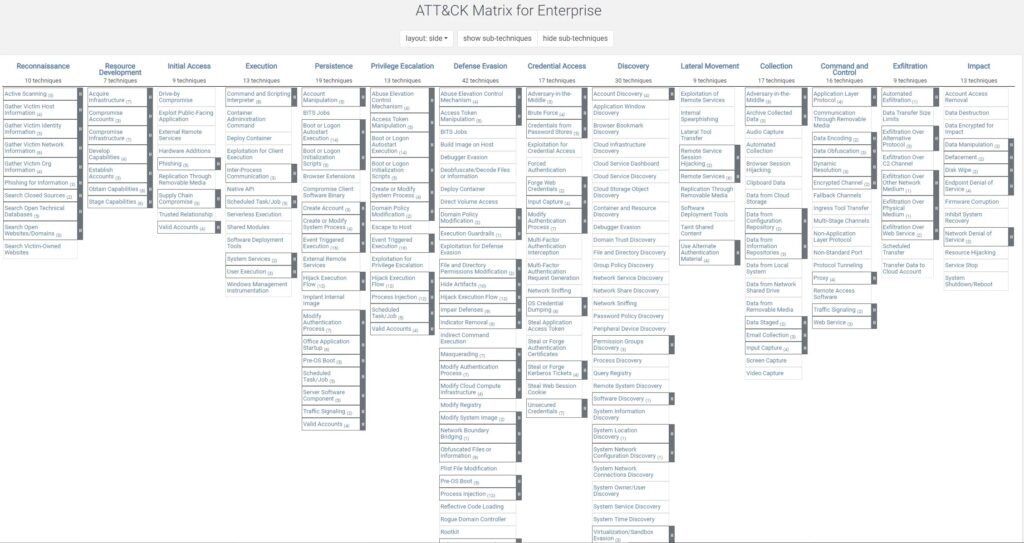
But ATT&CK is time-agnostic. It’s a taxonomy, not a timeline. It tells you what adversaries can do, not when or in what order they’ll do it. If you’re analyzing a campaign and you identify techniques T1566 (Phishing), T1059 (Command and Scripting Interpreter), T1003 (OS Credential Dumping), and T1021 (Remote Services), ATT&CK doesn’t tell you the sequence or how they connect.
This is where the Unified Kill Chain provides value. It gives you the sequential narrative that ATT&CK lacks. You can map those ATT&CK techniques to specific UKC phases to understand the attack’s progression, seamlessly integrating into your broader threat intelligence lifecycle. T1566 maps to Initial Access (the In cycle). T1059 and T1003 map to Execution and Credential Access (the Through cycle). T1021 maps to Lateral Movement (also Through cycle).
The UKC provides the story arc. ATT&CK provides the detailed technical choreography.
In practical terms, you’d use the UKC to structure your threat intelligence report: “The adversary followed a typical APT kill chain: Initial Access via spear-phishing, establishing Command and Control, conducting Discovery and Credential Access, Lateral Movement to high-value targets, and finally Collection and Exfiltration.”
Then you’d use ATT&CK to specify exactly how: “They used technique T1566.001 (Spearphishing Attachment), established C2 via T1071.001 (Web Protocols), dumped credentials using T1003.001 (LSASS Memory), and moved laterally via T1021.001 (Remote Desktop Protocol).”
The Diamond Model: The Attribution Framework
The Diamond Model, developed by Sergio Caltagirone and others, analyzes intrusions as atomic events with four core features: Adversary, Infrastructure, Capability, and Victim. It’s designed for attribution and relationship mapping, helping analysts understand who’s attacking whom, with what tools, and through what infrastructure.

The Diamond Model excels at analyzing atomic events. Each phase of the Unified Kill Chain can be studied as a Diamond event.
The Delivery phase (UKC Phase 3) becomes a Diamond: the Adversary (APT28) used a Capability (weaponized PDF) delivered through Infrastructure (a compromised legitimate website) to a Victim (the target organization). The Lateral Movement phase (UKC Phase 14) becomes another Diamond: the Adversary used a Capability (PsExec with stolen credentials) through Infrastructure (the internal network) against a Victim (a domain controller).
By treating each UKC phase as a Diamond event, you build a rich dataset for attribution analysis. You can identify patterns in infrastructure reuse, capability development, or targeting that link campaigns to specific threat actors.
The relationship between these frameworks isn’t competitive. It’s complementary, and understanding this is crucial for building an effective CTI team:
- Unified Kill Chain provides the sequential process and strategic structure. It is your strategic roadmap.
- MITRE ATT&CK provides the tactical techniques and defensive mitigations. It is your tactical playbook.
- The Diamond Model provides the attribution focus and relationship analysis. It is your intelligence analysis tool.
You don’t choose one. You use all three for different aspects of your analysis.
Think of it this way: if you’re writing a threat intelligence report about an APT campaign, you’d structure it using the UKC’s phases, populate each phase with specific ATT&CK techniques, and use the Diamond Model to draw attribution conclusions based on infrastructure and capability overlaps with known adversaries.
Key Takeaways for CTI Analysts
As you begin implementing the Unified Kill Chain, keep these principles in mind:
Think strategically, act tactically. Use the UKC to understand the big picture of an attack campaign, then drill down to ATT&CK techniques for specific detection and response actions. The frameworks complement each other. The UKC provides the narrative structure while ATT&CK provides the technical playbook.
Focus on the Through cycle. Most organizations have reasonable coverage of the In cycle through perimeter defenses, but struggle with visibility into internal lateral movement, privilege escalation, and credential theft. These Through cycle phases deserve special attention in your defensive planning.
Measure what matters. Track your detection coverage across UKC phases as a key performance indicator. A coverage percentage (detected phases / active phases × 100) provides an objective metric for improvement over time and helps justify security investments to leadership.
Tailor to your threats. Not all 18 phases matter equally for every organization. Understand which threat actors target your industry and sector, identify their preferred phases and techniques, and prioritize defenses accordingly. A ransomware-focused threat model requires a different emphasis than an espionage-focused one.
Document and share. Create a standardized UKC mapping template for your team. Consistent documentation helps build organizational knowledge and makes threat intelligence more actionable. Share your UKC-based analysis with peer organizations through ISACs and information-sharing communities.




Frequently Asked Questions
What Is the Unified Kill Chain?
Developed by Paul Pols in 2017, the eighteen-phase Unified Kill Chain (UKC) is a comprehensive attack model for analyzing modern cyber attacks from reconnaissance to final strategic objectives.
It expands upon the original seven-phase Cyber Kill Chain by explicitly modeling post-compromise activity, accommodating non-linear attack progression, and accounting for modern threat vectors such as insider threats, supply chain compromises, and cloud-native attacks. The UKC organizes phases into three cycles (In, Through, Out) representing the adversary’s progression from initial access through internal propagation to objective completion.
How Is the Unified Kill Chain Different From the Cyber Kill Chain?
The Unified Kill Chain (UKC) overcomes two major flaws in the original Cyber Kill Chain.
- It adapts to modern attacks by explicitly including Social Engineering and acknowledging non-technical initial access, moving beyond the sole focus on perimeter and malware.
- It drops the rigid linearity, recognizing that adversaries loop, iterate, and run parallel operations. The UKC’s eighteen phases offer far greater detail on post-compromise activity (the Through cycle). The original model’s single “Actions on Objectives” phase is replaced by ten UKC phases that describe internal reconnaissance, lateral movement, privilege escalation, and objective achievement.
Should I Use the Unified Kill Chain or MITRE ATT&CK?
Use both the Unified Kill Chain (UKC) and MITRE ATT&CK; they are complementary. The UKC offers the strategic, sequential narrative of an attack’s progression. ATT&CK provides the tactical library of specific adversary techniques for each stage.
View the UKC as the strategic map and ATT&CK as the detailed guidebook. In analysis, use the UKC phases as structure, then populate each phase with specific ATT&CK techniques and detection recommendations to gain both the “what happens when” story and the “specifically how they do it” detail.
What Are the Three Cycles of the Unified Kill Chain?
The UKC organizes its eighteen phases into three cycles that represent the adversary’s strategic progression.
- The In cycle (Phases 1-8) covers initial access and foothold establishment: reconnaissance, weaponization, social engineering, delivery, exploitation, persistence, defense evasion, and command and control.
- The Through cycle (Phases 9-14) describes internal network propagation: pivoting, discovery, privilege escalation, execution, credential access, and lateral movement.
- The Out cycle (Phases 15-18) details the adversary’s end goals: collection, exfiltration, impact, and the achievement of strategic objectives.
When Should I Use the Unified Kill Chain?
Use the UKC for strategic analysis of sophisticated, multi-stage attacks, APT campaigns, threat profiles, red team planning, gap analysis, and comprehensive threat reports. It’s especially useful for post-compromise phases or explaining complex campaigns to mixed audiences.
For quick incident triage or simple malware detection, MITRE ATT&CK or the original Cyber Kill Chain is often a better choice. The UKC is most valuable against advanced adversaries operating over weeks or months.
What’s the Biggest Mistake People Make When Implementing the UKC?
Treat the UKC as a descriptive guide, not a strict checklist. It highlights possible phases, not required ones. Focus investments on phases relevant to your threats, assets, and risk tolerance. For ransomware, prioritize lateral movement and credential access detection; for espionage, emphasize collection and exfiltration detection. Aim for deep coverage on crucial phases rather than perfect coverage across all eighteen.