
Imagine this: It’s 9 AM on a Tuesday. You’re a CTI analyst, you’ve just had your first coffee, and you spot a weird phishing email. It’s clever—perfect branding, no spelling mistakes, and a payload you’ve never seen. Your tools catch it, you block the sender, clean the machine, and file a detailed internal report. Job done. You lean back, feeling pretty good about saving the day.
But by 9:05 AM, the same attack, from a different IP, hits another company in your sector. By 10:30 AM, analysts at a dozen other organizations are scrambling to deal with the same new payload. By lunchtime, it’s a full-blown, sector-wide problem, with security news sites starting to pick up the chatter. All while your brilliant, detailed report sits idle and unseen on an internal server. The critical value of that intelligence is decaying by the minute.
This is the daily reality of cyber defense, and it highlights a critical problem: intelligence kept in a silo has a very short shelf life. The solution? CTI sharing communities.
If you’re tired of playing a lonely game of whack-a-mole and ready to level up your defenses, you’re in the right place. This guide will explain why CTI sharing is a genuine force multiplier, explore the four main types of CTI sharing communities you can join, and provide a clear roadmap to get started. Let’s jump in!
What is CTI & Why Share it?
Let’s do a quick refresher. Cyber Threat Intelligence (CTI) isn’t just raw data. It’s not just a list of bad IPs or suspicious file hashes. It is analyzed information—data enriched with context to answer specific questions about the motives, targets, and behaviors of threat actors.
It’s the difference between saying “Here’s an IP” and “This IP is a new C2 server for an APT group we track, and they are using it in a campaign targeting our finance department with lures disguised as auditor requests.” That context is what turns data into intelligence.
But that intelligence becomes 10x more powerful when it’s shared. Why?
#1 No One Has the Full Picture
Remember the parable of the blind men and the elephant? It’s the perfect analogy for CTI.
Your org sees the tusk (a file hash from one email). Another org sees the leg (a C2 server, their firewall blocked). A government agency sees the tail (the threat group’s staging infrastructure). This is because every organization has different network visibility, different toolsets, and different logging.
Separately, they’re just interesting data points. Shared and pieced together, they reveal the entire elephant—the full scope of the campaign.
#2 It Shifts You to Proactive Defense
Sharing TTPs (Tactics, Techniques, and Procedures) and indicators allows your peers to actively hunt for those threats in their own networks before the “boom.” When a trusted peer shares intel, you can immediately use it to proactively deploy new detection rules, update your blocklists, and brief your SOC team on the exact TTPs to watch for.
It’s the essence of threat hunting, and it’s nearly impossible to do effectively without community-sourced intel.
#3 It’s Often a Requirement
In critical sectors like finance, healthcare, and energy, regulators often mandate participation in CTI sharing communities. This isn’t just red tape; it’s about managing systemic risk. An attack that cripples one bank can shake public confidence in the entire financial system. Regulators know that shared defense is essential to ensure the stability of the whole industry.
Attackers collaborate. They don’t have silos. They have private forums, underground marketplaces, and encrypted Telegram channels where they share tools, infrastructure, and techniques. CTI sharing is how we, the defenders, build our own collaborative defense to level the playing field.
The Four Types of CTI Sharing Communities
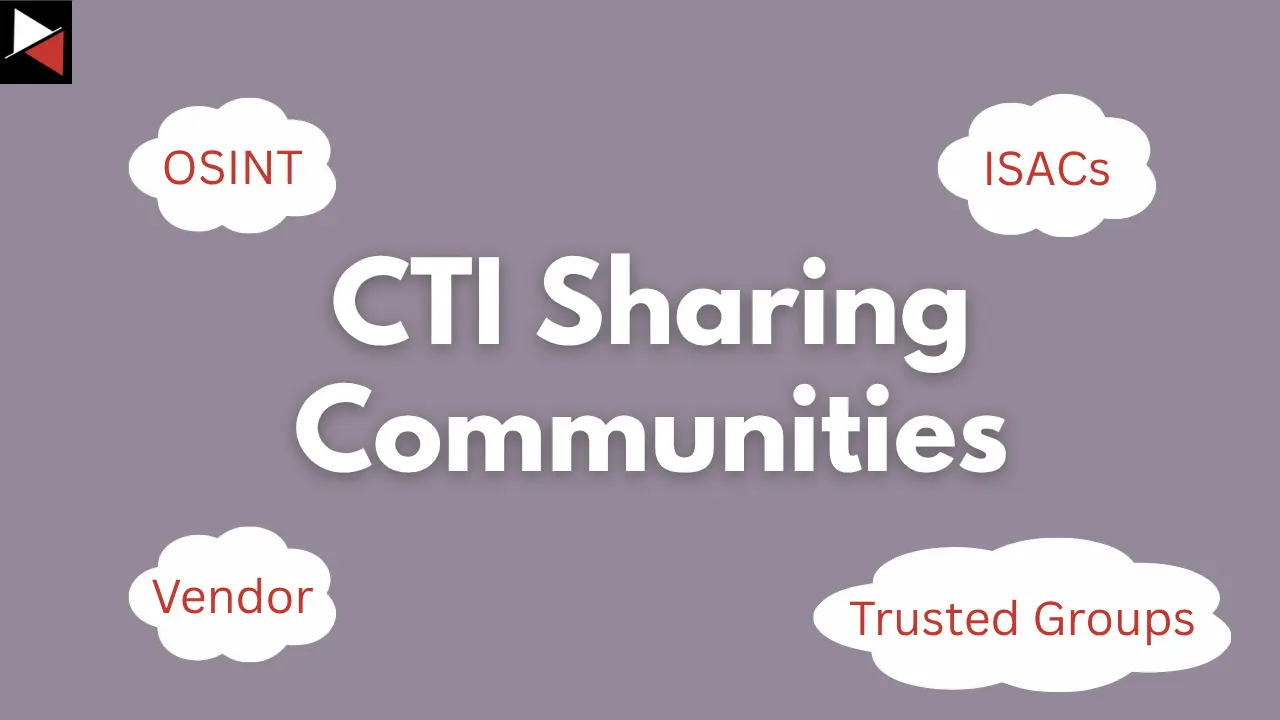
So, you’re sold on sharing. But where do you do it? CTI communities generally fall into four main categories, each with its own rules, benefits, and level of trust.
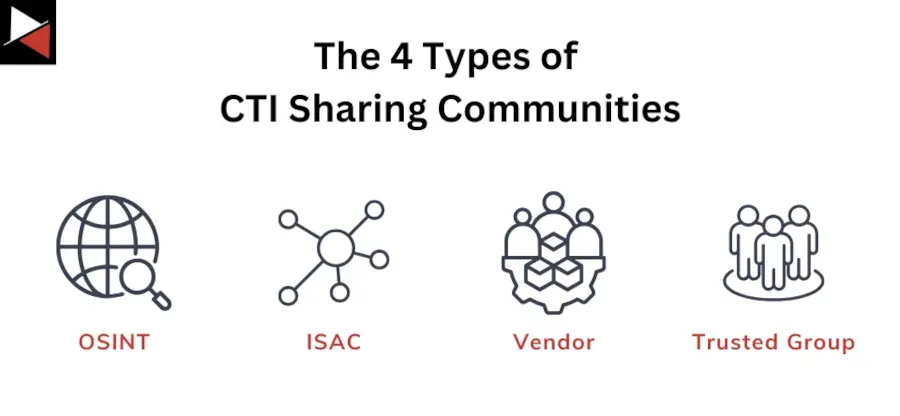
Think of these four types as existing on a spectrum, moving from the ‘wide-open and noisy’ public square to the ‘locked-down and high-signal’ private circle. Each one solves a different problem.
Open Source (OSINT) Communities
This is the public square, the place where everyone starts. It’s the massive, sprawling, and chaotic world of publicly available information. It’s the “Wild West” of threat intel, and it’s your job to be the sheriff and curate what is relevant to your business.
OSINT includes:
- Security News & Blogs: Sites like Bleeping Computer and Krebs on Security, which break news on major breaches and actor tactics.
- Government Alerts: Bulletins from agencies like CISA in the US or the NCSC in the UK. These are often your “official source of truth” for major, widespread vulnerabilities (like Log4j).
- Community Platforms: Free platforms like AlienVault OTX, where anyone can submit, browse, and consume threat data “pulses.”
- Social Media: Researchers sharing findings, YARA rules, and hot-takes in real-time on X (formerly Twitter), Mastodon, and LinkedIn. This is where you’ll often see the very first mention of a new attack.
- Public Repositories: GitHub repos packed with IOCs, malware samples, and analysis scripts. These are invaluable for building out your own analysis toolkit.
The key skill here is managing the fire hose of information, often by creating your own CTI aggregator.
| Pros | Cons |
|---|---|
| It’s free, instantly accessible, and covers a vast range of topics. It’s the perfect training ground for new analysts to learn how to track threat actors, pivot between data points, and understand the landscape. | It’s incredibly noisy. You’ll be drowning in low-confidence, unvetted, or flat-out wrong data. The real danger here isn’t just the noise; it’s the cost of being wrong. Chasing a bad OSINT indicator can send your SOC team on a 4-hour wild goose chase. Blocking a bad IP that’s actually a shared cloud provider (like an AWS or Azure IP) can take down a critical business service. The key skill isn’t just finding intel, it’s validating it and filtering out 99% of the noise to see the 1% of gold. |
Information Sharing and Analysis Centers (ISACs)
Now we’re getting more formal and exclusive. ISACs are non-profit, members-only organizations built to serve specific industry sectors (e.g., FS-ISAC for finance, H-ISAC for healthcare, E-ISAC for energy).
The superpower of an ISAC is its relevance. A bank doesn’t really care about a new TTP for industrial control systems, but they desperately need to know about a new banking trojan targeting their mobile app. Conversely, a hospital in the H-ISAC needs to be immediately notified of a new ransomware strain targeting a specific electronic health record (EHR) system. ISACs filter this by default.
They provide a high-trust environment, governed by strict rules like the Traffic Light Protocol (TLP) and binding NDAs. This means you can share sensitive data (like a TLP:AMBER indicator) with the confidence that it won’t end up on a public blog tomorrow.
Membership often provides more than just an email list; you get access to machine-readable (using standards like STIX/TAXII) feeds, curated threat reports, analyst-to-analyst roundtables, and a secure portal to ask sensitive questions of your peers.
| Pros | Cons |
|---|---|
| Highly relevant, actionable, and vetted intelligence from your direct peers who face the same threats you do. The trust factor is high, meaning people share more sensitive and useful context. | There’s usually a cost to join, which can be a hurdle for smaller organizations. The sector-specific focus can also create blind spots. An ISAC is great at vertical threats (sector-specific) but can sometimes be slower to respond to horizontal threats (such as a new, generic ransomware strain affecting all sectors). |
Vendor Communities
If you use a commercial security product from a major player (think CrowdStrike, Mandiant, Recorded Future, etc.), you likely have access to their vendor community. These companies cultivate massive intelligence ecosystems by pulling anonymized telemetry from millions of endpoints, sandboxes, and honeybots worldwide.
This massive telemetry stream gives them a “god-mode” view of emerging threats. They can perform large-scale data science and see the very first instance of a new malware family in the wild—the “patient zero” of the internet—long before any single organization or ISAC does.
Often, the gateway is a Threat Intelligence Platform (TIP) that acts as a hub for their professional research, curated threat feeds, and customer-shared findings.
| Pros | Cons |
|---|---|
| Highly structured, machine-readable data that’s often easy to integrate directly into your security tools via API. This is a massive win for automation, as that feed can plug directly into your SOAR platform or firewall, blocking new threats in seconds. Plus, it’s backed by world-class, professional research teams. | It requires you to be a customer (at a cost). The intelligence may also be biased toward threats that their specific products are great at detecting. This isn’t necessarily a bad thing—in fact, it’s a feature if you’re a customer (“this intel tells me exactly what my tool can stop”). But you must be aware of what you’re not seeing. Smart analysts augment vendor intel with OSINT and ISAC feeds to cover these gaps. |
Trusted & Private Groups
This is the most exclusive circle, the “fight club” of CTI. These are often small, informal, invitation-only groups of individual researchers and analysts who have built deep, personal trust over the years. They live on private Slack channels, Signal groups, or encrypted email lists.
Access is based entirely on reputation. This isn’t something you can buy; it’s something you earn by consistently sharing high-quality, contextualized intel in other communities. You have to prove you’re a “giver,” not just a “taker.” The intel shared here is often nascent. It’s not a polished report. It’s a hunch: “Hey, I’m seeing weird traffic to this unknown domain. Has anyone else seen this?” It’s collaborative analysis at its purest, happening in real-time.
Trust is everything. You get in by being a known quantity. You get kicked out (and blacklisted from future groups) by breaking that trust. Leaking info, sharing without permission, or even just lurking and never contributing (being a “vampire”) is the fastest way to lose your seat at the table.
| Pros | Cons |
|---|---|
| The most sensitive, timely, and high-context intelligence you can get. The “context” is often the person sharing it. You’re not just getting an IP; you’re getting it from “Analyst Jane at Org X,” whom you know is a world-class malware researcher. Her reputation provides context, giving you the confidence to act immediately. | Strictly invitation-only. You can’t just sign up; you have to earn your way in by building a personal, professional reputation over time. |
How to Join These Communities
Ready to get in on the action? It’s not just a checklist; it’s a journey from passive consumer to active contributor. This is your roadmap for building the reputation and relationships that unlock the best intelligence.
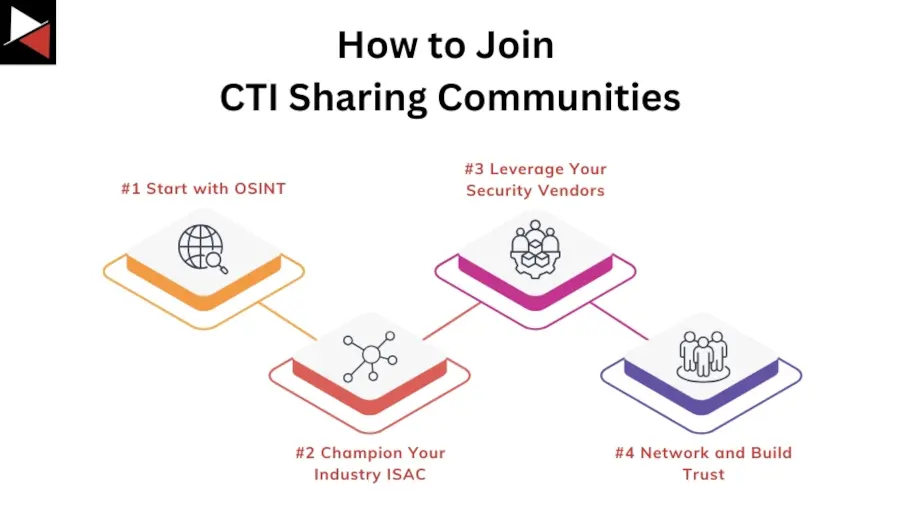
Step 1: Start with OSINT (And Give Back)
This is your foundation, your training ground, and your public resume all in one. Before you can be a valuable contributor, you must be a skilled consumer.
- Be an Active Consumer: This means more than just casual reading. Follow key researchers on social media, subscribe to blogs, and set up keyword alerts. Your goal is to build a mental baseline of “what’s normal” and “who’s credible.” This baseline lets you spot anomalies—the tiny, weird signals that hint at something new.
- Be a Public Producer: Don’t just lurk. Produce. Start a blog, even if it’s free. Start a GitHub repository. When you analyze a malware sample for fun, document it publicly. Don’t just write a one-liner; do a full write-up. What was the infection vector? What was the payload? What did the C2 traffic look like? Show your work, your methodology, and your conclusions.
- Why This Works: This public work is your currency. It’s your proof of skill. Publishing well-commented YARA rules or analysis scripts is how you prove your technical chops to people you’ve never met. It demonstrates you can communicate complex ideas clearly, which is the #1 skill in CTI. This portfolio is what gets your foot in the door for Step 2 and builds the reputation for Step 4.
Step 2: Champion Your Industry ISAC
Once you’re comfortable with OSINT, it’s time to get your organization involved at the industry level. If your company isn’t already a member, this is your chance to become a strategic internal champion.
- Build the Business Case: You can’t just ask your manager to spend money. You have to build a business case framed in the language they speak: risk and money. Research the ISAC for your sector. Find out the annual fee. Then, find a public report on the average cost of a data breach in your industry (it’s usually in the millions).
- Speak Their Language: Your pitch isn’t: “I want more cool intel feeds.” Your pitch is: “The ISAC membership costs $10,000. The average cost of a single breach in our sector is $4.5 million. This membership gives us direct, actionable intelligence from our top peers, like [Competitor X] and [Competitor Y], helping us prevent that breach. It’s a tiny investment for a massive risk reduction.”
- The ‘Benchmarking’ Advantage: Explain that an ISAC is also a benchmarking tool. “It helps us answer: Are we seeing the same attacks as our peers? Are our defenses catching them? If our peers are all reporting a phishing campaign that we’re completely blind to, that’s a critical gap we need to fix now.”
Step 3: Leverage Your Security Vendors
You are already paying your security vendors (for EDR, firewalls, TIPs, etc.) tens or hundreds of thousands of dollars. It’s time to get every single ounce of value from that investment.
- Go Beyond the Tool: Most organizations use 20% of their tools’ features. The other 80% is often in the community and intelligence offerings. Dig into their portal. Participate in their webinars, read their annual threat reports, and actively join their community forums.
- Engage the Experts: Those forums aren’t just for IT support tickets. They’re for intel sharing. Ask questions like, “Is anyone else seeing this strange registry key being set by the EDR?” or “What’s the best practice for blocking this new TTP?” This lets you engage directly with the vendor’s expert analysts.
- Get Your Money’s Worth: Ask your account manager for a quarterly threat briefing tailored to your company. Make them do the work for you. Ask them: “What are you seeing targeting our specific industry, and how does your product portfolio stop it?” This builds a personal connection and turns a generic vendor into a specific, valuable intelligence partner.
Step 4: Network and Build Trust (The Long Game)
This is the golden rule, the final boss, and the key that unlocks the most valuable, high-trust private groups (Type 4). Access here is built 100% on reputation, and reputation is built on a straightforward principle: “Give to Get.”
- Don’t Be a Vampire: The CTI community has a long memory for “intelligence vampires”—people (or organizations) who just log in, download all the shared IOCs, and never, ever contribute back. Don’t be that person.
- Context is King: The golden rule of giving is to provide context. A bad contribution is just a list of IPs or hashes. It’s just noise. A great contribution is a story.
- Bad: “Here’s an IP: 1.2.3.4”
- Good: “TLP
:AMBER. We just saw 1.2.3.4 acting as a C2 for a new Qakbot variant. Traffic is on port 443, masquerading as Google CDN traffic. The initial infection vector was an ISO file. Here’s our brief analysis and the YARA rule we wrote for it.”
- Be a Person, Not a Logo: The second contribution is actionable. It builds your reputation. The first one could damage it. Be active, be helpful, be credible. Finally, put a face to your name. Attend conferences (even virtual ones), join ‘birds of a feather’ sessions, participate in CTFs, and get involved. Trust is ultimately built between people, not corporate logos.
Looking for more places to start? This is just the beginning. For a wider list, check out this overview of threat intelligence sources.
Summary
CTI sharing isn’t just a “nice-to-have “; it’s a core, non-negotiable component of any mature security program. It’s the force multiplier that turns your single, siloed organization into a node in a global defense network. That 9 AM phishing email? In a connected world, that report could have been anonymized, tagged with TLP, and shared with your ISAC by 9:30 AM, protecting hundreds of your peers before their coffee even got cold.
The threats we face are collaborative, persistent, and organized. We, the defenders, need to be too.
Your journey starts with being a curious and active participant in the open-source world, strategically leveraging your employer’s resources (like ISACs and vendors), and, most importantly, building human relationships based on trust. Don’t be an intel island.
After all, the person you help today could be the one who warns you about tomorrow’s attack.




Frequently Asked Questions
What’s the Best CTI Sharing Community for a Beginner?
The Open Source (OSINT) community, without a doubt. It’s free, accessible to everyone, and serves as the foundation for all other intelligence work. It’s the perfect place to learn, build your baseline knowledge, and start building a public reputation. More importantly, it teaches you the critical-thinking skills needed to vet information. You’ll learn who the credible sources are, how to pivot from one data point to another, and how to spot disinformation.
What Is TLP and Why Does It Matter in CTI Sharing?
TLP stands for Traffic Light Protocol. It’s a set of four colors (RED, AMBER, GREEN, and WHITE) used to indicate how sensitive a piece of intelligence is and how widely it can be shared. It’s the common language that builds trust, as it gives the originator control over who sees their data. Using TLP correctly is a sign of maturity and trustworthiness. Misusing it (like sharing TLP:RED data publicly) is the fastest way to get kicked out of a trusted group. It’s the golden rule of sharing.
I’m Just an Analyst. How Can I Convince My Company to Pay for an ISAC?
Frame it in terms of business value and risk reduction. Don’t say, “I want more cool intel.” Say, “This will give us visibility into the specific threats our direct competitors are facing right now.” Explain that it’s a tool for benchmarking: “Are we seeing the same attacks as our peers? Are our defenses catching them? If not, why?” It provides an invaluable external measuring stick and provides highly actionable, sector-specific intelligence that you simply can’t get from OSINT.
Is It Risky to Share Our Company’s CTI?
It can be, which is precisely why high-trust communities (like ISACs) and protocols (like TLP) exist. These frameworks allow you to share intelligence with trusted peers without it going public. The key is to anonymize your sharing. You don’t share that it hit you or how it impacted you. You share the indicators and TTPs of the attack itself.
This protects your organization while still contributing to the collective defense. You must always weigh the risk of sharing (e.g., an attacker finding out you’re tracking them) against the risk of not sharing (e.g., being blind to the attack your peer just saw). In a trusted community, the benefits of shared defense almost always outweigh the risks.