

If you’re working in cyber security right now, maybe you’re a CTI analyst or grinding it out in a Security Operations Center (SOC), I need to ask you something important.
Have you ever felt like you’re just reacting? Like you’re always one step behind the adversaries, waiting for some vendor’s black box tool to tell you something went wrong?
Yeah, I’ve been there too.
But what if I told you there’s a career path that flips that entire script? A role where you become the architect of defense, where you decide what gets detected and how, where you’re not just using the cookbook… you’re writing it.
Welcome to detection engineering!
This guide will teach you what detection engineering is, how to use the Pyramid of Pain framework to prioritize your detections, the three essential skill sets you need to develop, and a four-step career transition plan you can start implementing today. By the end, you’ll have a clear roadmap for one of the most in-demand and intellectually satisfying careers in cyber security.
Let’s dive in.
What is Detection Engineering?
Picture this: you’re a blue team defender, and your job is to detect threats. But across from you sits a threat actor who’s constantly evolving their techniques to evade your defenses. They’re adapting, innovating, and getting sneakier.
This creates what’s called the detection gap.
The detection gap is the difference between what adversaries can do and what you can actually detect. And historically, we’ve been losing that race.
According to the SANS 2024 Detection Engineering Survey, 67% of organizations report significant gaps in their detection coverage, particularly around cloud-based attacks and living-off-the-land techniques.
Why have we been losing? Most organizations have been stuck in a reactive mindset. They deploy vendor tools like Splunk, CrowdStrike, or Microsoft Sentinel, and then they just… wait. Wait for an alert. Wait for the tool to tell them something’s wrong.
But here’s the brutal truth about vendor tools. They’re great, but they have three massive blind spots:
- They don’t know your environment like you do. That admin tool that’s totally normal in 99% of companies? In your high-security environment, that’s a red flag. Generic detections can’t account for these nuances.
- They don’t have tailored intelligence for your threats. A financial services company faces totally different adversaries than a healthcare provider. But you’re both getting the same generic detections that may not align with your actual risk profile.
- They don’t disclose their detection logic. It’s a black box. You have no idea if they’re even detecting what they claim to detect. You just have to trust them.
So what do you do? You can’t just sit there, blind and reactive, hoping your vendor catches everything.
That’s where detection engineering comes in.
Defining Detection Engineering
Detection engineering is the systematic, proactive approach to closing the detection gap. It’s about taking control of your security program by building custom detections tailored to your environment, your threats, and your risk profile.
At its core, detection engineering is a structured, repeatable process for designing, building, testing, and deploying threat detections. But it’s so much more than just writing detection rules.
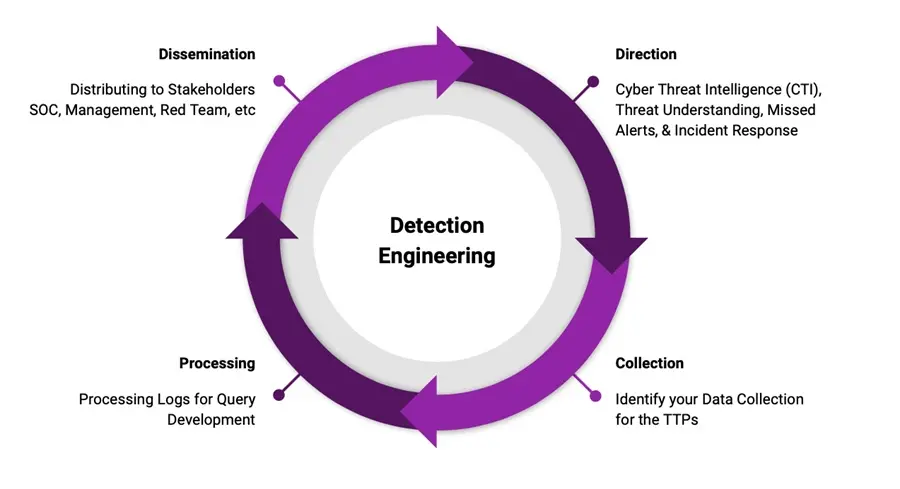
If the old SOC model was like being a line cook (someone hands you a recipe, you follow it, you serve the dish), then detection engineering is like being a chef. You’re researching ingredients, experimenting with flavors, and creating the recipes that everyone else will use.
The Detection Engineering Process
Here’s how detection engineers work. They pull from three main sources to create effective detections:
- Cyber threat intelligence (CTI): Your CTI team says, “Hey, APT 29 is using this new technique.” That becomes a requirement for a new detection. You’re translating strategic intelligence into operational defense by converting intelligence requirements into actionable detection rules.
- Threat Hunting: Your threat hunters identify suspicious lateral movement that was missed by existing detection systems. You turn that hypothesis into an automated, repeatable detection so it never slips through again.
- Incident Response: A breach happens, you learn from it, and you build detections to ensure it never happens the same way twice. Every incident becomes a learning opportunity that feeds back into your detection library.
Detection engineers take these inputs and apply a technique called detection-as-code.

You’re treating detection rules like software. You’re versioning them in Git, testing them in development environments, and deploying them through CI/CD pipelines. Your detections become repeatable, auditable, and scalable.
But why is this important?
The Pyramid of Pain
Now let’s talk about why detection engineering matters so much. To understand this, you need to know about the Pyramid of Pain.
The Pyramid of Pain is a concept created by David Bianco in 2013 that ranks indicators by the pain they cause an attacker when detected or blocked. This framework has become fundamental to modern detection engineering because it helps prioritize where to invest your detection efforts.
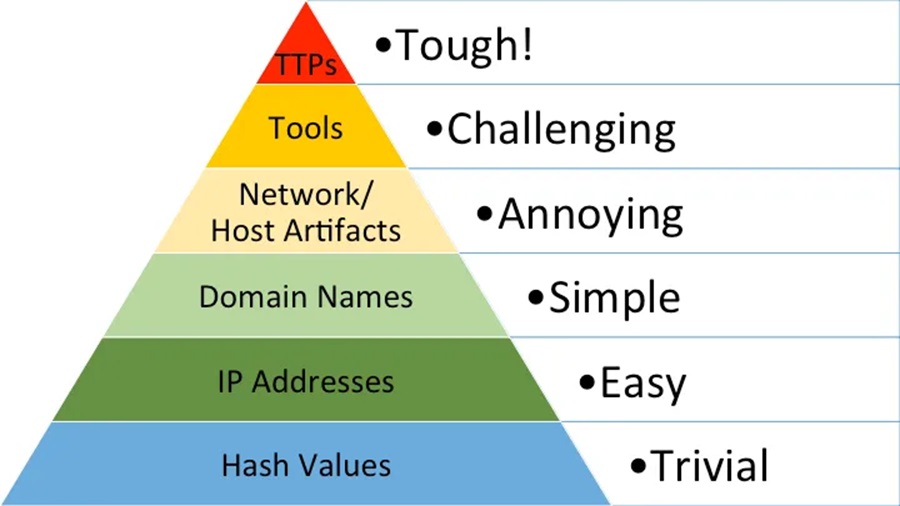
Let me walk you through each level, from least painful to most painful for attackers:
Hash values (bottom level). These are the easiest things to detect, but they’re also the easiest for attackers to change. One tiny modification to a file, and boom, the hash is different. Detection evaded. This causes attackers virtually no pain. Example: detecting malware using MD5 or SHA-256 hashes.
IP addresses (second level). Slightly better than hashes, but still trivial for attackers to change. They just spin up a new server, get a new IP, and they’re back in business. Cloud infrastructure makes this especially easy.
Domain names (third level). Getting more painful now. Registering new domains costs money and time, but sophisticated adversaries have infrastructure ready to go. It slows them down, but it doesn’t stop them.
Network artifacts (fourth level). These include user agent strings, URI patterns, and certificate characteristics. Changing these requires retooling and testing, which causes real pain for attackers. Example: detecting specific URI patterns used by a C2 framework.
Host artifacts (fifth level). This is where it gets interesting. These are things like registry keys, service names, or file paths that attackers use. Changing these might require recompiling tools or rewriting automation. Now you’re forcing them to invest significant time.
Tactics, techniques, and procedures (TTPs) at the top. This is the holy grail of detection engineering. When you detect adversary behavior rather than specific indicators, you’re forcing attackers to completely rethink their methodology. This is maximum pain.
The Pyramid of Pain directly maps to the MITRE ATT&CK framework. When you build detections around ATT&CK techniques, you’re automatically targeting the top of the pyramid. This is why understanding threat actors and their operational patterns is crucial.
Why This Matters for Detection Engineers
Here’s the thing: most organizations are stuck at the bottom of the pyramid. They’re chasing hashes and IP addresses because that’s what their threat intelligence feeds give them. But sophisticated adversaries laugh at these detections.
Detection engineers climb the pyramid. They build detections focused on behaviors, patterns, and TTPs that are hard for attackers to change. Instead of detecting “this specific malware hash,” you detect “any process that’s doing credential dumping in this particular way.”
A 2024 study by Mandiant found that behavioral detections (TTPs and host artifacts) had an 89% success rate in identifying novel attack variants, compared to just 23% for hash-based detections. That’s the power of climbing the pyramid.
The Real-World Impact
Let’s talk about what this actually looks like in practice and the tangible impact detection engineering has on security operations.
- You’re making defenders’ lives better: SOC analysts are drowning in alerts. Most of them are false positives or low-value noise. When you engineer high-fidelity detections, you’re giving analysts alerts they can actually act on. You’re transforming their job from “triage hell” to “investigate interesting threats.” This reduces alert fatigue!
- You’re making attackers’ lives harder: Every time you build a detection that catches adversary behavior, you’re forcing them to change tactics. You’re raising their costs, slowing them down, and making your environment less attractive as a target. You’re climbing that Pyramid of Pain.
- You’re building institutional knowledge and organizational resilience: When you document why a detection works, what data sources it uses, and what assumptions it makes, you’re creating a knowledge base that outlives any individual team member. New hires can understand your detection strategy. Senior leadership can see your coverage gaps.
- You’re enabling proactive defense and continuous improvement
Instead of waiting for an incident to happen, you’re building detections based on threat intelligence and threat hunting. You’re detecting adversary techniques before they become your problem.
Let me give you a concrete example. A financial services company discovered that a sophisticated threat group was using Windows Management Instrumentation (WMI) for lateral movement, a technique mapped to MITRE ATT&CK T1047.
Here’s how a detection engineer approached this:
Research Phase: They studied the technique in MITRE ATT&CK and identified required data sources (WMI event logs via Event ID 5857, process creation logs, network connection data).
Design Phase: They created detection logic looking for unusual patterns:
index=windows EventCode=5857 OR EventCode=4688
| where (process_name="wmiprvse.exe" AND parent_process!="svchost.exe")
| join type=inner network_connections
| where dest_port IN (135, 445) AND dest_ip=internal_network
| stats count by src_host, dest_host, user
| where count > 3 within 5 minutesTesting Phase: They validated the detection using Atomic Red Team’s WMI execution tests. Initial tests generated 47 alerts over a week, with a 32% false-positive rate (legitimate admin activity).
Refinement Phase: They added allowlisting for known admin hosts and refined timing thresholds, reducing false positives to 8%.
Result: The detection successfully identified three instances of unauthorized lateral movement during the first month of deployment, catching activity that vendor tools missed because they only looked at WMI process creation without correlating network behavior.
According to Gartner’s 2024 Market Guide for Security Operations, organizations that implement dedicated detection engineering programs see a 45% reduction in mean time to detect (MTTD) and a 38% decrease in false positive rates compared to those relying solely on vendor-provided detections.
The Skillset
Now I know what you’re thinking: “This sounds amazing, but what skills do I actually need?”
Detection engineering requires a unique combination of three distinct skill sets. You’re part software engineer, part senior SOC analyst, and part security researcher. Let’s break down each one.
You’re a Software Engineer
You need to code. Python is your primary language. You’re writing scripts to automate deployment, validate detection logic, and pull metrics from your SIEM via an API. You need to understand Git, CI/CD pipelines, and version control.
Detection-as-code isn’t just a buzzword… It’s literally how you work!
You don’t need to be a full-stack software engineer, but you do need to be script-fluent. Can you write a Python script that queries your SIEM’s API, validates that detections are firing correctly, and exports metrics to a dashboard? If not yet, that’s okay. That’s a learnable skill.
If you’re interested in building Python skills specifically for security work, check out resources on Python threat hunting tools. The principles translate directly to detection engineering, and you can start with simple scripts for parsing CSV files or interacting with APIs.
You’re a Senior SOC Analyst
You need deep, expert-level knowledge of SIEM platforms like Splunk, Microsoft Sentinel, or Elastic. But it’s not enough to just use them… you need to master the query language.
Whether it’s SPL (Splunk Processing Language), KQL (Kusto Query Language), or EQL (Event Query Language), you need to be the person everyone comes to when they need a complex query to find evil in the environment.
And you need to understand MITRE ATT&CK in depth. That framework is your entire worldview. It’s how you classify detections, map coverage gaps, and prioritize your work.
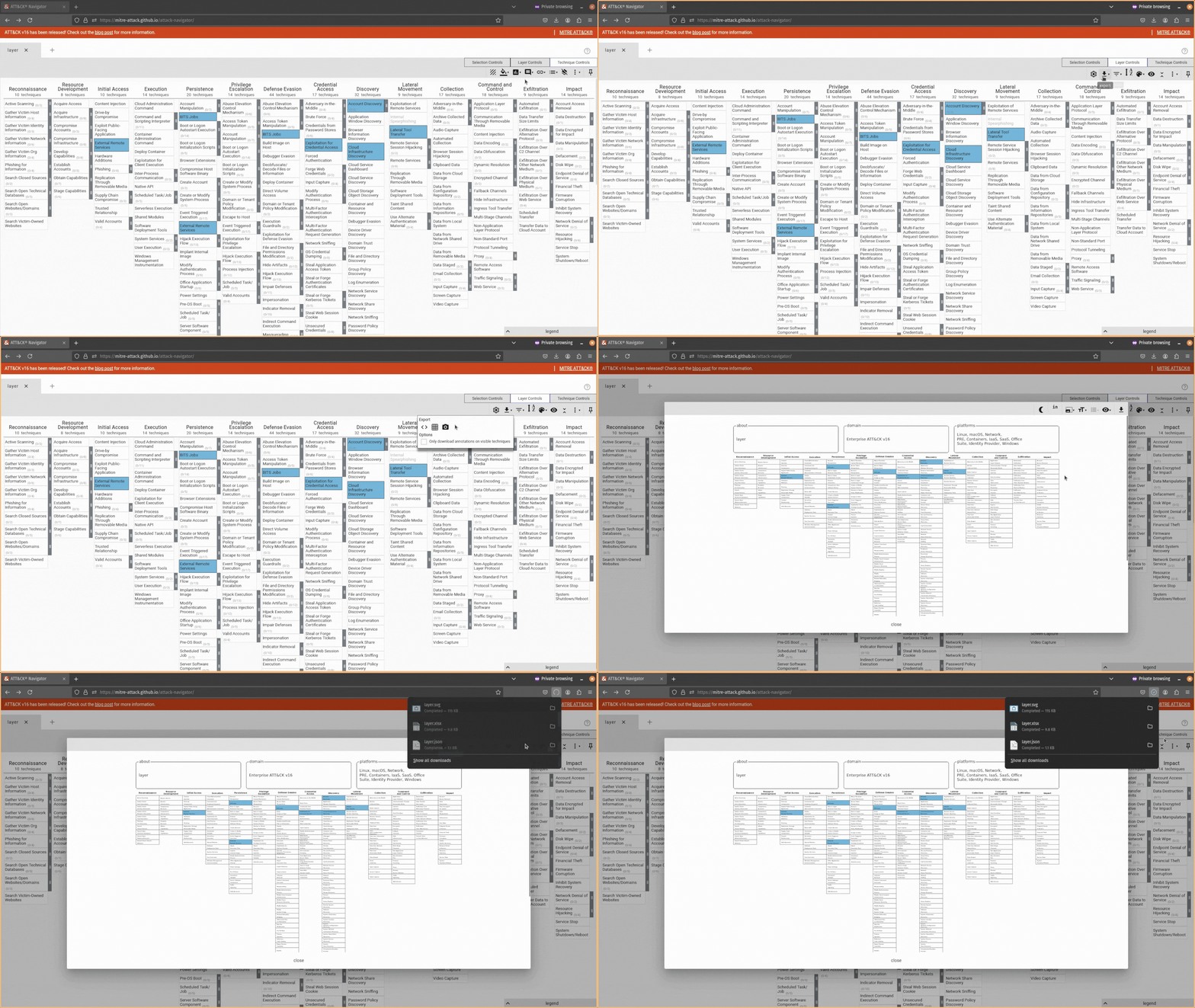
Every detection you build should map to specific ATT&CK techniques. Tools like ATT&CK Navigator help visualize your detection coverage.
You’re a Security Researcher
You need to understand operating system internals. Windows process injection. Linux privilege escalation. macOS persistence mechanisms. You need to know network protocols, malware analysis, and forensics.
Why? Because you can’t detect what you don’t understand.
- When a threat hunter comes to you and says, “I found this weird lateral movement technique,” you need to understand it at a technical level so you can engineer a robust detection for it.
- When your CTI team reports on a new adversary TTP, you need to research how it actually works at the system level.
It’s that unique combination (builder, analyst, researcher) that makes detection engineers so valuable and so in demand.
The Career Path
Okay, so how do you actually get there? What’s the career path, and realistically, how long does it take?
The most common feeder role is that of a SOC analyst. And if you’re in a SOC right now, feeling burned out from triaging alerts all day, this is your level-up. This is how you go from reactive to proactive, from consumer to creator.

Four Steps to Transition
Here’s what you need to focus on to make the transition from SOC analyst to detection engineer:
First, get comfortable with your SIEM’s query language. Don’t just run searches… build them. Experiment. Optimize. Become the person everyone goes to when they need a complex query. Start with simple hunting queries and gradually increase complexity. Challenge yourself to answer questions like “show me all PowerShell executions that made outbound network connections” or “find processes that were spawned by unusual parent processes.”
Second, learn Python. Start small. Automate something annoying. Parse a CSV file. Hit an API. Build from there. You don’t need to become a software engineer overnight, but you do need to be comfortable writing scripts. Set a goal: automate one repetitive task per month. Maybe it’s enriching indicators, pulling metrics from your SIEM, or validating detection coverage.
Third, dive into MITRE ATT&CK. Map every alert you triage to a technique. Start thinking in terms of adversary behavior, not just indicators. When you investigate an alert, ask yourself: “What ATT&CK technique is this? What other techniques might be part of this same attack chain? What detections could we build to catch this earlier in the kill chain?”
This mindset shift from “what happened” to “what behavior pattern is this” is fundamental to detection engineering.
Fourth, start documenting. Seriously. Write down why a detection works, what data sources it uses, and what assumptions it makes. Get used to the idea that your work needs to be reproducible and shareable. Create a personal wiki or notebook where you document detection ideas, testing results, and lessons learned.
If you’re a threat hunter, you’re even closer. Detection engineering is basically the operationalization of threat hunting. You’re already thinking proactively. You already understand TTPs. You’re already comfortable with data analysis and building complex queries. Now you just need to learn how to engineer that knowledge into repeatable, automated detections.
This isn’t an overnight roadmap, but if you’re willing to invest time and effort, it will pay off. You’re building something. You’re creating impact. You’re not just reacting… you’re engineering!
Key Takeaways
- Detection engineering closes the detection gap between what adversaries can do and what you can actually detect. It’s a structured approach combining CTI, threat hunting, and incident response insights into automated, repeatable detections.
- The Pyramid of Pain teaches us that behavioral detections targeting TTPs are far more valuable than indicator-based detections. Organizations that focus on climbing the pyramid see significantly better detection rates against novel attacks.
- Detection engineers need three skill sets: software engineering (Python, Git, CI/CD), SOC analysis (SIEM expertise, MITRE ATT&CK), and security research (OS internals, malware analysis). Development takes twelve to eighteen months of focused effort from a junior SOC analyst position.
- The most common path is from SOC analyst to detection engineer, and the journey requires deliberate skill-building in query languages, automation, adversary behavior analysis, and documentation.
The demand is real and growing. If you’re in cyber threat intelligence or working in a SOC, this is one of the most exciting and rewarding career pivots you can make. You go from reactive scrambling to proactive engineering.
You’re building something real that makes a measurable difference in your organization’s security posture!




Frequently Asked Questions
What Does a Detection Engineer Do?
A detection engineer develops, tests, and deploys customized threat detections, treating them like software with version control and CI/CD. This contrasts with purely vendor-based, reactive security. Key tasks involve researching adversary methods, writing SIEM queries, automating deployment, minimizing false positives, and collaborating with CTI, threat hunting, and SOC teams to operationalize security insights.
What Skills Do I Need to Become a Detection Engineer?
Detection engineers require three core skills: software engineering (Python, Git, CI/CD for detection-as-code), expert SOC analysis (SIEM queries such as SPL, KQL, EQL, and MITRE ATT&CK), and security research (OS internals, malware, network protocols, forensics). Develop capabilities in all three through deliberate practice over twelve to eighteen months.
How Is Detection Engineering Different From SOC Analysis?
SOC analysts respond to alerts from existing security tools, triaging and investigating incidents in accordance with predefined rules. Detection engineers create these alerts. They design, test, optimize, and continuously improve the detection rules based on threat intelligence.
It’s the difference between using a cookbook (SOC analyst) and writing the recipes (detection engineer). Detection engineers focus on research, development, and optimization, while SOC analysts prioritize rapid triage and investigation.
What Is the Pyramid of Pain?
The Pyramid of Pain, created by David Bianco, ranks attacker indicators by the difficulty of changing them: hashes, IP addresses, domains, network artifacts, host artifacts, and TTPs (tactics, techniques, and procedures). Detection engineers prioritize TTP-based detections because they inflict maximum pain and are harder to evade.
Can I Transition From a CTI Analyst Role Into Detection Engineering?
CTI analysts have a strong advantage in detection engineering due to their understanding of adversary TTPs and the intelligence lifecycle. Focus on developing technical skills: SIEM query languages, detection rule creation, and automation (Python, detection as code). Your intelligence background is ideal for creating effective, behavior-based tactical detections, as demonstrated by many successful detection engineers from CTI.