

So, you want to be a Cyber Threat Intelligence (CTI) analyst? It’s a question that echoes across cyber security forums and networking events, and for good reason. The world of a CTI analyst is a fascinating blend of digital detective work, high-stakes strategy, and deep technical knowledge.
Forget the stereotypes of just sharing IOCs or reading reports all day. This role is about getting ahead of the adversary, understanding their motives, and providing the critical insights that protect a business from digital harm.
If you’re tired of being reactive and want to hunt threats and inform key business decisions proactively, you’re in the right place. This guide will break down what a CTI analyst really does, the skills you need to succeed, and a clear roadmap to help you land the job. To get started, let’s take a look at what a CTI analyst does!
What Does a CTI Analyst Do?
At its core, the primary mission of a CTI analyst is to reduce risk for the business. That’s it. While that sounds simple, it takes many forms, evolving from a technical function into a critical business enabler.
The role isn’t just about collecting technical data; it’s about performing in-depth analysis to answer the fundamental intelligence questions: the who (attribution), why (motivation and intent), and what (capabilities and infrastructure) behind a threat. By answering these, a CTI analyst provides actionable intelligence that empowers an organization to make smarter, faster, and more informed security decisions, from the server room to the boardroom.
This intelligence is delivered at different levels, each tailored to a specific audience.

Strategic Intelligence
This is the high-level, forward-looking view for executives and decision-makers. It answers the “so what?” questions for the business.
For example, a CTI analyst might produce a report on the geopolitical threat landscape in a region the company plans to expand into, or analyze emerging ransomware trends to help leadership justify a multi-million dollar investment in endpoint detection and response (EDR) and immutable backups.
This intelligence is less about IP addresses and more about adversary motivations, long-term campaigns, and their potential impact on business goals.
Operational Intelligence
This focuses on the how. It provides rich context about an adversary’s TTPs (Tactics, Techniques, and Procedures). This is intelligence for the defenders.
An operational report might detail how a specific financially motivated group gains initial access, moves laterally, and exfiltrates data. This helps operational teams like the Security Operations Center (SOC) and threat hunters understand what to look for, enabling them to write more effective detection rules and hunt for adversary behaviors, not just indicators.
Tactical Intelligence
This is the most immediate and technical level, focused on the here and now. It includes things like indicators of compromise (IOCs)—malicious IP addresses, file hashes, or domains—that help teams detect and respond to active threats.
But it’s more than just a list; it’s enriched, high-fidelity data.
For example, instead of just a domain, tactical intelligence would specify, “This domain is a known C2 server for Qakbot, observed in campaigns targeting financial institutions in North America within the last 48 hours.” This context allows for rapid, confident blocking and remediation.
Ultimately, a CTI analyst is the bridge between the technical weeds and the business vision, ensuring everyone has the intelligence they need to do their jobs effectively. So what does this look like daily?
Day-to-Day Tasks
A day in the life of a CTI analyst is rarely the same twice, but the work generally falls into three main buckets, creating a dynamic and challenging environment.
Structured Intelligence Work
This is the planned, proactive work driven by the organization’s formal intelligence requirements. These are the big questions the business needs answered to manage risk.
To fulfill them, you’ll work on long-term projects and Requests for Information (RFIs).
This could involve producing a quarterly threat landscape report for a specific business unit, reviewing daily intelligence feeds from a Threat Intelligence Platform (TIP) to find relevant threats, triaging breaking news about a new zero-day vulnerability, or maintaining and updating detailed profiles on the key threat actors targeting your industry.
This work is methodical and deeply analytical, forming the foundation of the intelligence program.
Ad-Hoc Requests
These are the curveballs that make the job exciting.
- An incident response team might escalate a suspicious PowerShell script found on a critical server, and your job is to analyze it on the fly to determine its function, origin, and impact.
- The vulnerability management team might need you to urgently research a newly disclosed CVE to determine if relevant threat actors are actively exploiting it.
These ad-hoc RFIs require you to be agile, think on your feet, and rapidly synthesize information from multiple sources to provide timely answers when the pressure is on.
Continuous Development
The threat landscape never sleeps, and neither can your skillset. A significant part of the job is dedicated to continuous learning and capability improvement.
This isn’t just passive reading; it’s active development.
One day, you might be developing custom Python scripts to automate the collection of data from a new OSINT source. Next, you could be tuning and managing intelligence feeds to reduce false positives, or learning a new analysis framework like the MITRE ATT&CK Framework to map adversary behaviors better.
This also includes understanding the business’s evolving technology stack to anticipate future threats. This constant refinement ensures the CTI function remains effective and ahead of the curve.
Great. You know what a CTI analysis role looks like; the next question is “What skills do you need to fulfill this role?”
Skills Needed
To juggle these diverse tasks, a successful CTI analyst needs a blend of technical, analytical, and soft skills. This trio of competencies forms the bedrock of an effective analyst, allowing them to both understand the threat and communicate its importance.

Technical Skills
You need a solid, practical foundation to understand the battleground.
- This includes a deep understanding of networking protocols like TCP/IP and DNS, which is crucial for analyzing network captures to spot command-and-control traffic or DNS tunneling.
- You need intimate knowledge of operating systems—not just how to use them, but how they work under the hood. For Windows, this means understanding the registry, event logs, and processes like lsass.exe. For Linux, it’s about knowing the file system, permissions, and tools like iptables.
- A key accelerator is proficiency in a scripting language like Python. This isn’t about becoming a software developer; it’s about being able to write scripts to automate repetitive tasks, such as querying the VirusTotal API with a list of hashes or parsing large, unstructured log files into clean, usable data.
This technical base is often forged in the fires of a role like a SOC analyst, where you get daily, hands-on experience with malware analysis, incident response, and learning to think like an attacker.
Analytical Skills
This is the art of turning raw data into finished intelligence.
It requires strong critical thinking to look at a piece of information and ask, “What does this actually mean? What is the source’s bias? What is not being said?” You need the ability to recognize patterns across disparate datasets. For example, noticing that three separate incidents used the same obscure port for C2 communication, potentially linking them to a single threat actor.
A key part of this is using Structured Analytic Techniques (SATs), like the Analysis of Competing Hypotheses (ACH), to challenge your own assumptions and avoid cognitive biases that can lead to wrong conclusions.
The ability to take a complex stream of data, analyze it rigorously, and distill it into a clear, concise finding with an assessment of confidence is what separates a data collector from a true intelligence analyst.
Soft Skills
Don’t overlook these; they are force multipliers for your technical and analytical abilities. As a CTI analyst, you are a storyteller and a translator.
You need excellent report writing and briefing skills to tailor your intelligence to different audiences.
- A report for incident responders will be packed with technical indicators and mitigation steps.
- The presentation for the board of directors will focus on business risk, potential financial impact, and strategic recommendations, avoiding technical jargon.
Collaboration is another vital skill. You’ll work closely with the SOC to tune detections, with incident response during a crisis, and with the vulnerability management team to prioritize patching.
Finally, emotional intelligence and adaptability are critical. You must remain calm and objective under pressure, clearly communicate complex findings during a high-stress incident, and constantly adapt to a threat landscape that changes daily.
Learning the Skills
So, how do you acquire this powerful skillset? It’s a journey of continuous, deliberate effort.
Start with the fundamentals. Build your technical base with foundational IT and cyber security courses or certifications like the CompTIA Security+ or Network+. While a degree can provide a structured learning path, what truly matters is demonstrable, practical, hands-on experience.
The single best way to get this experience is by working in a SOC. A SOC role is an incredible training ground where you are exposed to real-world attacks daily. You’re not just reading about security principles; you’re living them.
While you’re gaining this invaluable experience, start layering on CTI-specific knowledge. You can take a CTI certification to learn the formal concepts and vocabulary, like the threat intelligence lifecycle, but don’t let that be the end of your learning.
Immerse yourself completely in the world of threat intelligence.
Create a disciplined reading habit. Consume highly technical deep-dives from sources like The DFIR Report to deconstruct how real-world intrusions unfold, from initial access to final impact. Simultaneously, read the strategic, high-level annual reports from major vendors like CrowdStrike, Mandiant, and Unit 42 to understand the broader trends and the geopolitical and economic drivers behind cyber attacks. This combination of tactical-level and strategic-level reading will build the mental models you need to be a well-rounded CTI analyst.
But just learning the skills is not enough. You must apply them to show prospective employers you have them!
Applying the Skills
Passively consuming content is not enough. You must transition from a consumer to a producer. This is done through deliberate practice.
Use platforms like TryHackMe and Hack The Box not just to complete exercises, but to practice your entire analytical workflow. Pick a relevant scenario, investigate it thoroughly, and then write a formal intelligence report on your findings. Structure it with an executive summary, a detailed analysis section (perhaps with a Diamond Model diagram), and a list of recommended mitigations.
This exercise forces you to practice the critical skill of communicating your findings.
When you read a public breach report, don’t just read it; try to replicate parts of the analysis in your own lab.
- Can you find the malware samples on VirusTotal or MalwareBazaar?
- Can you analyze them and identify the same TTPs the report mentioned?
The goal is to build a portfolio that proves your skills.
Write your own reports based on your investigations and publish them on a personal blog or LinkedIn. Try to explain a highly technical concept—like process injection—in simple, clear terms that a non-technical manager could understand.
If you can master the art of making the complex simple, you are well on your way to becoming a highly effective CTI analyst.
Getting a Job
Knowing the skills is one thing; proving you have them is the real challenge. In today’s competitive market, a resume and a certification aren’t enough. You need to provide tangible proof of your abilities.
Here’s how to build a compelling case for yourself.
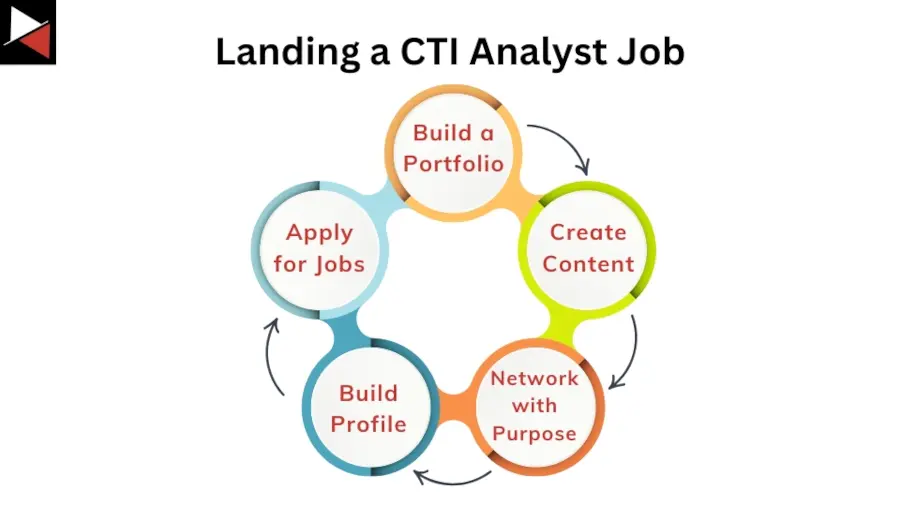
Step 1: Build a Portfolio That Solves Problems
Don’t just list skills; demonstrate them. Create a public GitHub repository that showcases your practical abilities. This isn’t about writing the next great security tool. It’s about showing you can solve real-world problems.
For example, create a Python script that takes a list of IOCs from a CSV file, enriches them using APIs from services like VirusTotal or AbuseIPDB, and outputs a clean, readable report. This single project demonstrates scripting skills, knowledge of CTI tools, and an understanding of the analyst workflow.
A portfolio is your evidence locker—it’s undeniable proof that you can do the job.
Step 2: Create Content to Showcase Your Mind
You need to show hiring managers how you think. The best way to do this is to create public content. Start a blog and write a detailed analysis of a recent malware campaign, complete with MITRE ATT&CK mapping. Post a short, insightful analysis of a new vulnerability on LinkedIn.
This does two things:
- It proves you have the analytical and communication skills required for the role.
- It builds your personal brand and acts as a networking magnet, drawing like-minded professionals and recruiters to you.
Step 3: Network with a Purpose
Don’t just collect connections; build relationships.
- Go to cyber security conferences (virtual or in-person) and local meetups like BSides. But don’t just attend—participate. Ask thoughtful questions.
- Engage in conversations. On platforms like LinkedIn and X (formerly Twitter), don’t be a lurker. Share interesting articles, add your own insights in the comments, and connect with CTI professionals whose work you admire.
A strong professional network, built on genuine interaction, can open doors to unadvertised jobs and provide invaluable mentorship.
Step 4: Leverage Work Experience as Your Audition
This is the gold standard, especially if you’re already in a role like a SOC analyst. Don’t wait for a CTI job to open up; start doing the job now.
- Volunteer for tasks that have an intelligence component. If your team encounters a new malware family, ask if you can take the lead on researching its TTPs and creating a threat profile.
- Proactively write a short intelligence summary for your team about a new phishing campaign you’ve observed. This demonstrates initiative and passion, and proves to your current (and future) employers that you are ready for the next step.
You’re not just asking for a CTI role; you’re auditioning for it every day.
Typical Career Path
While every journey is unique, a well-trodden and highly effective path leads to a career in CTI. It’s a path that builds a strong, practical foundation before moving into the more specialized, analytical world of intelligence.
A common starting point is a foundational role in IT helpdesk, system administration, or graduating with a relevant university degree. This is where you learn the fundamentals of how technology works.
From there, the critical next step is landing a job in a SOC. The SOC is your crucible. It’s where you learn the visceral reality of an attack by triaging thousands of alerts. It’s where you learn to read logs like a second language and develop an instinct for what looks ‘wrong’ on a network. This hands-on, reactive security experience is non-negotiable; you can’t produce intelligence to stop an attacker if you don’t first understand how they operate and what their activity looks like on the wire.
After gaining one to three years of solid experience as a SOC analyst, you’ll reach a fork in the road where you can specialize. Some may gravitate toward offensive security as penetration testers, learning to break things. Others pursue advanced blue team roles in digital forensics (reconstructing what broke) or malware analysis (reverse-engineering the tool that broke it).
The path to becoming a CTI analyst is another specialization. It involves a crucial mindset shift from reactive to proactive. Instead of just responding to the what (the alert), you begin to focus on the who and the why. A CTI analyst leverages knowledge from various domains to focus on the adversary behind the keyboard—their motivations, their playbook, and their likely next moves—to prevent the breach from happening in the first place.
This is why the CTI analyst role is considered an advanced position; it builds upon and requires an understanding of a strong foundation of real-world, hands-on security experience.
Summary
Becoming a CTI analyst is a challenging but incredibly rewarding journey. It requires a commitment to continuous learning, a passion for solving complex puzzles, and the discipline to put in the work. There are no shortcuts.
You must learn the skills, apply them through deliberate practice, prove your abilities through projects and content, and build a professional network.
Start in a foundational role like the SOC, immerse yourself in the threat landscape, and never stop learning. The path is demanding, but if you’re driven to get ahead of the adversary and make a real impact, a career as a CTI analyst might be the perfect fit for you.




Frequently Asked Questions
What Is the Most Important Skill for a CTI Analyst?
While technical skills provide the foundation, the ability to communicate effectively is arguably the most critical. Intelligence is useless if it isn’t understood and acted upon. A CTI analyst must be a master translator, able to take complex technical findings and articulate them clearly to different audiences.
For the SOC team, this means providing precise, technical details for detection and hunting. For C-suite executives, it means summarizing the threat in terms of business risk, potential financial impact, and strategic recommendations, all without getting lost in technical jargon.
Do I Need a Degree to Become a CTI Analyst?
No, a degree is not a strict requirement, and you’ll find many successful analysts from diverse backgrounds. Cyber security is a meritocracy based on practical ability. While a relevant degree can sometimes help get past initial HR filters for entry-level jobs, for a specialized role like CTI, employers overwhelmingly prioritize verifiable skills and real-world experience.
A strong portfolio showcasing your analysis of malware campaigns, scripts you’ve written to automate OSINT, and hands-on experience from a SOC role are far more valuable and compelling to a hiring manager than a diploma alone.
How Is a CTI Analyst Different From a SOC Analyst?
Think of it as a firefighter versus a fire marshal.
- A SOC analyst is the firefighter on the front lines, responding to alarms (alerts) in real-time, containing the blaze (incident), and putting it out. Their focus is immediate and reactive.
- A CTI analyst is the fire marshal. They study past arsons (breaches), understand the tools the arsonists use (TTPs), identify who is starting fires and why (threat actor profiling), and recommend changes to the building security controls to prevent fires from starting in the first place.
Their focus is proactive and strategic, aiming to understand the adversary to enhance the overall defense capabilities of an organization.