
You’re a year into your SOC analyst role, staring at your SIEM, drowning in false positive alerts. Or maybe you’re three years into IT support, closing your 10,000th password reset ticket. Either way, you’re thinking the same thing: there has to be more to cyber security than this whack-a-mole game.
Here’s what nobody’s telling you. There is a clear, logical progression from where you are right now to one of the most strategic and rewarding roles in the industry: Cyber Threat Intelligence (CTI) analyst. The path isn’t random, and you don’t need to start from scratch.
This guide will walk you through the three-stage roadmap from IT foundation to SOC crucible to CTI watchtower. By the end, you’ll know exactly where you stand, where you’re going, and the critical mindset shifts you need to make at every stage to get there. Let’s get started.
The 3-Stage CTI Analyst Career Roadmap Overview
Before diving into the details, let’s look at the big picture.
The cyber security career path to a CTI analyst isn’t a leap. It’s a climb. Each stage builds on the last, and skipping a step means building on a foundation that isn’t there. The three stages are:
- The IT Foundation. Learning how systems work in a real business environment
- The SOC Crucible. Learning how attacks manifest in those systems
- The CTI Watchtower. Anticipating attacks before they ever happen
In IT, you learn the city’s map. In the SOC, you learn where the fires break out. In CTI, you become the person who predicts which buildings might catch fire next and where to place your resources.
The technical skills stack at each stage, but more importantly, the cognitive complexity compounds. You are not leaving behind what you learned. You are elevating it to a more strategic level.
Stage 1: The IT Foundation
IT support, help desk, systems administration. This is where most cyber security careers actually begin. And there’s a reason for that.
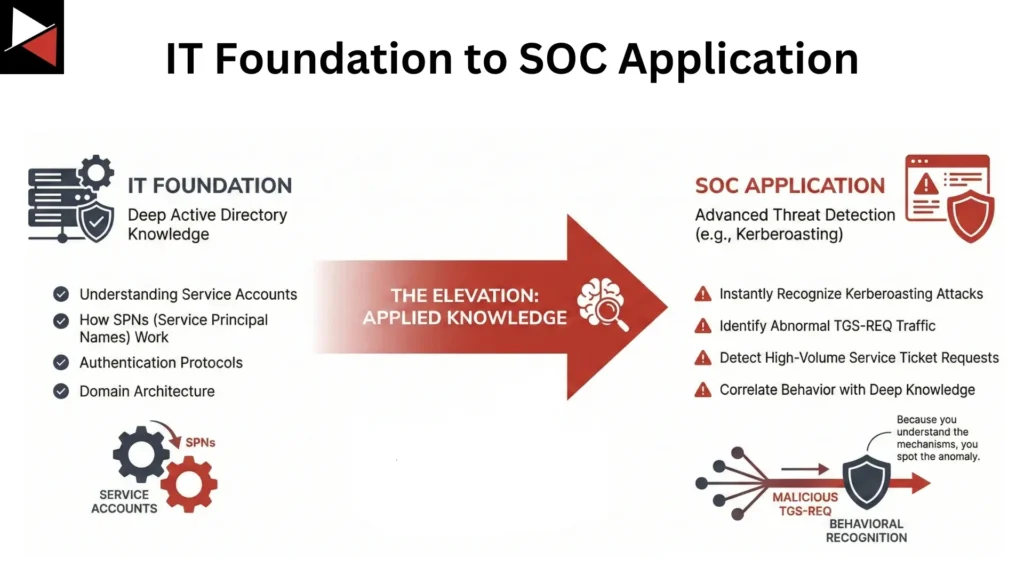
In an IT role, you’re learning the fundamentals of how technology works in a business context. You’re touching Active Directory, understanding network topology, seeing how users interact with systems, and, most critically, learning how things break in production.
Every ticket you close teaches you something about normal behavior versus anomalous behavior, even if you don’t realize it yet.
However, here’s the trap… IT roles are reactive by design. Something breaks, you fix it.
Your success is measured in closed tickets and SLA adherence. This creates a mindset that, if left unchecked, will follow you into security and hold you back.
The key skill you need to develop in this stage is curiosity beyond the immediate problem.
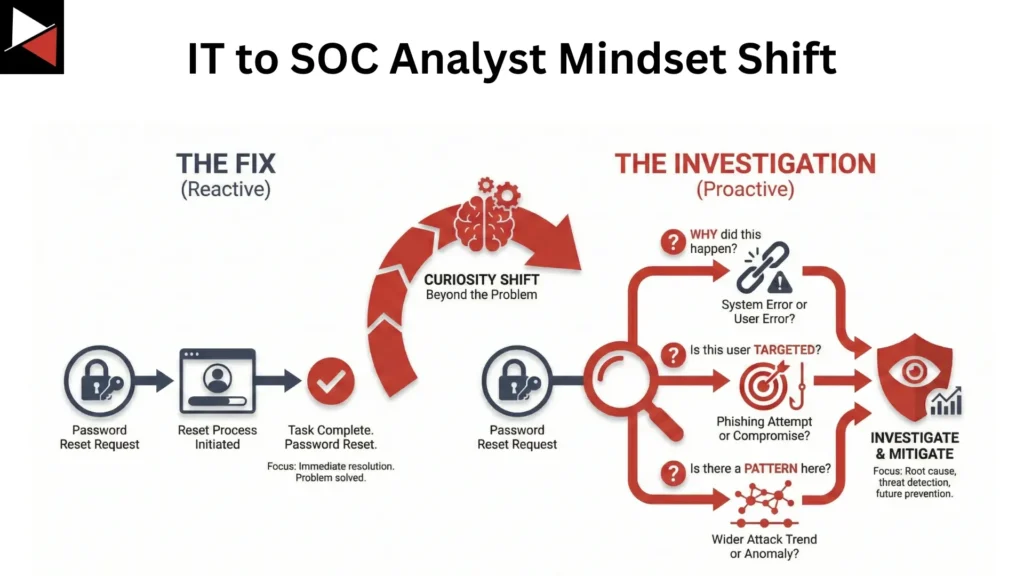
When you’re resetting that password, ask yourself:
- Why did this happen?
- Has this user been targeted before?
- Is there a pattern here I haven’t spotted?
You’re not just fixing an issue. You’re starting a security investigation. That mental habit, practiced consistently, is what sets apart the IT professionals who break into security from those who stay stuck.
You don’t need a security-specific job title to start learning security. Volunteer for anything security-adjacent within your organization: documenting endpoints, supporting phishing simulations, and helping with access reviews. You’re not waiting for permission. You’re creating visibility and making your interest known.
How to Level Up From Stage 1
- Get certified. CompTIA Security+ and Cybersecurity Analyst (CySA+) are the two credentials that signal you’re ready for a SOC role. They open the door to that first security operations position.
- Build a home lab. Set up a free TryHackMe or HackTheBox account and work through the detection labs. Hands-on practice with Windows event logs and basic SIEM queries is more valuable than any additional IT ticket.
- Volunteer internally. Find your security team and make yourself useful. Every security-adjacent task builds both skills and relationships that matter when a SOC role opens up.
Check out our CTI analyst roadmap for a full breakdown of certifications worth pursuing at every level of this career path.
Stage 2: The SOC Crucible
The jump from IT to the Security Operations Center (SOC) is the first major transition. You’re moving from a general technology support role to a specialized security operations one. And this is where most people get their first real taste of cyber defense.
In a SOC, you are the firefighter.
Your SIEM is screaming at you with thousands of alerts every day. Your job is to triage, investigate, escalate, and contain. According to Darktrace research, security teams routinely face overwhelming alert volumes, with the vast majority being false positives that dilute analyst attention from genuine threats. The operational tempo is intense. Your world shrinks to the four walls of your organization’s network, and your timeline shrinks to right now.
This stage builds something incredibly valuable: pattern recognition under pressure.
You develop an intuition for what malicious activity looks like on the wire. You learn how security controls fail. You understand the chaos of incident response when you’re trying to put out a fire while the building is still burning. Tools like Splunk, QRadar, and EDR platforms become second nature.
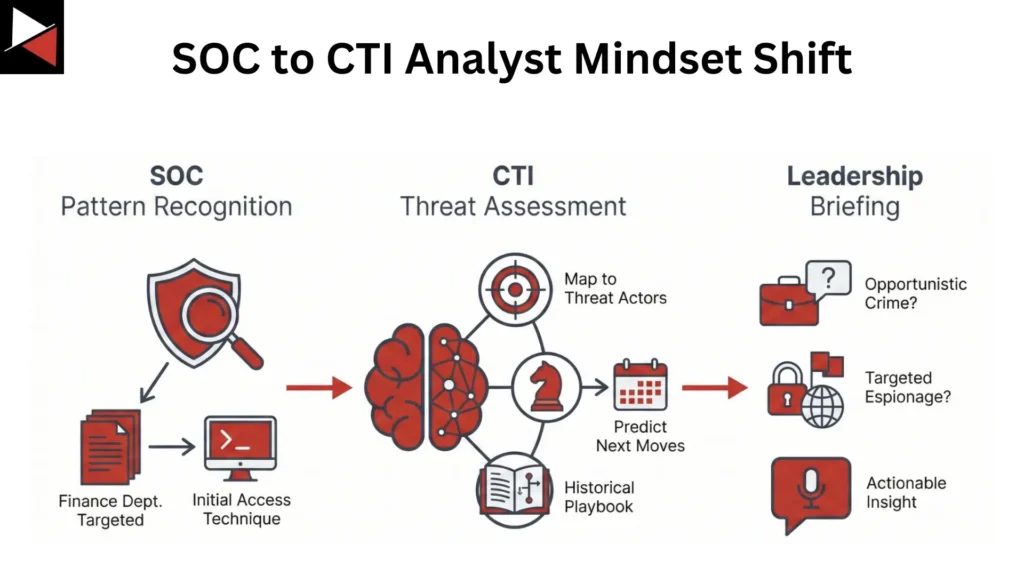
But here’s what’s crucial to understand. The SOC mindset is binary. Is this alert malicious or benign? Block or allow? Yes or no? Your decisions need to be fast and definitive because the clock is always ticking and the adversary is already in your network.
Alert fatigue is one of the most talked-about challenges in SOC work, and it’s real. But it’s also one of the most valuable training grounds in cyber security. Learning to distinguish signal from noise at speed is a skill that will serve you throughout your entire career, including in CTI.
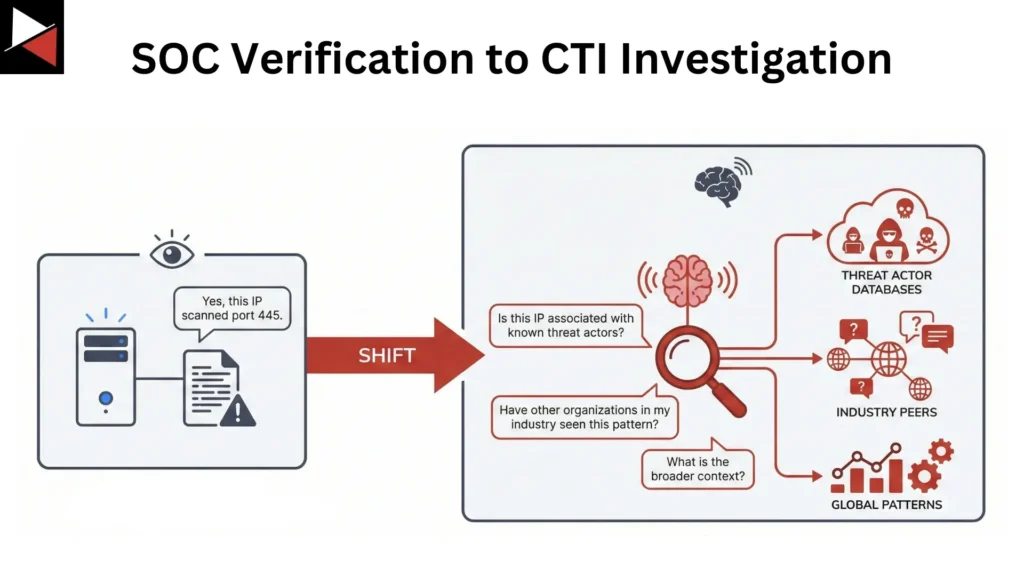
The cognitive shift you need to start making at this stage is moving from verification to investigation.
Don’t stop at “Yes, this IP scanned port 445.” Start asking:
- Is this IP associated with a known threat actor?
- Have other organizations in my industry seen this pattern?
This is the moment you begin looking outward rather than just inward. You’re starting to think like a threat intelligence analyst before you even have the title.
Start learning the frameworks at this stage too. Familiarize yourself with the MITRE ATT&CK framework for mapping adversary techniques, and begin reading threat intelligence reports from vendors like CrowdStrike and Mandiant to understand how CTI analysts think and communicate.
The cyber kill chain, originally developed by Lockheed Martin, is another essential model that gives you a language for describing adversary behavior across the full attack lifecycle.
How to Level Up From Stage 2
- Go deeper than the ticket. Every time you close an incident, spend an extra 30 minutes researching the adversary tactic involved. Map it to a MITRE ATT&CK technique. Build the habit of contextualization that CTI analysts live by.
- Write one-pagers. Start producing short analytical write-ups of patterns you notice in the alert queue. You don’t need permission. These become the portfolio that separates you from every other SOC analyst applying for a CTI role.
- Learn a CTI tool. Set up a free MISP instance or explore OpenCTI via Docker. Understanding how intelligence is stored, linked, and shared gives you a real edge in your first CTI interview.
Stage 3: The CTI Watchtower
Now we get to the destination. The CTI analyst role.
And this is where everything you’ve learned gets flipped on its head.
CTI analysts operate on a completely different plane. Your job is no longer to respond to what’s happening right now. Your job is to predict what’s going to happen next. You’re looking at the global threat landscape, tracking adversary campaigns, understanding geopolitical context, and translating all of that into actionable intelligence your organization can use.
Instead of handling hundreds of alerts per day, you might spend three days investigating a single intrusion to uncover the threat actor behind it. You have the luxury of going down the rabbit hole. Your view extends far beyond your organization’s perimeter. You’re monitoring the dark web, threat actor forums, vulnerability disclosures, and industry-specific targeting trends.
If the SOC analyst is the firefighter, the CTI analyst is the arson investigator and the building code inspector combined.
But here’s the mindset shift that trips up most SOC analysts trying to make this jump.
You can no longer think in binary terms. Intelligence is probabilistic.
- A SOC analyst: “This IP is malicious; we blocked it.”
- A CTI analyst: “This IP is almost certainly associated with APT29, based on infrastructure overlap with previously attributed campaigns. It’s consistent with targeting of healthcare organizations, and there’s a reasonable probability this represents early-stage reconnaissance for a larger campaign. We should prioritize patching the vulnerabilities this actor has historically exploited.”
Same data. Completely different output.

The frameworks that become your daily language in CTI include the Diamond Model of intrusion analysis for pivoting between adversary infrastructure, the MITRE ATT&CK framework for mapping techniques to specific TTPs, and the threat intelligence lifecycle for structuring your workflow from collection to dissemination.
Understanding Priority Intelligence Requirements (PIRs) is also essential. Without them, you’re just doing aimless research
Your First Steps Into the CTI Role
Getting your first CTI position requires proof of skills in a format that a hiring manager can evaluate. The most effective way to build that proof while you’re still in the SOC is a portfolio of three report types:
- A tactical report listing IOCs with context, for SOC analysts and firewall administrators
- An operational report profiling a threat actor using the Diamond Model, for incident response leads
- A strategic report analyzing a threat trend, for a CISO or executive audience
Host these on GitHub or a personal blog. This demonstrates not just technical knowledge, but the ability to communicate intelligence at different levels, which is exactly what separates candidates in CTI interviews.
CTI is a community-driven field. Much of the most valuable threat intelligence is shared in trusted practitioner communities before it appears in public reports. Join Discord communities. Don’t just lurk. Share your home lab findings, publish your portfolio reports, and ask for feedback. This is how the best CTI professionals accelerate their development.
How to Level Up From Stage 3
- Pursue a specialist certification. The GIAC Cyber Threat Intelligence (GCTI) is the gold standard that top-tier employers actively seek. If self-funding, EC-Council’s CTIA or the CREST CRTIA are strong alternatives with genuine industry respect.
- Reframe your SOC resume. Rewrite your experience to highlight analysis over action. “Monitored SIEM alerts” becomes “Conducted deep-dive analysis on recurring malware campaigns, identified a common C2 infrastructure pattern, and produced a report that led to proactive blocking of a phishing campaign.”
- Practice the pivot. Find malware on a platform like MalwareBazaar, do some analysis, and extract IOCs. Run those IOCs through a full Diamond Model investigation using Shodan, VirusTotal, and Maltego to pivot and find more IOCs. Document your findings. That write-up is portfolio item one.
The CTI Analyst Career Path: How Each Stage Prepares You
The easiest way to see this pathway’s value is to watch the same skill evolve across all three stages.
| Skill | IT Foundation | SOC Crucible | CTI Watchtower |
|---|---|---|---|
| Systems Knowledge | Understanding Active Directory, SPNs, and how things break in production | Recognizing Kerberoasting because you know how service accounts work | Writing an incident report with a timeline and indicators for the IR team |
| Pattern Recognition | Spotting that a user keeps locking their account at unusual hours | Noticing finance department targets share the same initial access technique | Mapping that pattern to a known threat actor and predicting their next move |
| Communication | Documenting a resolved ticket for a line manager | Writing an incident report with timeline and indicators for the IR team | Producing a finished threat assessment for the CISO with probabilistic judgments and defensive recommendations |
Each stage is not just a job. It’s a prerequisite. A CTI analyst who has never worked in a SOC struggles to understand what “actionable” actually means for the defenders they’re supporting. Skip a step, and you’re building on a foundation that isn’t there.
Marcus’s Story: From Help Desk to CTI Analyst
To bring this roadmap to life, let me tell you about someone I know.
Three years ago, Marcus was a desktop support technician at a healthcare organization. Fast at troubleshooting, patient with users, reliable. But bored.
He started volunteering for any security-adjacent work he could find. When the security team needed help documenting endpoints, Marcus did it. When they needed someone to run phishing simulations, Marcus raised his hand. He wasn’t waiting for permission. He was creating visibility and making his interest in security known.
After 8 months, a Tier 1 SOC analyst position opened. Marcus applied. Because he’d already demonstrated genuine interest and built relationships with the security team, he got the interview. He was straightforward: “I don’t know SIEM query languages well, but I understand Windows event logs from years of troubleshooting, and I’m ready to learn.”
He got the job.
For the next year and a half, Marcus worked nights in the SOC. He triaged alerts and worked through the daily grind. But he started doing something different from his peers.
Whenever he closed an incident, he’d spend an extra 30 minutes researching the adversary tactic he’d encountered. If he blocked a malicious IP, he’d pivot to see what other infrastructure it connected to. He started using the MITRE ATT&CK framework as a common language to describe what he was seeing. Eventually, he started writing up his findings. Simple one-pagers about patterns he’d noticed.
One of those one-pagers caught his manager’s attention.
“We’ve seen five phishing attempts this month targeting our billing department. Here’s the infrastructure map showing how they’re connected. And here are 12 other domains I found using Shodan that match this same pattern. We should proactively block these now.”
That is not a SOC analyst closing tickets. That is a CTI analyst in the making.
When the organization decided to build out a threat intelligence function, Marcus was the obvious choice. Today, he’s tracking adversary groups targeting healthcare, producing threat assessments for executive leadership, and informing defensive strategies before attacks happen.
He’ll tell you the same thing I’m telling you. He didn’t get there because he was the most technical person in the room. He got there because at every stage, he chose to think one level beyond what his job description required.
Conclusion
The cyber threat intelligence career path from IT to SOC to CTI analyst is real, logical, and people are walking it successfully every day.
This guide has shown you the three stages:
- IT Foundation – where you learn how systems work.
- SOC Crucible – where you learn how attacks manifest.
- CTI Watchtower – where you learn to anticipate what comes next.
Each stage delivers the skills and context that enable the next stage. The mindset shift from reactive to investigative to predictive is the thread that ties it all together.
The question is not whether you can make this journey. The question is whether you’re going to be reactive and wait for the perfect opportunity, or proactive and go create it yourself.
Start where you are. Think one level beyond your job description. And keep your eyes on the watchtower.
Good luck!




Frequently Asked Questions
What Is a CTI Analyst and What Do They Do?
A Cyber Threat Intelligence (CTI) analyst collects, analyzes, and produces finished intelligence about adversarial threats. Rather than responding to active incidents like a SOC analyst, a CTI analyst focuses on understanding who is targeting their organization, why, and how, and communicating that intelligence to stakeholders from the firewall administrator to the board of directors. Our CTI career guide covers what CTI analysts do and the skills they need.
How Long Does the SOC to CTI Analyst Career Path Take?
Most professionals spend one to three years in a SOC role before moving into CTI. The timeline depends less on years logged and more on the quality of your analytical development. SOC analysts who practice investigation techniques, learn frameworks like the Diamond Model and MITRE ATT&CK, and produce analytical write-ups tend to make the transition faster than peers focused solely on alert triage.
What Certifications Help You Become a CTI Analyst?
The most recognized are GIAC Cyber Threat Intelligence (GCTI), EC-Council’s Certified Threat Intelligence Analyst (CTIA), and CREST’s Registered Threat Intelligence Analyst (CRTIA). Before those, CompTIA Security+ and CySA+ are solid foundations. Our full CTI analyst roadmap covers the complete certification landscape.
What Is the Biggest Mindset Difference Between a SOC Analyst and a CTI Analyst?
The shift from binary thinking to probabilistic thinking. SOC analysts operate in a world of “malicious or benign.” CTI analysts operate in a world of “likely, probable, almost certain.” Learning to make confident assessments based on incomplete information and to communicate that confidence using estimative language is the single most important cognitive upgrade for anyone making this transition.
Do I Need a Computer Science Degree to Become a CTI Analyst?
No. Many successful CTI analysts come from non-traditional backgrounds, including history, political science, and linguistics, since intelligence analysis is as much about critical thinking and communication as technical knowledge. Demonstrable experience, strong knowledge of frameworks, and a portfolio of analytical work often matter more than any formal qualification.