
Imagine this. You’ve just spent £700 on a flashy-sounding CTI certification and three months grinding through study material. You finally sit down in the interview… and the hiring manager has never heard of it. That happens more often than you think.
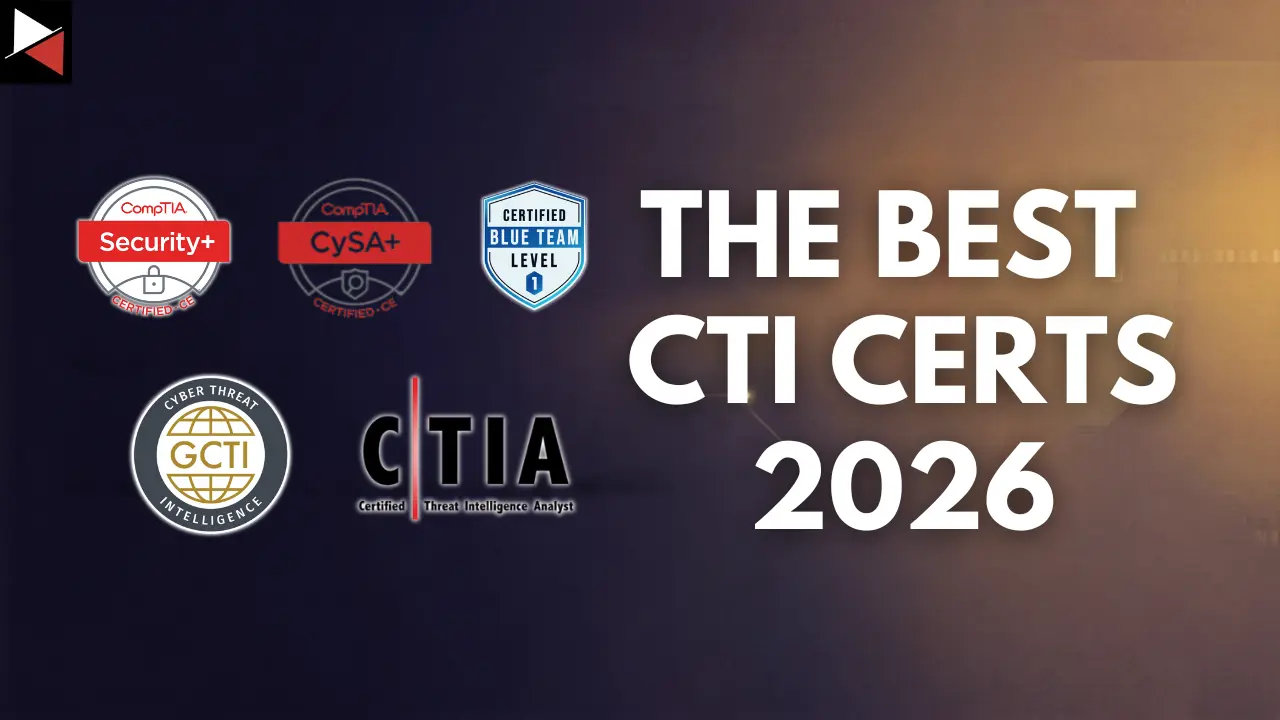
If you’ve decided you want to work in cyber threat intelligence (CTI) and you’ve looked at job postings for intelligence analyst, CTI analyst, or threat researcher roles, you know exactly how overwhelming the certification landscape is. One Google search returns a wall of acronyms. GCTI. CTIA. BTL1. Security+. CySA+. CRTIA. Everyone has an opinion, and nobody is telling you what you actually need right now, at the start of your career, to land your first role.
I’ve worked CTI roles inside MSSP and enterprise environments, hold an MSc in Cyber Security Engineering, and now train aspiring CTI analysts through Kraven Security. This guide is the conversation I have with people over and over again who are trying to break in. Four certifications, in the right order, with the reasoning behind each one, so you can build toward your first CTI role without burning your savings account. Let’s get into it!
CTI Certification Landscape
The cyber security certification market is oversaturated, and the CTI-specific corner of it is no different. Before you spend a single pound, you need to understand one thing: not all certifications are equal at every career stage.
The most common mistake I see is people going straight for the gold standard credentials before they’ve built the foundation beneath them. They spend thousands of dollars and months of study time chasing credentials that hiring managers aren’t even looking for at the entry level.
Here’s the reality of the CTI certification landscape in 2026:
- Foundation certs (Security+, CySA+) demonstrate that you understand the broader security world CTI sits inside.
- Practical certs (BTL1, HTB CDSA) prove you can actually do the work under pressure.
- Specialist certs (CTIA, GCTI, CREST CRTIA) signal deep domain knowledge and become increasingly relevant as you move up.
Understanding where each cert sits on that spectrum helps you spend your money and time intelligently.
CTI work doesn’t exist in isolation. It sits atop operational security, and without understanding what an alert looks like in a Security Operations Center (SOC), how incidents are escalated, and what threat actor behavior actually looks like in real logs, CTI analysis doesn’t make sense.
The order you obtain CTI certs needs to reflect that reality.
For a broader look at how CTI fits into the wider security career ecosystem, the IT to SOC to CTI analyst career guide is a great place to start.
The Four-Cert Path at a Glance
Four certifications. Logical progression. Each one builds on the last.
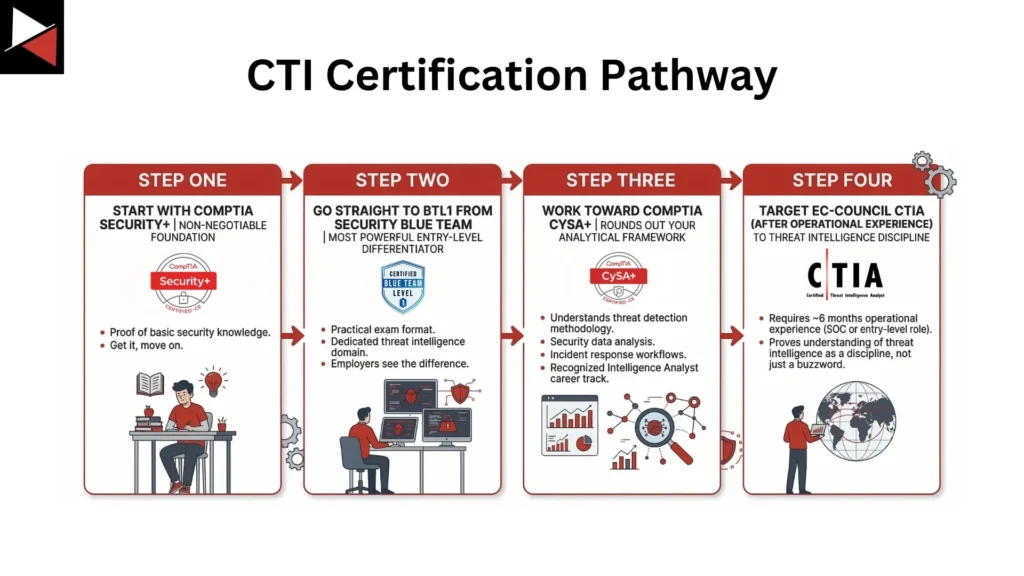
Here’s the order I recommend if you’re targeting your first CTI role:
- CompTIA Security+ — Your proof of foundation. Get it and move on.
- BTL1 — Your most powerful entry-level differentiator. The practical exam format sets you apart immediately.
- CompTIA CySA+ — After BTL1 proves you can do the work, CySA+ proves you understand the analytical framework underneath it.
- EC-Council CTIA — Your bridge credential. Target this once you have around six months of operational experience.
Now, let’s break each one down in the order you should actually do them.
Cert #1 — CompTIA Security+ (Your HR Filter Pass)
I can already hear people saying, “Security+ is for help desk, not CTI.” And you’re not entirely wrong. But here’s the reality.
Security+ is the credential that gets you through the initial HR filter at most organizations. Before a hiring manager even sees your name, an applicant tracking system is scanning for recognizable credentials, and Security+ is one of the most recognized certifications in the world. It validates that you understand the fundamentals: networking, threat vectors, basic cryptography, and incident response concepts.
Without that foundational knowledge, CTI work doesn’t make sense. Cyber threat intelligence sits atop operational security. If you don’t understand the environment your adversaries are operating in, you can’t meaningfully analyze or report on what they’re doing.
- Widely Recognized
Security+ appears on hiring manager checklists across government, financial services, and enterprise organizations globally, giving you a credential almost anyone in the industry will recognize. - Affordable Foundation
Compared to advanced certifications, the Security+ exam is cost-effective and achievable without a background in security, making it an accessible first step. - Covers Core CTI Adjacencies
Threat vectors, attack types, and incident response concepts covered in Security+ directly underpin how you’ll think about threat actors and the cyber kill chain in a CTI role.
Take it, pass it, and use it as your launch pad.
If you have a bachelor’s or master’s degree in a technical field like computer science, you can probably skip Security+ and move straight to BTL1. The cert exists to demonstrate foundational technical knowledge, and a relevant degree already does that.
Cert #2 — BTL1 (The Most Underrated CTI Cert)
Here is the certification I genuinely believe is among the most underrated in the industry, especially for people looking to break into CTI. The Blue Team Level 1 (BTL1) certification from Security Blue Team is not your typical multiple-choice exam. It is a 24-hour practical simulation.
You are given a mini incident in a live lab environment. You have to investigate it, reconstruct the attack timeline using a SIEM (Security Information and Event Management platform), apply digital forensics, and use threat intelligence tools to understand what happened. This is the closest you will get to real CTI work before you’re actually doing it professionally.
Employers can tell the difference between someone who has passed a theory exam and someone who has completed a 24-hour live incident investigation and can discuss it in an interview. BTL1 gives you that proof before you’ve had your first day in the CTI role you’re chasing.
From my experience working in an MSSP SOC environment, the thing that separated analysts who progressed from those who stayed stuck was their ability to actually do the work under pressure. Not recall definitions. Not reference textbooks. Sit down, look at real data, and produce something useful. That’s exactly what BTL1 tests.
When I’ve spoken to hiring managers about what makes an entry-level candidate stand out, practical demonstrations and the ability to discuss them in an interview come up every single time.
The BTL1 has a dedicated threat intelligence domain baked into the certification. It covers:
- The core tiers of CTI: strategic, operational, and tactical intelligence
- Threat actor research and global campaign analysis
- Using threat intelligence tooling as part of a real investigation
This is not another theoretical exercise. You’re practicing the skills you’ll use on the job, and you’ll walk out of the exam with a story you can tell in interviews. If I were starting over right now with a limited budget, after Security+, I would jump straight to BTL1.
BTL1 pairs naturally with efforts to build out your understanding of the threat intelligence lifecycle. Before or during your studies, it’s worth getting familiar with the threat intelligence lifecycle so the concepts you encounter in the exam already have context. The data, information, and intelligence distinction is another concept worth locking in early.
Cert #3 — CompTIA CySA+ (The Analytical Foundation)
This is where things start getting interesting. The CompTIA Cybersecurity Analyst (CySA+) certification is explicitly about analyzing security data, identifying threats, and recommending defensive actions.
Sound familiar? That’s a lot of the work you will be doing as a threat intelligence analyst.
CySA+ introduces you to threat hunting concepts, behavioral analysis, and the idea of using data to make security decisions. All of these are core skills in a CTI role. To a hiring manager, CySA+ signals that you’re not just interested in CTI; you have the analytical security background to back it up.
Where Security+ says “I understand how security works,” CySA+ says “I understand how to think analytically about security data.” That distinction matters enormously in CTI, where your output is intelligence for decision-makers, not just raw data. The ability to take what you’re seeing in logs and telemetry and turn it into something actionable is precisely what separates a good CTI analyst from a great one.
BTL1 proved you can do the work. CySA+ now proves you understand the underlying analytical framework. Together, they round out your profile in a way that a single cert simply can’t.
Cert #4 — EC-Council CTIA (Your Bridge Into Specialism)

The EC-Council Certified Threat Intelligence Analyst (CTIA) sits slightly above pure entry-level, and it’s worth targeting once you have your foundation built and some operational experience behind you, around six months in a SOC or entry-level security role.
A quick note before we go further: EC-Council, as a vendor, has a mixed reputation in some practitioner circles, largely stemming from criticism of earlier CEH versions. The CTIA itself stands on its own merits. It’s mapped to the NIST Cybersecurity Workforce Framework (NIST SP 800-181) and CREST-accredited, both of which carry real weight on the hiring side.
Where Security+ and CySA+ show that you understand security broadly, the CTIA is structured around the intelligence lifecycle itself: planning and direction, collection, analysis, and dissemination. That’s the language CTI teams use every single day.
When you walk into an interview with a CTIA, and you start talking about intelligence requirements, stakeholder analysis, and how to transform raw threat data into actionable reporting, you sound like someone who’s already doing the job.
What the CTIA v2 Curriculum Covers (Current for 2026)
- The full intelligence lifecycle: planning, collection, processing, analysis, and dissemination
- Threat actor profiling and adversary attribution techniques
- Cloud environment threats – a gap in many older CTI curricula
- Exposure to over 50 different threat intelligence tools and platforms
- Dark web and open-source intelligence (OSINT) collection methodologies
- Structured reporting and communicating intelligence to stakeholders
The breadth of tooling coverage in the CTIA matters because CTI analysts are expected to know what’s in the tool landscape, even if they don’t use every platform daily. Walking into a role already aware of the major threat intelligence platforms, OSINT tools, and analysis frameworks gives you an immediate head start.
This is your bridge credential. The one that says “I understand the threat intelligence discipline,” not just using it as a buzzword.
Here’s a side-by-side view so you can see exactly what you’re committing to.
| Cert | Level | Exam Format | Time to Prepare | Approx. Cost | Renewal | Best For |
|---|---|---|---|---|---|---|
| CompTIA Security+ | Foundation | Multiple choice + performance-based, ~90 mins | 2–4 months | ~£300 | 50 CEUs / 3 yrs | Passing the initial HR/ATS filter |
| BTL1 | Practical entry-level | 24-hour live lab investigation | 2–4 months | ~£300 | No expiry | Proving hands-on capability |
| CompTIA CySA+ | Foundation / analytical | Multiple choice + performance-based, ~165 mins | 3–5 months | ~£370 | 60 CEUs / 3 yrs | Analytical framework; threat hunting |
| EC-Council CTIA v2 | Specialist (entry-mid) | 50 multiple-choice, 2 hours, 70% pass mark | 2–4 months | ~£400–£500 | 120 ECEs / 3 yrs | Bridging into CTI specialism |
You don’t need all four certifications before you start applying for roles. Security+ and BTL1 together are a genuinely strong entry-level combination. Start applying once you have them, then keep building your profile.
Honourable Mentions
The four-cert path covers the core route, but a handful of other credentials are worth knowing about, especially as you start to specialize.
- MITRE ATT&CK Defender (MAD): Free and paid tracks directly from MITRE that drill into ATT&CK-based threat intelligence, detection engineering, and adversary emulation. The Cyber Threat Intelligence track, in particular, is excellent supplementary content alongside any of the four certs above.
- CREST CRTIA (Registered Threat Intelligence Analyst): A UK/EU/Australia-focused credential aligned with TIBER-EU and CBEST regulatory frameworks. Often expected for analysts working with financial services and government clients in those regions. Not an entry-level cert, requires around two years of field experience, but worth knowing it exists and targeting it later in your career if you’re working in regulated sectors.
- ArcX Cyber Threat Intelligence Courses: A UK-built CTI-specific certification that has been gaining traction for its practical, mentor-led training model.
- Mandiant Cyber Intelligence Foundations: Vendor training from one of the most respected names in the industry. Less widely recognized by HR systems than the four certs above, but the curriculum is high quality, and the brand carries weight in interviews.
These aren’t replacements for the core path. They’re additions you can layer on once you’ve established your foundation and want to differentiate in a specific direction.
3 Mistakes to Avoid
Before we wrap up, I want to be direct about the mistakes I see people making, so you can avoid them.
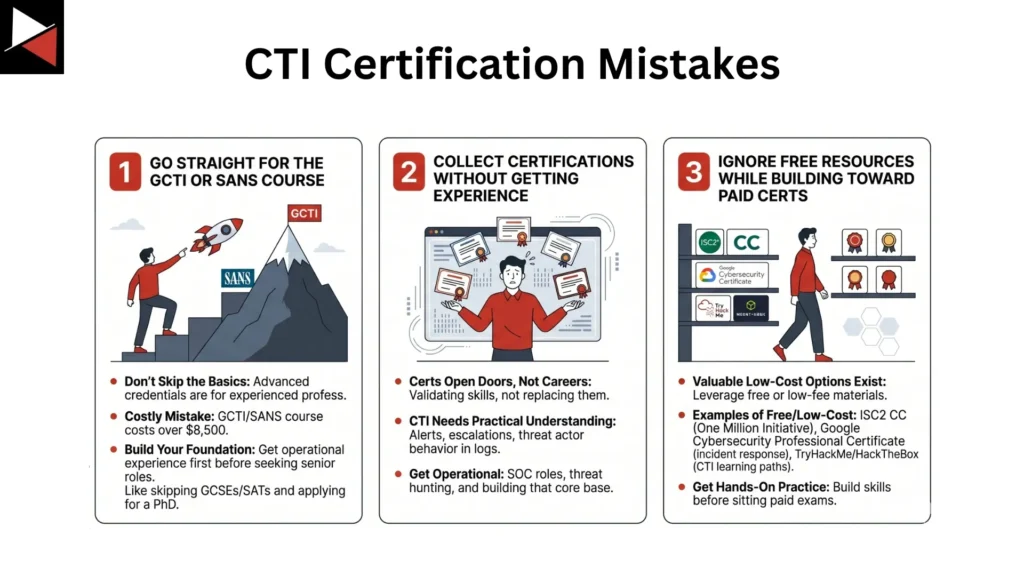
Mistake 1: Going straight for the GCTI or SANS course
The GIAC Cyber Threat Intelligence Certification (GCTI), associated with the SANS FOR578 course, is widely regarded as the industry gold standard for senior CTI professionals. The content, instruction, and live labs are genuinely excellent. But the SANS course costs over $8,500, and the GCTI is an advanced credential designed for practitioners with years of operational experience.
It is not where you start. Build your foundation first. Get experience. Then invest in the GCTI when you’re genuinely ready for senior-level roles. Chasing it before you have the basics is like skipping your GCSEs (SATs if you’re U.S-based) and applying directly for a PhD.
Mistake 2: Collecting certifications without getting experience
Certifications open doors. They do not replace time in the operational world. CTI roles require you to understand what an alert looks like in the SOC, how incidents are escalated, and what threat actor behavior actually looks like in real logs. Get into a SOC role, do real threat hunting, and build that operational base. The certifications validate your skills, but you need to have the skills first.
Mistake 3: Ignoring free resources while you build toward paid certifications
There are excellent free and low-cost resources available right now.
- The ISC2 Certified in Cybersecurity (CC) certification currently offers free training and exam vouchers as part of the One Million Certified in Cybersecurity initiative.
- The Google Cybersecurity Professional Certificate on Coursera provides solid foundations in threat modeling and incident response at a low monthly fee.
- Platforms like TryHackMe and HackTheBox offer dedicated CTI learning paths that provide hands-on practice before you sit any paid exam.
Use these as you build toward your paid certifications. The hands-on experience is invaluable.
Conclusion
Getting your first CTI role is absolutely achievable, and your certification path plays a real role in making it happen. But the path matters as much as the destination.
Here’s the roadmap: start with CompTIA Security+ as your proof of foundation. Move to BTL1 as your practical differentiator, the cert that shows you can actually do the work. Add CompTIA CySA+ to deepen your analytical framework. Then, once you have operational experience, bridge into the specialism with the EC-Council CTIA.
You don’t need all four before you start applying. Security+ and BTL1 together are a genuinely strong entry-level combination. Start applying once you have them, keep building your profile, and keep getting hands-on with real data.
The analysts who progress are the ones who combine credentials with real operational time. Certifications open the door. Your ability to do the work keeps you in the room.




Frequently Asked Questions (FAQs)
What Is the Best CTI Certification for Beginners?
For most people starting out, CompTIA Security+ and BTL1 are the strongest entry-level combination. Security+ demonstrates foundational security knowledge sufficient to pass initial HR screening, while BTL1 proves practical, hands-on capability through a 24-hour live incident simulation. Together, they give hiring managers both the credential check and the proof of skill they’re looking for at the entry level.
Do I Need a CTI-Specific Certification to Become a CTI Analyst?
Not necessarily, but it significantly strengthens your application. Many CTI analysts enter the field from SOC roles with foundational security certs. However, earning a CTI-specific credential like the EC-Council CTIA demonstrates that you understand the intelligence lifecycle, not just security operations, which is exactly the language CTI teams use. Pairing SOC experience with a dedicated CTI cert is the most effective approach.
What Is the Difference Between the CTIA and the GCTI Certification?
The EC-Council CTIA is an accessible, entry-to-mid-level CTI certificate focused on the intelligence lifecycle, threat actor research, and tooling fundamentals, with the exam costing roughly £400 to £500. The GIAC GCTI, associated with the SANS FOR578 course, is an advanced, industry gold-standard credential that costs several thousand pounds when bundled with training and is best suited to experienced practitioners targeting senior CTI roles. The CTIA is where you build your specialism; the GCTI is where you demonstrate mastery.
How Long Does It Take to Get a CTI Certification?
It depends on the certification. CompTIA Security+ typically takes two to four months of self-study. BTL1 is similarly achievable within a few months, though its practical format means time in labs matters as much as book study. CySA+ may take three to five months.
The CTIA with self-paced training can be completed in two to four months. Completing the full progression from Security+ through CTIA realistically takes one to two years, including the operational experience needed between steps.
Are There Free Resources to Help Me Prepare for CTI Certifications?
Yes. The ISC2 Certified in Cybersecurity (CC) currently offers free training and exam vouchers, which is a solid starting point. The Google Cybersecurity Professional Certificate on Coursera provides foundational training in threat modeling and incident response at a low cost. Platforms like TryHackMe and HackTheBox offer dedicated CTI learning paths with hands-on labs. The MITRE ATT&CK Defender program also has free CTI content directly from MITRE. These are worth working through while you build toward paid certifications.